
Let’s talk about men.
Specifically, let’s talk about the kind of men who get written about in sports romance — and the kind who should be.
Because here’s the thing I keep coming back to as both a reader and a writer in this genre: we do not need toxic masculinity in sports romance. We never did. It was never the point. The appeal of the hockey player, the football star, the elite athlete, has never actually been about emotional unavailability or aggression or the performance of hardness. That’s not what draws us to these characters. What draws us is the physicality of the life — the discipline, the sacrifice, the team bond, the body pushed to its absolute limits in service of something bigger than itself. That’s compelling. That’s romantic, in the truest sense of the word.
The toxicity was never the feature. It was always the bug.
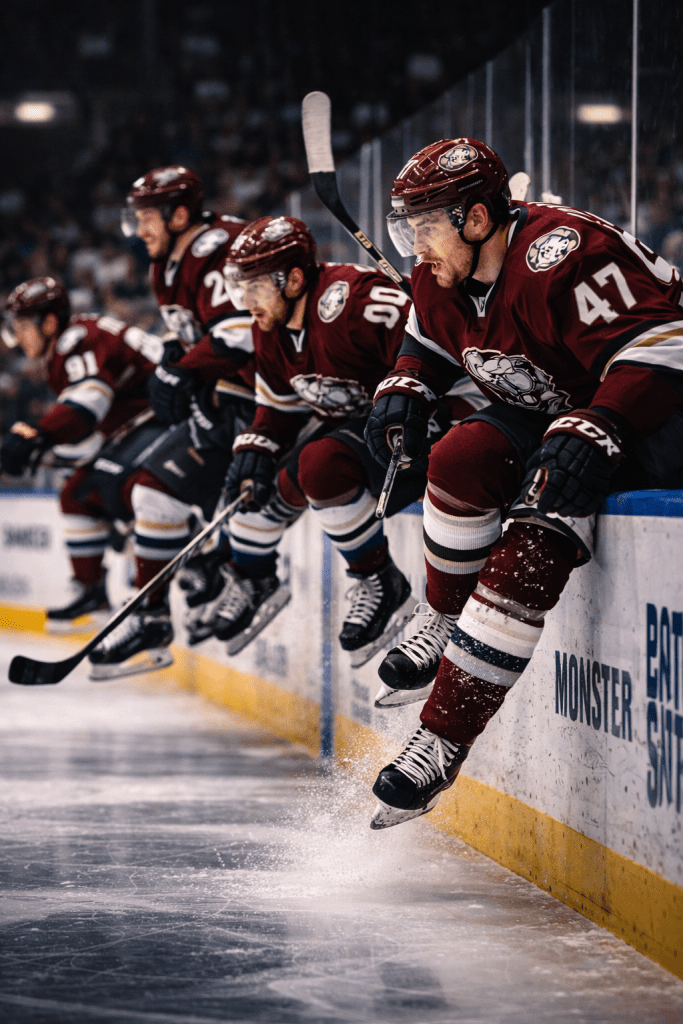
My guys in the PHLu universe are masculine. I won’t pretend otherwise and I wouldn’t want to. They’re big and physical and competitive and they bleed for the game. But they also feel. Maybe not right away — often not right away — but the capacity is always there, underneath the pads and the tape and the persona they’ve built for public consumption. The work of the story, so often, is just getting them to the point where they can access it. Where they can name it. Where they stop being afraid of what it means that they feel things as deeply as they do.
That’s not un-masculine. That’s just human.
Let’s be honest about something, because I think we all know it and nobody in mainstream hockey coverage particularly wants to say it out loud: the real NHL has locker rooms. And locker rooms, when you pack them full of elite competitive athletes performing a very specific kind of hyper-masculine identity for each other day after day — well. We can imagine.
Actually, we don’t have to imagine. For those of us who’ve read The Long Game, Rachel Reid gave us Montreal (the team that Shane has been captain of for years), and Montreal gave us a pretty unflinching look at what that environment can actually feel like from the inside — the background radiation of homophobia that nobody names but everybody navigates, the way it shapes what you say and don’t say, what you show and don’t show, who you are allowed to be in that room. It’s not cartoon villainy. It’s subtler and more suffocating than that. And it rings true precisely because we all know, on some level, that it’s not fiction.
We also know — and this is the open secret of the entire hockey romance genre — that the realistic gay and bisexual representation level in the fictional hockey leagues writers have built is… let’s call it aspirationally high. Gloriously, joyfully, deliberately high. And that’s not naivety. That’s intention. That’s a whole community of writers collectively deciding that if the real league won’t make space, we’ll build our own league that will.
Which is exactly why I have the PHL.
The Premiere Hockey League exists, in no small part, so that my characters don’t have to spend their emotional energy surviving a locker room that wants to erase them. They can just — play hockey. Fall in love. Be whole people. The PHL isn’t a utopia exactly, it has its own tensions and politics and complicated men doing complicated things, but the baseline hostility that testosterone-saturated real-world environments so often produce? We left that at the door. On purpose. With zero apology.
I want to talk about Ilya Rozanov and Shane Hollander, because Rachel Reid did something with those two men in Heated Rivalry that I think about constantly, and that gets to the absolute heart of what I’m trying to say.
Here are two of the most compelling, most genuinely masculine characters in the genre. Shane — the golden boy, the clean image, the captain energy, the man who has spent his entire career being exactly what everyone needed him to be. Ilya — the showman, the villain of the rival team’s story, the smirk and the swagger and the devastating skill underneath all of it. Both of them, unquestionably, men in every way that word gets applied to athletes.
And for ten years, they hid.
Ten years of a relationship built in secret — in hotel rooms during away games, in the margins of a rivalry that the entire hockey world was watching. Ten years of something real and loving and sustaining, conducted entirely in the dark. Because the culture they lived inside — the professional hockey world, the media scrutiny, the locker room politics, the national identity wrapped up in both of them — didn’t have a box for what they were to each other.
And that is the indictment, right there. Not of Ilya. Not of Shane. Of the culture.
Shane’s image was so carefully constructed, so central to his career and his sense of self, that the idea of cracking it open felt unsurvivable. Ilya, for all his apparent confidence, carried his own weight — the Russian hockey landscape, his public persona, the expectations layered onto him from every direction. Neither of them had been given a world that said you can be this and also be loved openly. So they took what they could get, in the only way that felt safe.
That’s not weakness. That’s two men navigating an impossible set of constraints with the tools they’d been given by a culture that failed them.
What wrecks me about their story is that the love was never the problem. The love was easy, in the end — it had been there for years, it was the most natural thing in either of their lives. The problem was everything built up around them. The sport they gave their lives to. The personas required to survive inside it. The world that had very specific ideas about what a hockey player was and was allowed to be.
This is the real cost of toxic masculinity in sporting culture. Not the big dramatic moments. The quiet, decade-long cost of two people who loved each other having to hide it because the room they lived in had never been made safe enough for the truth.
This is why I write the men I write.
I want to give my characters the thing Ilya and Shane had to fight so hard for — a world, within the pages at least, where feeling things doesn’t cost you everything. Where you can be physically formidable and emotionally present. Where the team bond includes the whole person, not just the athlete. Where loving someone, regardless of who that someone is, doesn’t have to be a secret kept in hotel rooms for a decade.
My PHLu men are not soft. But they learn. They stumble toward understanding their own interiors like it’s a foreign country they’ve been told they’re not allowed to visit. And when they get there — when they finally let themselves feel the thing they’ve been skating around for three hundred pages — that’s the moment. That’s why we’re here.
Masculinity and emotional depth are not opposites. They never were. Sports culture convinced a lot of people they were, and sports romance, at its best, has been quietly and persistently dismantling that lie one fictional locker room at a time.
Ilya and Shane didn’t hide because they were broken. They hid because the culture hadn’t yet made room for them.
I’m trying to write the room.
— Bella 🏒

