
Real Men Feel Things: On Masculinity, Hockey, and Why Ilya and Shane Broke My Heart (In the Best Way)

Let’s talk about men.

Specifically, let’s talk about the kind of men who get written about in sports romance — and the kind who should be.

Because here’s the thing I keep coming back to as both a reader and a writer in this genre: we do not need toxic masculinity in sports romance. We never did. It was never the point. The appeal of the hockey player, the football star, the elite athlete, has never actually been about emotional unavailability or aggression or the performance of hardness. That’s not what draws us to these characters. What draws us is the physicality of the life — the discipline, the sacrifice, the team bond, the body pushed to its absolute limits in service of something bigger than itself. That’s compelling. That’s romantic, in the truest sense of the word.

The toxicity was never the feature. It was always the bug.
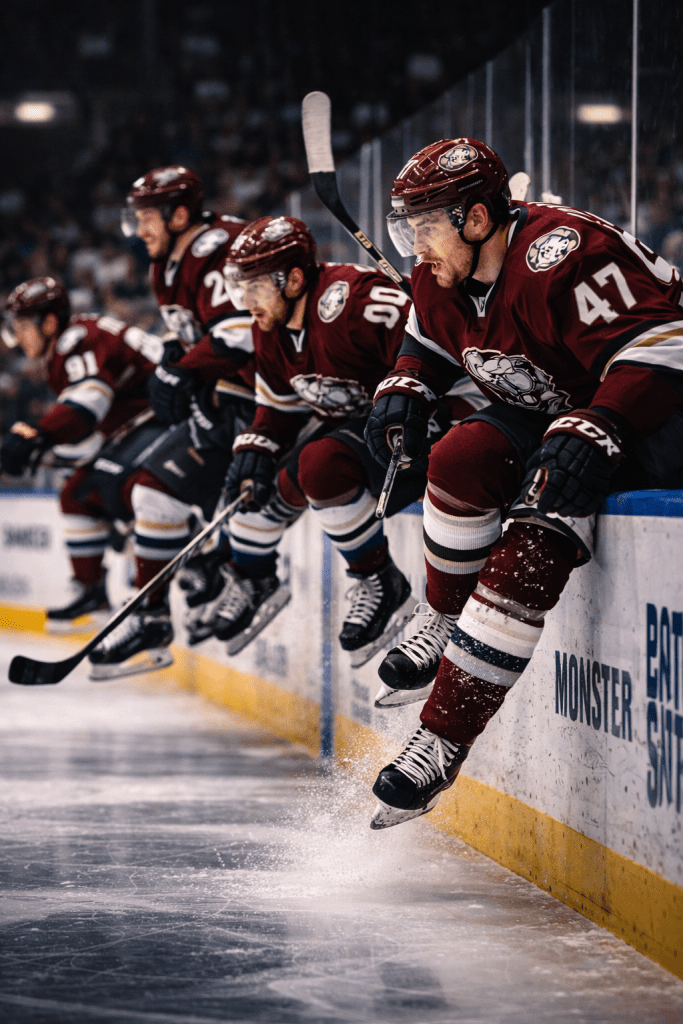
My guys in the PHLu universe are masculine. I won’t pretend otherwise and I wouldn’t want to. They’re big and physical and competitive and they bleed for the game. But they also feel. Maybe not right away — often not right away — but the capacity is always there, underneath the pads and the tape and the persona they’ve built for public consumption. The work of the story, so often, is just getting them to the point where they can access it. Where they can name it. Where they stop being afraid of what it means that they feel things as deeply as they do.

That’s not un-masculine. That’s just human.


Let’s be honest about something, because I think we all know it and nobody in mainstream hockey coverage particularly wants to say it out loud: the real NHL has locker rooms. And locker rooms, when you pack them full of elite competitive athletes performing a very specific kind of hyper-masculine identity for each other day after day — well. We can imagine.

Actually, we don’t have to imagine. For those of us who’ve read The Long Game, Rachel Reid gave us Montreal (the team that Shane has been captain of for years), and Montreal gave us a pretty unflinching look at what that environment can actually feel like from the inside — the background radiation of homophobia that nobody names but everybody navigates, the way it shapes what you say and don’t say, what you show and don’t show, who you are allowed to be in that room. It’s not cartoon villainy. It’s subtler and more suffocating than that. And it rings true precisely because we all know, on some level, that it’s not fiction.

We also know — and this is the open secret of the entire hockey romance genre — that the realistic gay and bisexual representation level in the fictional hockey leagues writers have built is… let’s call it aspirationally high. Gloriously, joyfully, deliberately high. And that’s not naivety. That’s intention. That’s a whole community of writers collectively deciding that if the real league won’t make space, we’ll build our own league that will.

Which is exactly why I have the PHL.

The Premiere Hockey League exists, in no small part, so that my characters don’t have to spend their emotional energy surviving a locker room that wants to erase them. They can just — play hockey. Fall in love. Be whole people. The PHL isn’t a utopia exactly, it has its own tensions and politics and complicated men doing complicated things, but the baseline hostility that testosterone-saturated real-world environments so often produce? We left that at the door. On purpose. With zero apology.


I want to talk about Ilya Rozanov and Shane Hollander, because Rachel Reid did something with those two men in Heated Rivalry that I think about constantly, and that gets to the absolute heart of what I’m trying to say.

Here are two of the most compelling, most genuinely masculine characters in the genre. Shane — the golden boy, the clean image, the captain energy, the man who has spent his entire career being exactly what everyone needed him to be. Ilya — the showman, the villain of the rival team’s story, the smirk and the swagger and the devastating skill underneath all of it. Both of them, unquestionably, men in every way that word gets applied to athletes.

And for ten years, they hid.

Ten years of a relationship built in secret — in hotel rooms during away games, in the margins of a rivalry that the entire hockey world was watching. Ten years of something real and loving and sustaining, conducted entirely in the dark. Because the culture they lived inside — the professional hockey world, the media scrutiny, the locker room politics, the national identity wrapped up in both of them — didn’t have a box for what they were to each other.

And that is the indictment, right there. Not of Ilya. Not of Shane. Of the culture.

Shane’s image was so carefully constructed, so central to his career and his sense of self, that the idea of cracking it open felt unsurvivable. Ilya, for all his apparent confidence, carried his own weight — the Russian hockey landscape, his public persona, the expectations layered onto him from every direction. Neither of them had been given a world that said you can be this and also be loved openly. So they took what they could get, in the only way that felt safe.

That’s not weakness. That’s two men navigating an impossible set of constraints with the tools they’d been given by a culture that failed them.

What wrecks me about their story is that the love was never the problem. The love was easy, in the end — it had been there for years, it was the most natural thing in either of their lives. The problem was everything built up around them. The sport they gave their lives to. The personas required to survive inside it. The world that had very specific ideas about what a hockey player was and was allowed to be.

This is the real cost of toxic masculinity in sporting culture. Not the big dramatic moments. The quiet, decade-long cost of two people who loved each other having to hide it because the room they lived in had never been made safe enough for the truth.


This is why I write the men I write.

I want to give my characters the thing Ilya and Shane had to fight so hard for — a world, within the pages at least, where feeling things doesn’t cost you everything. Where you can be physically formidable and emotionally present. Where the team bond includes the whole person, not just the athlete. Where loving someone, regardless of who that someone is, doesn’t have to be a secret kept in hotel rooms for a decade.

My PHLu men are not soft. But they learn. They stumble toward understanding their own interiors like it’s a foreign country they’ve been told they’re not allowed to visit. And when they get there — when they finally let themselves feel the thing they’ve been skating around for three hundred pages — that’s the moment. That’s why we’re here.

Masculinity and emotional depth are not opposites. They never were. Sports culture convinced a lot of people they were, and sports romance, at its best, has been quietly and persistently dismantling that lie one fictional locker room at a time.

Ilya and Shane didn’t hide because they were broken. They hid because the culture hadn’t yet made room for them.

I’m trying to write the room.

— Bella 🏒

In Which I Have Thoughts About Hockey Shows

So this morning I finally sat down and watched Off Campus.

And I have to admit something that may get my hockey romance card revoked:

…I was kind of underwhelmed.

Not because it was terrible. It wasn’t. The production value was there. The budget was clearly there. Everybody was pretty. The hockey looked fine. On paper, this should have been exactly my thing.

But the entire time I was watching it, I kept finding myself comparing it to HR.

And unfortunately for Off Campus, HR exists.

Maybe if Off Campus had been the first modern hockey romance style show released, I would feel differently. Maybe I would have fallen completely in love with it. Maybe I would have been screaming into the void about locker room tension and emotionally unavailable men in compression shirts.

But instead, it arrived after something that already nailed the thing I personally think matters most in hockey romance:

chemistry.

Not just romantic chemistry either. Team chemistry. Friendship chemistry. Banter. Warmth. That feeling that these people genuinely exist together when the cameras stop rolling.

HR has charm in a way that feels almost accidental. Like lightning in a bottle. It feels lived in. Messy in the best way. The relationships feel textured and weird and human. Even the background interactions feel natural.

Off Campus, weirdly, felt more polished and somehow less alive.

And maybe that sounds unfair because objectively it probably is the “bigger” production. Better funded. Cleaner. More cinematic in places. But I kept waiting for it to click emotionally for me and it just… didn’t.

It almost felt like they had all the ingredients and somehow forgot seasoning.

I don’t even know if the issue is the writing. It might genuinely come down to casting chemistry. Hockey romance absolutely lives or dies on whether you believe these people would choose each other in every universe.

If I don’t buy the longing, the protectiveness, the “I would absolutely help you hide a body” energy, then the whole thing starts feeling like actors reading attractive dialogue at each other.

And the frustrating part is that there are glimpses in Off Campus where you can see the potential. Little flashes where I thought, oh there it is. Then it would disappear again under another overly polished scene that somehow forgot to feel.

The boys living in the dorm house almost had it.

That was the frustrating part.

There were moments — particularly during the training scenes — where you could feel the shape of the thing it could have been. The burpees, the exhausted chirping, the half-feral team energy, everybody existing in each other’s pockets twenty-four hours a day… for a second I thought, oh here we go. There it is.

And then somehow it just vanished somewhere between the motivational speeches and the bro hugs.

Which sounds ridiculous because I am absolutely the target audience for this kind of thing. Give me emotionally constipated hockey players living in a chaotic share house and I should be seated immediately with snacks and emotional investment.

But I kept wanting more texture.

More quiet affection.
More stupidity.
More loyalty.
More “this idiot is my family now.”
More moments where the audience gets to live with them instead of simply watching plot happen around them.

And honestly? I think that’s what I’m discovering I want from television in general these days.

I would not remotely complain if every scripted drama on the boob tube (good lord, am I showing my age with that phrase?) was one of the following:

  • hockey players navigating life and feelings badly
  • firefighters saving everybody while emotionally imploding
  • deeply repressed soldiers trying to figure out how to exist in normal society

Apparently that is my entire media diet now.

But I think the reason those stories work when they do work is because underneath all the action and conflict and dramatic music, they’re fundamentally stories about people choosing each other.

Found family.
Loyalty.
Protection.
Love in all its messy forms.

And maybe that’s why some modern shows leave me a little cold. Everything feels so determined to be high stakes all the time that nobody remembers to let the characters breathe together.

I don’t necessarily want less drama.

I just want more love.

More scenes where people cook dinner together.
More exhausted conversations at 2am.
More teammates showing up without being asked.
More “I’ve got you.”
More humanity.

The world is already exhausting enough. Let fictional people care about each other properly.

Also let them do it while wearing hockey gear.

Obviously.

Why Heated Rivalry Works: What the TV Adaptation Gets Right About Rachel Reid’s Novel

Rachel Reid’s 2019 novel Heated Rivalry arrived quietly into the hockey romance subgenre and proceeded to break a great many hearts. The story of Shane Hollander and Ilya Rozanov — golden-boy Canadian captain and mercurial Russian superstar — appears simple on the surface: rivals who cannot keep their hands off each other. Beneath that premise, however, Reid built something far more layered: a decade-long portrait of two men slowly drowning in a love they have no language for, no safe harbour in, and no clear way out of.

To understand why Heated Rivalry lands with such force, it helps to know where it sits within Reid’s broader Game Changers series. The first book, Game Changer, introduces Scott Hunter and Kip Grady — their relationship the initial ripple in what becomes a widening circle of queer love within professional hockey. Reid’s particular strength across the series is her refusal to treat any pairing as interchangeable. Each couple exists on its own emotional frequency, with its own humour, tenderness, and damage. By the time you reach Shane and Ilya, you understand you are not reading a formula but entering a world where characters behave with stubborn, recognisable humanity. That specificity — the sense that every character speaks in their own distinct voice — is what makes the series so compulsively readable and so difficult to leave.

The novel is exceptional. The television adaptation, created and directed by Jacob Tierney for Crave and streaming internationally, does something rarer — it doesn’t merely honour the source material, it illuminates it.

For readers who encountered the book first, the fidelity of the adaptation is immediately noticeable. Tierney has spoken about being drawn to the novel’s emotional honesty, and that commitment shows in the creative choices. Significant portions of dialogue appear almost verbatim from Reid’s prose — not as a shortcut, but as recognition that the dialogue itself is the relationship. The deflections, provocations, and rare moments of unguarded truth between Shane and Ilya form the architecture of the story. Rewriting them would have altered its emotional structure.

Where the novel is interior — much of its weight carried in what the characters refuse to say — the series must externalise that tension. Hudson Williams and Connor Storrie solve that problem through performance. Williams’ Shane wears repression physically; you see it in posture, in restraint, in the way he watches Ilya when unobserved. Storrie’s Ilya embodies a different sorrow: a man performing effortlessness so convincingly he has almost convinced himself. The accent, the stillness, the timing — all feel inhabited rather than performed.

What the series accomplishes, and what deserves particular recognition, is its refusal to dilute the relationship. This sounds like a baseline expectation, yet remains uncommon in practice. The central grief — the specific grief of men unable to live truthfully inside the lives they have built — is treated not as flavouring but as the subject itself. Their love, desire, and pain occupy the same narrative space as any central romance should. The closeted-athlete story has existed in fiction before, but often from an external viewpoint or resolved too neatly. Here it remains unresolved for exactly as long as it must.

The novel’s great achievement was always restraint. Reid never offers easy catharsis; she trusts the reader to sit with the discomfort of watching two people fail to save each other before they learn how to try. The series extends that same trust to its audience. In a television landscape that often tidies queer narratives into palatable arcs, Heated Rivalry remains quiet instead of declarative. It simply presents two men in love who cannot yet live openly in that love — and treats that reality as the tragedy it is.

There are minor divergences. Condensing a decade into six episodes inevitably compresses some of the novel’s gradual accumulation. Yet the adaptation consistently preserves emotional truth over structural exactness, the correct priority for this story. Its cultural reception — a word-of-mouth success beyond its niche — suggests audiences recognised that sincerity.

For readers, the series is not a replacement but a second language for the same narrative. For viewers discovering it on screen first, Reid’s novel offers what adaptation cannot fully translate: interiority, silence, and years of longing rendered in intimate perspective. Beyond it lies the entire Game Changers series — each book another variation on the theme of love negotiating reality.

Taken together, the book and its adaptation form a rare portrait of secrecy, vulnerability, and eventual honesty. They show both the cost of hiding and the courage required to stop.