Two weeks. Send Help.

Two weeks.

Fourteen days. Three hundred and thirty-six hours, give or take, depending on what time you’re reading this and whether my grasp on the space-time continuum holds up, which frankly I wouldn’t bet on right now.

Isolated releases in two weeks and I have feelings about this. I have so many feelings about this that they have taken up all available storage space and are now apparently spilling out into a blog post at — I’m not going to tell you what time it is. It’s fine. Everything is fine.

Here is what I know: I am confident about this book.

I want to say that clearly and mean it, because it’s true and because I think it matters to say true things even when the rest of your brain is staging a complete carnival. Deacon Worth and Konstantin Andropov are two of my favourite people — not characters, people, because if you’ve been here for five minutes you know that’s how this works — and I have given them everything I have.

But I want to tell you something about how long this has actually been.

  1. That’s when Kon first came to me. Fifteen years ago. Fifteen years of knowing the Worth family, of knowing beautiful, complicated, resilient Kon — which means that what you’re getting in two weeks is not a book I wrote recently and released into the world while the ink was still metaphorically drying. It is fifteen years of a person becoming fully himself on the page.

When Kon first arrived he was already carrying so much. He was being beaten by his father back in Russia. He was trapped inside a system that outed him at a team function — not his choice, not his moment, just the world deciding it owned something that was his to give — and his father’s response was to send him away to the US with bruises and a message that he was a disappointment. Not that he was dead to him. Not quite that. But that he had failed some fundamental expectation, and that was that.
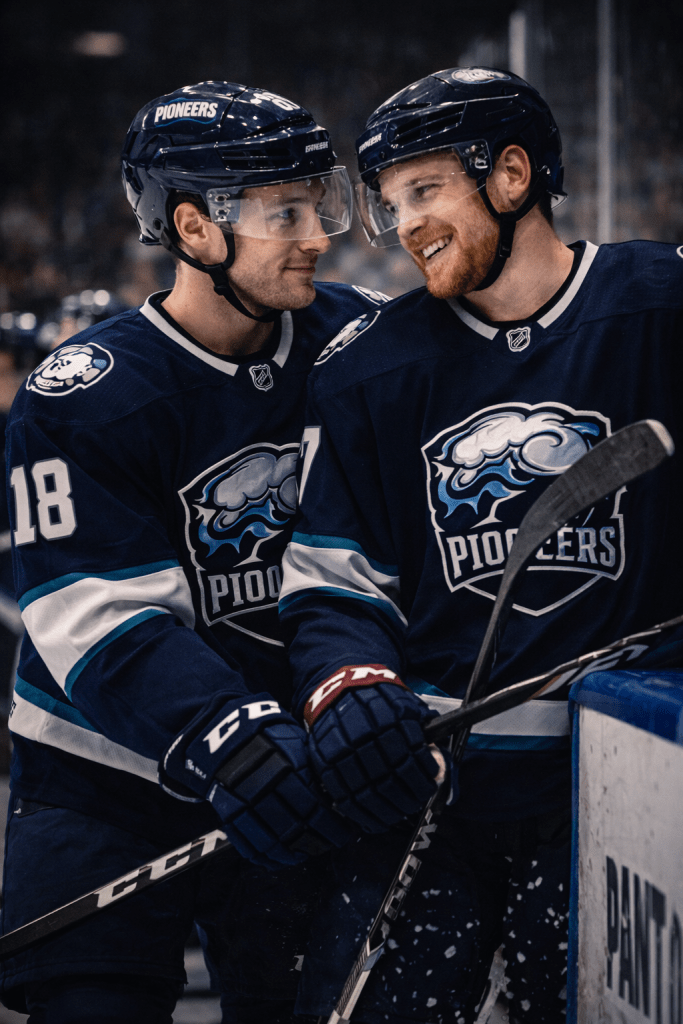
That is where Kon begins. That is what he is carrying when he meets Deke.

And then he keeps going. Because that is what Kon does — he keeps going, through everything, changing and growing and finding himself in ways that fifteen years of writing him have let me witness like watching someone you love become more fully who they were always supposed to be. He has been through so much since those early days. He has shed things and gained things and broken and healed and I have been there for every version of him, and every version has mattered.

I know him down to the marrow. I know what Deke’s hand on his face means to someone who learned early that hands could hurt. I know what as equals costs him to say and what it costs Deke to hear. I know the specific quality of Kon’s courage, which is not the loud kind but the kind that keeps going quietly in the dark without any guarantee of light at the end.

I believe in this book completely.

I am also nervous as absolute hell and I cannot find the off switch for that particular feeling no matter where I look.

And I’ve decided that’s okay. Confidence and nerves are not opposites. They live together, apparently — the confidence saying this is real and it’s good and people are going to feel it, and the nerves trailing off into a low ambient frequency of but what if that doesn’t really resolve into words. I’ve been trying to reign the nerves in for two weeks and I’m done. They have unpacked. They have booked the full fortnight. I’m going to let them stay and focus instead on the thing that matters more.

Somewhere out there are readers who don’t know yet that Kon exists. Who don’t know about the boy who was beaten and outed and sent away and chose, anyway, to hope. Who don’t know what it looks like when fifteen years of knowing someone finally gets to become a book.

I cannot wait for them to know.

Two weeks. I’ll be over here, alternating between serene certainty and low-grade chaos, if anyone needs me.

— Bella 🏒

On Writing Invisible Pain

There is a particular craft challenge that I don’t think gets talked about enough, and it’s this: writing pain that the reader feels completely but the character never shows.

I want to be precise about what I mean, because there is a version of this that is simply withholding — the author knows something the reader doesn’t, and the tension comes from that gap. That’s a legitimate technique and it has its place. But that’s not what I’m talking about.

What I’m talking about is something harder and, when it works, something far more devastating. The character is not hiding their pain from the reader. The character is hiding their pain from everyone, including themselves, and the author’s job is to write that hiding so completely and so honestly that the reader feels every single thing the character is refusing to feel.

The pain isn’t invisible. That’s the thing. It’s everywhere. It’s in the way someone doesn’t answer a question directly. It’s in what they reach for when a room gets too quiet. It’s in the joke they make at exactly the wrong moment, the one that lands a little too sharp, the one that makes the person across from them go still for just a second before they decide to let it go. It’s in the way they stand near a door. It’s in what they don’t say when someone who loves them leaves a silence open long enough for honesty to step into.

The reader sees all of it. That’s the whole point. The reader is supposed to see all of it and feel the weight of it pressing against all that careful containment, and understand — maybe before the character does — exactly what is being held back and exactly what it is costing.

Deacon Worth does not talk about his head injury the way someone who has made peace with it would talk about it. He talks about it the way someone who has built a very convincing replica of peace and placed it where the real thing used to be. The reader knows the difference. Deke, for a long time, does not let himself know the difference, and that gap — between what the reader can see and what the character will admit — is where the pain lives.

Kon carries two years of almost, two years of waiting, two years of hope that kept getting pulled out from under him, and he carries it so quietly that the people around him might not notice. The reader notices. The reader is supposed to notice. I put it in the silences and the careful word choices and the things he watches when he thinks no one is watching him, and I trust the reader to feel the weight of it even when Kon himself would rather they didn’t.

That is the craft of it, as far as I understand it. You have to know the pain completely — its shape, its history, its specific texture for this specific person — and then you have to render it entirely in shadow. Not absence. Shadow. The outline of something rather than the thing itself, drawn precisely enough that what it outlines is unmistakable.

When a reader tells me a scene broke them and they can’t quite explain why, when they say they felt something they couldn’t name — that is usually this. That is the invisible pain doing its work. Not invisible because it isn’t there. Invisible because the character needs it to be, and the author loved them enough to honour that need while making sure the reader could see through it anyway.

It’s a strange kind of betrayal, in the best possible sense. You protect the character’s secret and you give it away at the same time.

That tension, held carefully, is one of the most powerful things fiction can do.

— Bella 🏒

Why Hockey Romance Works – A completely Objective Analysis

I’ve been asked a few times why hockey romance works so well as a subgenre, and I have given this question the serious, considered, academic attention it deserves.

It’s because the men are hot.

I mean, I could dress this up. I could talk about the narrative tension inherent in professional sport, the built-in conflict between individual desire and team loyalty, the way the rink functions as a pressure cooker for emotion, the push and pull of ambition and vulnerability. All of that is true and all of that matters and I will absolutely discuss it with you if you want.

But let’s be honest with each other first.

Hockey players are built like someone sat down and said what if a person, but more. They are large and fast and absurdly athletic. They do something genuinely dangerous for a living and they do it with a level of skill and commitment that is, frankly, its own kind of attractive. They get knocked down and they get back up. They bleed for it. They fight for it. Every single game they go out there and they leave everything on the ice, and there is something in that — in the wholehearted, full-contact, nothing-held-back quality of it — that translates directly into the kind of men they are off the ice too.

Men want to be them. Women want to be with them. And honestly, depending on the day and the specific player in question, some people want both simultaneously and I completely understand that.

But here is where it gets interesting, because hot alone does not sustain a subgenre. Hot gets you through the first chapter. What keeps you reading at two in the morning is something more specific than that.

Hockey players, at least the ones I write, carry their hearts in the same way they play the game — all the way. Deacon Worth does not do anything halfway. Neither does Flynn McKenzie, or Lachlan, or any of the men in this universe who have taken up residence in my head and refused to leave. They are competitive and driven and occasionally absolutely impossible, and they love with that same all-or-nothing energy that makes them great at the game. When one of these men decides you are his person, you feel it in your bones. There is no hedging. No half measures. No carefully managed distance. Just the full weight of a person who has decided and is completely at peace with having decided.

That, combined with the fact that they look like that, is really quite a lot to deal with.

Hockey romance works because it gives us men who are physically extraordinary and emotionally all-in. Men who are tough enough to take a hit and soft enough to mean it when they say I love you. Men who are worth writing about and worth reading about and, on the best days, worth falling a little bit in love with yourself.

The men are hot. The rest is craft.

But mostly the men are hot.

— Bella 🏒

On Writing Tenderness Between Men

I want to talk about something that comes up more than it should, which is the idea that tenderness between men requires explanation.

It doesn’t. But here we are, and since we’re here I’m going to make the case as plainly as I can.

Men are tender. Real men, actual men, the men who exist in the world outside of fiction — they are tender with their children, with their elderly parents, with the people they love who are hurting. They bring cups of tea without being asked. They sit with someone in the dark. They know, without being told, when what’s needed is a hand on the back rather than a solution. Nobody bats an eye at any of this, and rightly so.

So why, the moment two men love each other, does tenderness become something that apparently needs to be justified?

I’ve thought about this a lot, because I write men loving men and I write them the way I believe them to be — which is fully human, with the full range of what that means. Deacon Worth does not become a different person because the love of his life is Konstantin Andropov rather than a woman. He is still a Worth, still led by his heart before his head has a chance to object, still capable of touching someone’s face with a tenderness that costs him nothing and means everything. That is who he is. The gender of the person receiving that tenderness doesn’t change it.

Because here is what I know about the men I write: they are not tender despite being the men they are. They are tender because of it. Because they have chosen, consciously or not, to reject the premise that strength and gentleness cannot occupy the same person at the same time. They are strong men who have simply never accepted the idea that tenderness is something to be rationed or hidden or ashamed of. The ones who have been hardened by the world — and some of mine have been hardened considerably — love with a quietness and a specificity that would undo you if you saw it up close.

What I’m really writing, when I write tenderness between men, is perspective. The perspective of a man who looks at the person he loves — this specific person, this face, these hands, this complicated and particular human being — and feels something that expresses itself gently. Not because he’s performing sensitivity. Not because the genre demands it. But because that is what love does when it’s paying attention. It notices. It takes care. It shows up in the small gestures that accumulate over time into something enormous.

That is not a female experience. That is not a male experience. That is a human experience, and my men get to have it, and I will not be writing them any other way.

They love who they love. They love them tenderly. That’s the whole story.

— Bella 🏒

What Readers Mean to an Indie Author — Or, Everything

I’ve been trying to write this post for a while now, and I keep running into the same problem: the honest answer is so large that it’s difficult to fit into sentences.

But I’m going to try.

When you publish independently, you are doing something that requires a particular kind of courage that nobody really prepares you for. There is no publisher behind you with a marketing budget and a publicity team and the institutional weight of a known name. There is no guarantee that anyone will find your book, let alone pick it up, let alone stay up until two in the morning because they can’t put it down. You put your work into the world and then you wait, and the waiting is its own particular flavour of terrifying.

And then someone finds it.

I don’t think I can adequately describe what it feels like the first time a reader reaches out to tell you that your characters got under their skin. That they stayed up too late. That they cried somewhere they probably shouldn’t have. That they immediately went looking to see if there was more. It is not a small thing. It will never be a small thing, no matter how many times it happens.

Because here is what readers actually are, for an indie author: they are the proof. The proof that the stories are worth telling, that the characters are real enough to love, that the hours and the doubt and the four in the morning rewrites and the moments of wondering whether any of this is going anywhere — that all of it meant something. A reader who connects with your work is handing you the most valuable thing they have, which is their time and their trust, and they are saying I chose this, and it was worth it.

Readers are also, practically speaking, everything that makes continuation possible. Reviews, word of mouth, a recommendation to a friend, a mention in a reader group — for an indie author these things are not nice-to-haves. They are the difference between a series continuing and a series stopping. Every single person who has ever taken a moment to leave a review or tell someone about a book they loved has kept a story alive. I don’t think most readers know how true that is, or how much it matters.

And beyond all of that — beyond the practical, beyond even the profound — there is this:

You make the loneliness of the work smaller. Writing is solitary by nature. You spend an enormous amount of time alone with fictional people, inside your own head, wondering if what you’re building connects to anything outside of yourself. Readers are the connection. They are the moment the story stops being yours alone and becomes something shared, something that exists between you in the way that only stories can.

What do readers mean to this indie author?

Everything. The world, and everything in between.

I am not being hyperbolic. I mean it precisely as literally as it sounds.

— Bella 🏒

Emotional Pacing: Or, Why I Don’t Actually Do That

I get asked about emotional pacing fairly regularly, and I’ve been sitting with the question for a while now because I want to give an honest answer rather than a writerly-sounding one.

Here it is: I don’t think I pace emotion at all. Not deliberately. Not with a spreadsheet or a beat sheet or a highlighter and a copy of somebody’s craft guide. I don’t sit down and decide that chapter twelve needs a tension spike or that we’re due for a tender moment before the conflict escalates in act three.

What I do instead is live with my people until they feel real to me, and then I get out of their way.

That probably sounds like I’m being precious about it. I’m not. It’s actually the most practical approach I’ve found, because the moment I start managing a character’s emotional journey from the outside — deciding when they should crack, when they should soften, when the breakthrough is supposed to land — it goes flat. Every time. The reader can feel the hand on the lever. It stops being a person and starts being a plot function, and nobody falls in love with a plot function.

Lachlan McKenzie does not have his emotional moments on my schedule. Neither does Flynn, or Declan, or Isla, or any of the Worth boys. They have them when they have them — when the pressure has been building long enough, when the right person says the wrong thing, when they’re tired or scared or finally, finally ready. My job is to know them well enough to recognise that moment when it arrives on the page, and to not rush it or manufacture it or tidy it up into something more convenient.

What that means in practice is that I spend an enormous amount of time in pre-writing just being with my characters. Not plotting them. Learning them. Their histories, their specific fears, the things they do when they’re trying not to feel something. By the time I start writing, I know how they move through the world — and emotion is just part of that movement.

Does the pacing work out? Mostly yes, and I think it works because it’s honest. Readers are extraordinarily good at detecting when an emotional beat has been engineered for effect versus when it grew naturally out of who someone is. They might not be able to name the difference, but they feel it. The real moments land. The manufactured ones clunk.

And yes — this probably explains why my three acts don’t always look like every other three act novel on the shelf. The shape of the story follows the shape of the people in it, not the other way around. Sometimes that means a slow build that takes longer than conventional wisdom says it should. Sometimes the crisis hits earlier, or the resolution is quieter, or there’s a detour that exists purely because that’s where the character needed to go. I’ve made peace with that. More than made peace with it, actually — I think it’s a feature, not a flaw.

Because if every book followed the same emotional blueprint, hit the same beats at the same intervals, delivered the same shape of feeling in the same order every time — what would be the point? We’d all be reading the same book with different names on the cover. The world is considerably more interesting than that, and so are the people in it, and so, I’d argue, should be the stories we tell about them.

So if you’re sitting there with your own manuscript wondering how to pace the emotional arc — maybe the question isn’t when should this happen, but who is this person, and what would actually break them open?

Answer that well enough, and the pacing takes care of itself.

— Bella 🏒

Real Men Feel Things: On Masculinity, Hockey, and Why Ilya and Shane Broke My Heart (In the Best Way)

Let’s talk about men.

Specifically, let’s talk about the kind of men who get written about in sports romance — and the kind who should be.

Because here’s the thing I keep coming back to as both a reader and a writer in this genre: we do not need toxic masculinity in sports romance. We never did. It was never the point. The appeal of the hockey player, the football star, the elite athlete, has never actually been about emotional unavailability or aggression or the performance of hardness. That’s not what draws us to these characters. What draws us is the physicality of the life — the discipline, the sacrifice, the team bond, the body pushed to its absolute limits in service of something bigger than itself. That’s compelling. That’s romantic, in the truest sense of the word.

The toxicity was never the feature. It was always the bug.

My guys in the PHLu universe are masculine. I won’t pretend otherwise and I wouldn’t want to. They’re big and physical and competitive and they bleed for the game. But they also feel. Maybe not right away — often not right away — but the capacity is always there, underneath the pads and the tape and the persona they’ve built for public consumption. The work of the story, so often, is just getting them to the point where they can access it. Where they can name it. Where they stop being afraid of what it means that they feel things as deeply as they do.

That’s not un-masculine. That’s just human.


Let’s be honest about something, because I think we all know it and nobody in mainstream hockey coverage particularly wants to say it out loud: the real NHL has locker rooms. And locker rooms, when you pack them full of elite competitive athletes performing a very specific kind of hyper-masculine identity for each other day after day — well. We can imagine.

Actually, we don’t have to imagine. For those of us who’ve read The Long Game, Rachel Reid gave us Montreal (the team that Shane has been captain of for years), and Montreal gave us a pretty unflinching look at what that environment can actually feel like from the inside — the background radiation of homophobia that nobody names but everybody navigates, the way it shapes what you say and don’t say, what you show and don’t show, who you are allowed to be in that room. It’s not cartoon villainy. It’s subtler and more suffocating than that. And it rings true precisely because we all know, on some level, that it’s not fiction.

We also know — and this is the open secret of the entire hockey romance genre — that the realistic gay and bisexual representation level in the fictional hockey leagues writers have built is… let’s call it aspirationally high. Gloriously, joyfully, deliberately high. And that’s not naivety. That’s intention. That’s a whole community of writers collectively deciding that if the real league won’t make space, we’ll build our own league that will.

Which is exactly why I have the PHL.

The Premiere Hockey League exists, in no small part, so that my characters don’t have to spend their emotional energy surviving a locker room that wants to erase them. They can just — play hockey. Fall in love. Be whole people. The PHL isn’t a utopia exactly, it has its own tensions and politics and complicated men doing complicated things, but the baseline hostility that testosterone-saturated real-world environments so often produce? We left that at the door. On purpose. With zero apology.


I want to talk about Ilya Rozanov and Shane Hollander, because Rachel Reid did something with those two men in Heated Rivalry that I think about constantly, and that gets to the absolute heart of what I’m trying to say.

Here are two of the most compelling, most genuinely masculine characters in the genre. Shane — the golden boy, the clean image, the captain energy, the man who has spent his entire career being exactly what everyone needed him to be. Ilya — the showman, the villain of the rival team’s story, the smirk and the swagger and the devastating skill underneath all of it. Both of them, unquestionably, men in every way that word gets applied to athletes.

And for ten years, they hid.

Ten years of a relationship built in secret — in hotel rooms during away games, in the margins of a rivalry that the entire hockey world was watching. Ten years of something real and loving and sustaining, conducted entirely in the dark. Because the culture they lived inside — the professional hockey world, the media scrutiny, the locker room politics, the national identity wrapped up in both of them — didn’t have a box for what they were to each other.

And that is the indictment, right there. Not of Ilya. Not of Shane. Of the culture.

Shane’s image was so carefully constructed, so central to his career and his sense of self, that the idea of cracking it open felt unsurvivable. Ilya, for all his apparent confidence, carried his own weight — the Russian hockey landscape, his public persona, the expectations layered onto him from every direction. Neither of them had been given a world that said you can be this and also be loved openly. So they took what they could get, in the only way that felt safe.

That’s not weakness. That’s two men navigating an impossible set of constraints with the tools they’d been given by a culture that failed them.

What wrecks me about their story is that the love was never the problem. The love was easy, in the end — it had been there for years, it was the most natural thing in either of their lives. The problem was everything built up around them. The sport they gave their lives to. The personas required to survive inside it. The world that had very specific ideas about what a hockey player was and was allowed to be.

This is the real cost of toxic masculinity in sporting culture. Not the big dramatic moments. The quiet, decade-long cost of two people who loved each other having to hide it because the room they lived in had never been made safe enough for the truth.


This is why I write the men I write.

I want to give my characters the thing Ilya and Shane had to fight so hard for — a world, within the pages at least, where feeling things doesn’t cost you everything. Where you can be physically formidable and emotionally present. Where the team bond includes the whole person, not just the athlete. Where loving someone, regardless of who that someone is, doesn’t have to be a secret kept in hotel rooms for a decade.

My PHLu men are not soft. But they learn. They stumble toward understanding their own interiors like it’s a foreign country they’ve been told they’re not allowed to visit. And when they get there — when they finally let themselves feel the thing they’ve been skating around for three hundred pages — that’s the moment. That’s why we’re here.

Masculinity and emotional depth are not opposites. They never were. Sports culture convinced a lot of people they were, and sports romance, at its best, has been quietly and persistently dismantling that lie one fictional locker room at a time.

Ilya and Shane didn’t hide because they were broken. They hid because the culture hadn’t yet made room for them.

I’m trying to write the room.

— Bella 🏒

They’re Real, They’re Actually Real

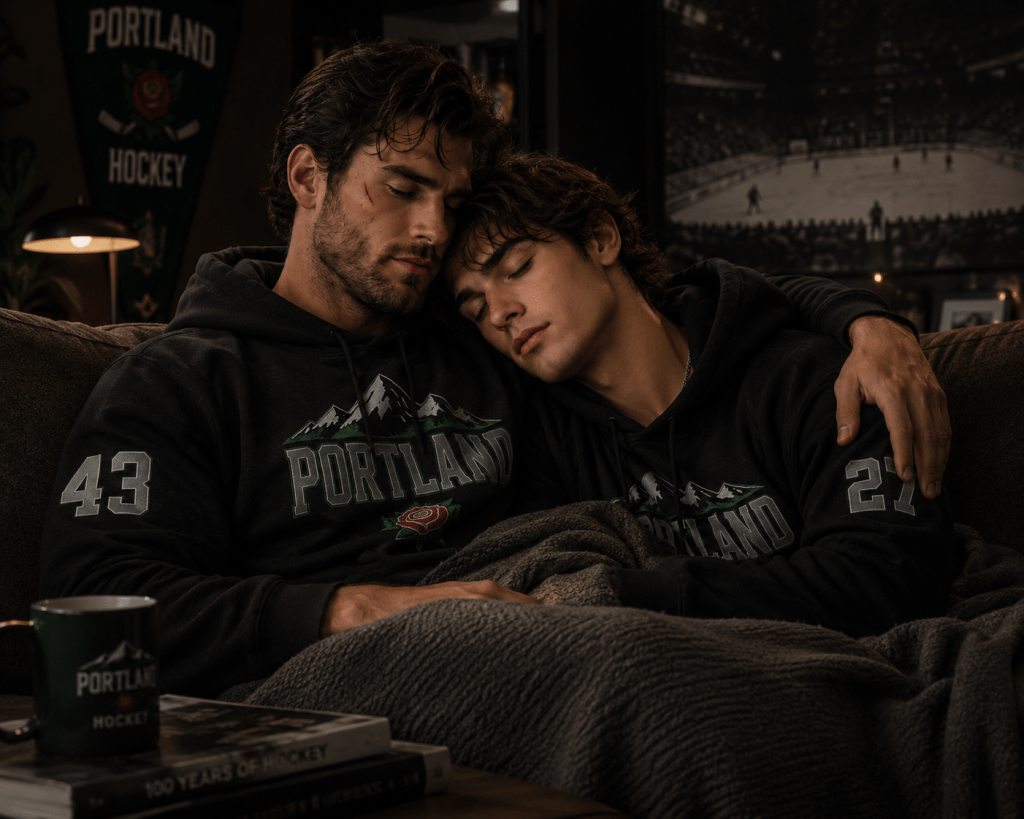
I have been sitting with this image for approximately twenty minutes and I cannot stop looking at it.

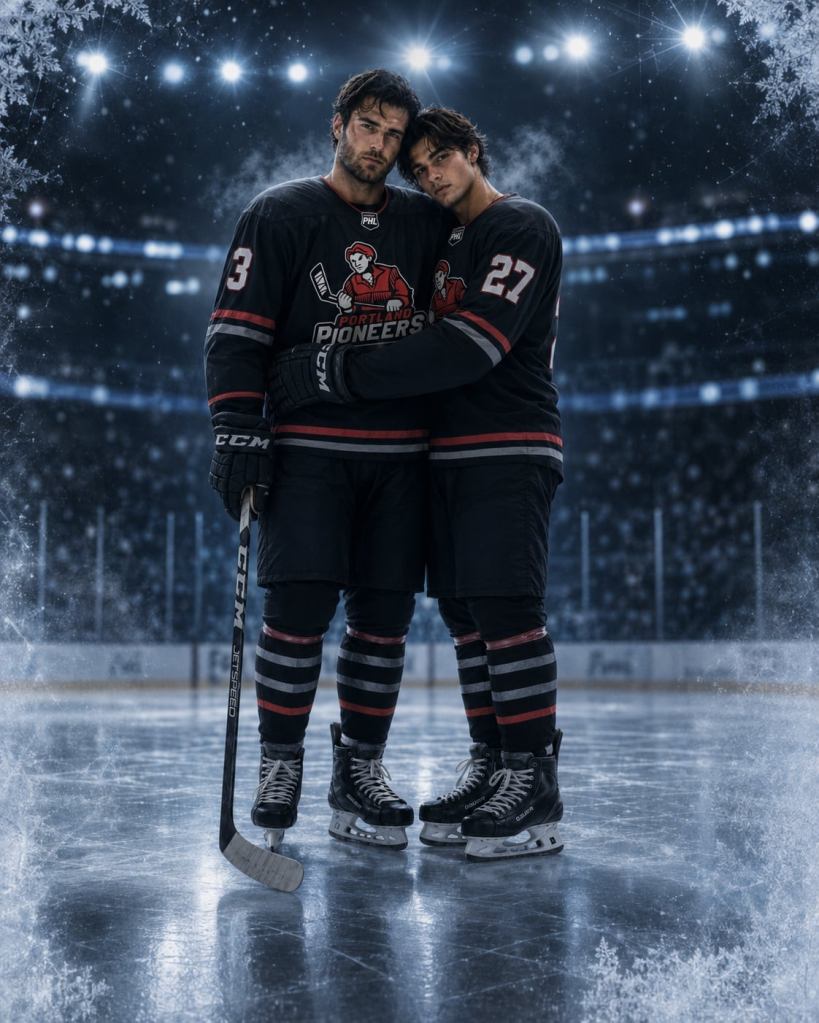
This is Deacon Worth and Konstantin Andropov. Number 43 and number 27. Portland Pioneers. My boys.

If you have been following along with the PHLu universe, you know Deke and Kon. You know the goal crease and the press conference and the year that changed everything and the specific, particular way these two found their way to each other on the ice and off it. You have lived inside their story with me. And now Paul — our incredible artist who has given visual life to all three of my universes — has given them a face.

I cannot tell you how close this is to what I saw when I wrote them. That is not a thing I expected to be able to say. You write a character and you have them in your head in the specific way that fictional people live in an author’s head — vivid and particular and entirely yours — and then someone else tries to render them and the gap between the interior version and the external version is usually where you learn to manage your expectations.

There is no gap here. None. This is Deke. This is Kon. The way they are standing, the way Kon is leaning in, the specific quality of how they are with each other — this is the book, made visible.

Isolated releases June 15.

Cover reveal June 5.

If you’d like to be notified the moment that cover drops — and I think you would like that, I think you would very much like that — watch this space. I am barely containing myself and I have known what the cover looks like.

You are going to love them. I already do, obviously. I have for quite some time.

🏒 — Bella

In Which I Have Thoughts About Hockey Shows

So this morning I finally sat down and watched Off Campus.

And I have to admit something that may get my hockey romance card revoked:

…I was kind of underwhelmed.

Not because it was terrible. It wasn’t. The production value was there. The budget was clearly there. Everybody was pretty. The hockey looked fine. On paper, this should have been exactly my thing.

But the entire time I was watching it, I kept finding myself comparing it to HR.

And unfortunately for Off Campus, HR exists.

Maybe if Off Campus had been the first modern hockey romance style show released, I would feel differently. Maybe I would have fallen completely in love with it. Maybe I would have been screaming into the void about locker room tension and emotionally unavailable men in compression shirts.

But instead, it arrived after something that already nailed the thing I personally think matters most in hockey romance:

chemistry.

Not just romantic chemistry either. Team chemistry. Friendship chemistry. Banter. Warmth. That feeling that these people genuinely exist together when the cameras stop rolling.

HR has charm in a way that feels almost accidental. Like lightning in a bottle. It feels lived in. Messy in the best way. The relationships feel textured and weird and human. Even the background interactions feel natural.

Off Campus, weirdly, felt more polished and somehow less alive.

And maybe that sounds unfair because objectively it probably is the “bigger” production. Better funded. Cleaner. More cinematic in places. But I kept waiting for it to click emotionally for me and it just… didn’t.

It almost felt like they had all the ingredients and somehow forgot seasoning.

I don’t even know if the issue is the writing. It might genuinely come down to casting chemistry. Hockey romance absolutely lives or dies on whether you believe these people would choose each other in every universe.

If I don’t buy the longing, the protectiveness, the “I would absolutely help you hide a body” energy, then the whole thing starts feeling like actors reading attractive dialogue at each other.

And the frustrating part is that there are glimpses in Off Campus where you can see the potential. Little flashes where I thought, oh there it is. Then it would disappear again under another overly polished scene that somehow forgot to feel.

The boys living in the dorm house almost had it.

That was the frustrating part.

There were moments — particularly during the training scenes — where you could feel the shape of the thing it could have been. The burpees, the exhausted chirping, the half-feral team energy, everybody existing in each other’s pockets twenty-four hours a day… for a second I thought, oh here we go. There it is.

And then somehow it just vanished somewhere between the motivational speeches and the bro hugs.

Which sounds ridiculous because I am absolutely the target audience for this kind of thing. Give me emotionally constipated hockey players living in a chaotic share house and I should be seated immediately with snacks and emotional investment.

But I kept wanting more texture.

More quiet affection.
More stupidity.
More loyalty.
More “this idiot is my family now.”
More moments where the audience gets to live with them instead of simply watching plot happen around them.

And honestly? I think that’s what I’m discovering I want from television in general these days.

I would not remotely complain if every scripted drama on the boob tube (good lord, am I showing my age with that phrase?) was one of the following:

  • hockey players navigating life and feelings badly
  • firefighters saving everybody while emotionally imploding
  • deeply repressed soldiers trying to figure out how to exist in normal society

Apparently that is my entire media diet now.

But I think the reason those stories work when they do work is because underneath all the action and conflict and dramatic music, they’re fundamentally stories about people choosing each other.

Found family.
Loyalty.
Protection.
Love in all its messy forms.

And maybe that’s why some modern shows leave me a little cold. Everything feels so determined to be high stakes all the time that nobody remembers to let the characters breathe together.

I don’t necessarily want less drama.

I just want more love.

More scenes where people cook dinner together.
More exhausted conversations at 2am.
More teammates showing up without being asked.
More “I’ve got you.”
More humanity.

The world is already exhausting enough. Let fictional people care about each other properly.

Also let them do it while wearing hockey gear.

Obviously.

Meet the McKenzies. Your Life is About to Get Complicated.

So. The PHL is going live June 15. You know that. You’ve marked your calendar. You’re ready.

But before the puck drops on the whole glorious league, I want to introduce you to the family at the heart of it all — because everything, and I mean everything in the McKenzie Legacy series starts with five Australian kids who looked at their futures and decided to chase them across the world, no matter what it cost.

Let me paint you a picture.

Five siblings. One family. Ambitions too big for one country to hold.

Three boys — identical triplets, because their parents clearly believed in doing things at scale — who grew up dreaming of ice. Of rinks. Of the NHL, or something like it. Of making it in the sport that had absolutely no business being the obsession of kids growing up in Australia, and yet. There they were. Obsessed. Determined. Entirely unstoppable.

And two girls — identical twins — who were born to skate, but not the way their brothers wanted to. Figure skating. Blades and music and the kind of precision that makes your throat tight when you watch it done perfectly. These two wanted it so badly, so completely, that they did something that still gets me right in the chest when I think about it: they gave up their Australian citizenship to compete for the country that could give them their dream.

Let that land for a moment.

Five kids. Five enormous futures. One family watching them all fly away, one by one, toward the lives they were built for.

The McKenzie Legacy is five books. Five love stories. Five characters who carry the weight of everything they left behind, and everything they’re still becoming.

And the first book?

The First Line.

🏒

Lachlan McKenzie. Captain. The kind of man who leads from the front and holds everything together and has absolutely no idea what to do when a woman walks into his orbit and refuses to be managed, organised, or tidily categorised.

Dr Sienna MacLeod. The woman in question. She has not read the memo about being tidily categorised, and she would like it known that she is very busy and does not have time for whatever this is.

I will be honest with you. When I imagine these two — when I see them in my head, which I have been doing for longer than I should probably admit — I see Thor and Merida.

You’re welcome.

He is, in every sense, built like a Viking who also somehow learned to skate. She is all fire and independence and she will absolutely shoot an apple off your head if you give her sufficient motivation. They are, on paper, a disaster. In practice — well. That’s what the book is for.

The First Line is the beginning. The McKenzie Legacy is the whole story — and once you’ve met this family, the triplets and the twins and all the love and loss and history they carry with them, I’ll be taking you somewhere very special.

To the team that sits at the shining heart of the entire PHLu.

The Portland Pioneers.

But first — Lachlan. And Sienna. And the moment everything starts.

June 15.

Cover reveal: May 31. Be there.

🏒 — Bella