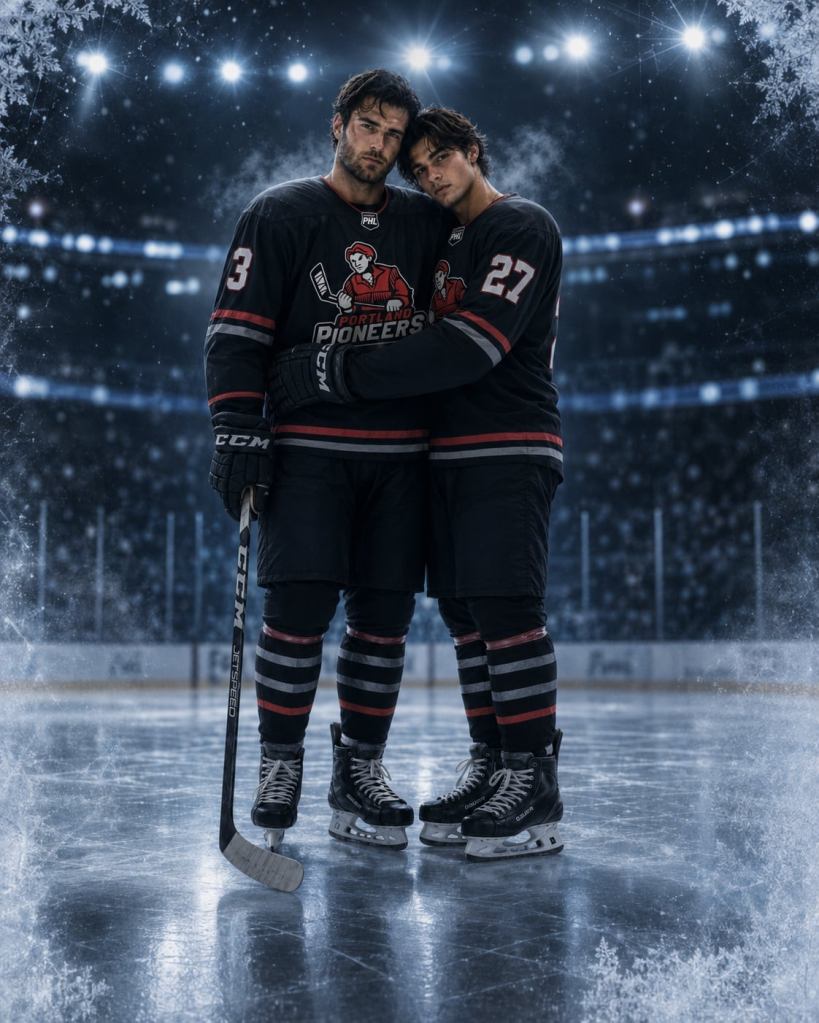
Meet the McKenzies. Your Life is About to Get Complicated.

So. The PHL is going live June 15. You know that. You’ve marked your calendar. You’re ready.

But before the puck drops on the whole glorious league, I want to introduce you to the family at the heart of it all — because everything, and I mean everything in the McKenzie Legacy series starts with five Australian kids who looked at their futures and decided to chase them across the world, no matter what it cost.

Let me paint you a picture.

Five siblings. One family. Ambitions too big for one country to hold.

Three boys — identical triplets, because their parents clearly believed in doing things at scale — who grew up dreaming of ice. Of rinks. Of the NHL, or something like it. Of making it in the sport that had absolutely no business being the obsession of kids growing up in Australia, and yet. There they were. Obsessed. Determined. Entirely unstoppable.

And two girls — identical twins — who were born to skate, but not the way their brothers wanted to. Figure skating. Blades and music and the kind of precision that makes your throat tight when you watch it done perfectly. These two wanted it so badly, so completely, that they did something that still gets me right in the chest when I think about it: they gave up their Australian citizenship to compete for the country that could give them their dream.

Let that land for a moment.

Five kids. Five enormous futures. One family watching them all fly away, one by one, toward the lives they were built for.

The McKenzie Legacy is five books. Five love stories. Five characters who carry the weight of everything they left behind, and everything they’re still becoming.

And the first book?

The First Line.

🏒

Lachlan McKenzie. Captain. The kind of man who leads from the front and holds everything together and has absolutely no idea what to do when a woman walks into his orbit and refuses to be managed, organised, or tidily categorised.

Dr Sienna MacLeod. The woman in question. She has not read the memo about being tidily categorised, and she would like it known that she is very busy and does not have time for whatever this is.

I will be honest with you. When I imagine these two — when I see them in my head, which I have been doing for longer than I should probably admit — I see Thor and Merida.

You’re welcome.

He is, in every sense, built like a Viking who also somehow learned to skate. She is all fire and independence and she will absolutely shoot an apple off your head if you give her sufficient motivation. They are, on paper, a disaster. In practice — well. That’s what the book is for.

The First Line is the beginning. The McKenzie Legacy is the whole story — and once you’ve met this family, the triplets and the twins and all the love and loss and history they carry with them, I’ll be taking you somewhere very special.

To the team that sits at the shining heart of the entire PHLu.

The Portland Pioneers.

But first — Lachlan. And Sienna. And the moment everything starts.

June 15.

Cover reveal: May 31. Be there.

🏒 — Bella

Why Team Stories Feel Like Home

There’s a reason sports romance readers fall hard for team stories, even if they didn’t grow up watching a single game.

On the surface, these books are about hockey, football, baseball, or whatever sport the characters play. But the truth is, the sport is only the setting. The real story—the one that hits readers right in the chest—is about belonging.

Because team stories are about family.

Not the one you’re born into.

The one you choose.


The Locker Room Is Chosen Family

Every team has a locker room. A space that outsiders rarely see.

It’s loud. It’s chaotic. It smells faintly like tape and sweat and whatever someone microwaved five minutes before a meeting. But it’s also where something important happens: people who started as strangers slowly become a unit.

They learn each other’s habits.

Who tapes their stick three times before a game.
Who sits in the same stall every day.
Who always forgets their gear and borrows someone else’s.

They argue. They chirp. They shove each other in the hallway.

And somewhere along the way, those strangers become the people who know you best.

In sports romance, the locker room isn’t just background scenery.

It’s the heartbeat of the story.


Rituals Matter More Than You Think

Every team develops rituals.

The same playlist before every game.
The same diner after late practices.
The same terrible pre-game speech that somehow still works.

These rituals look small from the outside, but they do something powerful: they create stability.

Athletes live in high-pressure environments. Wins and losses can change everything. Careers can shift overnight. But the rituals—the music, the meals, the dumb superstitions—remain constant.

They say: You’re part of this.

And readers recognize that feeling.

Because most of us are looking for those small rituals too. The routines that make us feel like we belong somewhere.


Teasing Is the Language of Affection

One of the most recognizable elements of team dynamics is the teasing.

Someone gets roasted for a bad haircut.
Someone else gets chirped for a terrible playlist.
A rookie gets stuck carrying bags for a month.

On the surface, it looks like chaos.

But underneath it, there’s affection.

Teasing on a team is often a form of acceptance. It’s how players say you’re one of us now. The moment someone stops being polite and starts chirping you is often the moment you know you’ve been fully absorbed into the group.

Sports romance captures that dynamic beautifully.

The jokes.
The running gags.
The way teammates show up for each other when things get serious.

Readers fall in love with the romance—but they stay for the team.


The Desire to Belong

At its core, sports romance taps into a universal human desire: the need to belong somewhere.

Everyone wants a place where they’re expected.

Where someone notices if they don’t show up.

Where their presence matters.

Teams embody that idea in a very visible way. You can see it on the ice, on the field, on the bench. A team only works when every player is part of the system.

Remove one person and the structure changes.

That kind of belonging is powerful.

And it’s deeply comforting to read about.


Why Sports Romance Hits Harder Than Expected

Many readers come into sports romance expecting something light.

A fun story.
Some competitive banter.
Maybe a few locker room antics.

What they often find instead is something deeper.

Because sports romance isn’t just about two people falling in love.

It’s about finding a place where you’re accepted completely—strengths, flaws, and all.

It’s about teammates who become brothers.
Coaches who become mentors.
Fans who become community.

And sometimes, right in the middle of that found family, two people realize they’ve fallen in love.

Not despite the team.

But because of it.


Everyone Wants Somewhere They’re Expected

That’s the real magic of team stories.

They remind us that belonging doesn’t have to be complicated.

Sometimes it looks like a crowded locker room.

Sometimes it looks like a late-night team meal.

Sometimes it looks like a group chat that never stops buzzing.

And sometimes it looks like love growing quietly in a place where everyone already feels like family.

Because at the end of the day, most of us are searching for the same thing:

A place where we’re expected.

A place where someone saves us a seat.

A place that feels like home.

Timeline Architecture: Keeping Seasons, Trades, and Career Arcs Consistent Across Books

I’m going to be honest with you in a way that I suspect will make a lot of writers feel significantly better about their own process.

I have 58 books in a fictional hockey universe. I have a 385 page series bible. I know the roster of every team in two leagues, the front office of every franchise, the names and numbers of cheer squads, the career arcs of players across three league levels, and the precise emotional geography of a family of twins and singletons whose love stories span multiple continents and decades.

And the timeline is the thing that keeps me up at night.

Not the characters. Not the plots. Not the emotional arcs or the romantic beats or the question of whether a particular scene is doing enough work. The timeline. The question of whether the events of Bergen’s book are sitting correctly in relation to the events of Deacon’s book, whether Grayson’s shoulder injury happened in the right season relative to Isla’s labral tear, whether Niklas’s rookie year overlaps precisely with Sorrenson’s story in the way it needs to for the secret to be the secret it has to be.

I have all 58 stories written. My current editing run — the one I am living inside right now, the one that is simultaneously thrilling and mildly terrifying — is dedicated almost entirely to making sure the timeline works. That every season is the right season. That every trade lands in the correct moment. That nobody is in two places at once and no career arc contradicts itself and the through-lines that connect all 58 books into a single coherent universe are actually doing what I need them to do.

It is the hardest part of building a universe at this scale.

It is also, I have come to believe, the most important.


Why Timeline Breaks Everything

A timeline error in a standalone novel is unfortunate. A timeline error in a 58 book universe is a fault line that runs through everything built on top of it.

This is the particular vulnerability of interconnected series — the same quality that makes them so rich and rewarding for readers, the fact that everything connects to everything else, is exactly what makes a single continuity error so consequential. If Bergen’s book establishes that Per died in the off-season between two specific years, then every subsequent book that references Per’s absence has to be consistent with that timing. If Grayson’s Seattle chapter covers a specific number of seasons before he returns to Portland, then his age at every point in the timeline has to reflect that accurately. If Isla McKenzie’s rehab overlaps with Grayson’s rehab in the way the story requires, the timing of both their injuries has to be architecturally possible within the hockey season calendar.

None of this is insurmountable. All of it requires rigorous, unglamorous, painstaking attention to detail that is about as far from the romantic inspiration of first-draft writing as it’s possible to get.

This is the part of universe-building that nobody tells you about when you fall in love with the idea of writing a series.


The Hockey Calendar Is Your Spine

The single most useful thing I can tell you about managing timeline in hockey romance specifically is this: the hockey calendar is not a constraint. It is your architecture.

An NHL season runs from October through April for the regular season, with playoffs extending into June for the teams that go deep. The draft happens in late June. Free agency opens in July. Training camp begins in September. This annual cycle — absolutely fixed, publicly documented, consistent year over year — is the spine on which every career arc in your universe hangs.

This means that certain things can only happen at certain times. A trade deadline move happens in late February or early March — not November, not May. A rookie arriving from the draft is arriving in September for training camp, not January. A player rehabbing from an injury sustained in the playoffs has a very specific window of recovery time before the next season begins, and whether they make it back or don’t make it back is determined by the nature of the injury and the length of that window.

These fixed points are gifts. They mean that if you know what season a story is set in and what time of year key events occur, a significant portion of your timeline is determined for you by the sport itself rather than by your creative choices. You’re not inventing when things happen. You’re discovering when they have to happen given the constraints of the world you’ve chosen.

Build a master calendar that maps your entire universe onto the actual hockey calendar. Every book, every key event, every career milestone — anchored to a specific month and year. This document is not exciting to create. It is absolutely essential to maintain.


Career Arcs Across Multiple Books

The particular complexity of a hockey romance universe isn’t just that multiple books are happening simultaneously — it’s that your characters appear across each other’s stories at different stages of their careers, and those appearances have to be consistent with where each character actually is at that moment in time.

Bergen Worth appears in Deacon’s book as a 28 year old captain who has already lost his parents. He appears in Grayson’s book as an older brother watching his youngest sibling fall for an Australian figure skater. Every time Bergen appears in someone else’s story, his age, his circumstances, his relationship status, and his emotional state have to reflect where his own timeline has placed him at that point.

Multiply this across 58 books and an ensemble cast of hundreds of characters and you understand why the editing run I’m currently doing exists.

The tool I’ve found most useful for managing this is a character timeline document that sits alongside the series bible — a linear record for each significant character that maps their age, career stage, relationship status, and key life events against the master calendar. When Bergen appears in chapter four of someone else’s book, I can check his timeline document and confirm exactly who he is at that moment.

It sounds like an enormous amount of administrative work.

It is an enormous amount of administrative work.

It is also what stands between a universe that feels coherent and alive and one that quietly undermines itself through accumulated inconsistency.


The Particular Problem of Trades

Trades are the element of hockey timeline architecture that cause me the most specific difficulty, and I suspect I’m not alone in this.

A trade is by definition a disruption — a player moving from one team to another, which changes their relationships, their living situation, their professional context, and their proximity to everyone they know. In a universe where multiple teams are interconnected — where the Pioneers play the Trade Winds, where the California teams share family members with the Portland world, where the women’s league exists alongside the men’s — a single trade has ripple effects across multiple storylines.

If a trade moves a character at the wrong moment in their timeline, it doesn’t just affect their own story. It affects every other story that character touches at that point. The timing of trades therefore needs to be determined not just by what makes sense for individual storylines but by what the entire universe can accommodate at that moment.

I plot trades on the master calendar before I finalise them in any individual book. I need to see the impact across the whole before I commit to any part of it.


When You Find the Error

You will find errors. I want to say this clearly and without softening it because I think writers who are building complex universes sometimes feel that finding a continuity error is evidence of failure rather than a normal and inevitable part of the process.

I have found errors in my editing run. I will probably find more before it’s complete. Some of them are small — a character’s age stated incorrectly in a throwaway line, a reference to an event that the timeline places in the wrong season. Some of them are larger — a career arc that doesn’t quite work when you lay it against the master calendar, a relationship development that is moving faster or slower than the established timeline permits.

The process of finding and fixing these errors is not failure. It is the editing run doing exactly what it’s supposed to do. The errors existed whether you found them or not. Finding them means your readers won’t find them first.

When you find an error in a complex interconnected universe, the fix has to account for every place that error has consequences. Change the date of one event and you may need to adjust three other books. This is painstaking and occasionally maddening and absolutely worth every minute it takes.


Making Peace With Imperfection At Scale

Here is the truth that I have had to make peace with across 58 books: at this scale, absolute perfection of timeline is probably not achievable. Not because the work isn’t worth doing — it absolutely is — but because the sheer volume of interconnection means that the number of potential conflict points is staggering, and the human brain, even one that has been living inside this universe for years, has limits.

What you are aiming for is not perfection. You are aiming for coherence — a timeline that feels consistent and trustworthy to your reader, that doesn’t break their immersion in the world you’ve built, that honours the investment they’ve made in following these characters across multiple books.

Most readers are not reading your 58 book universe with a spreadsheet open beside them tracking dates and ages and career statistics. They are reading because they love these people and they trust you to take care of the world those people live in. That trust is what you’re protecting with every hour you spend on the editing run that nobody will ever see.

The timeline work is invisible when it’s done right.

That’s exactly how it should be.

Do it anyway. Do it thoroughly. Do it with the same love you brought to creating January Jones Jarvis and Kon and Isla McKenzie and every other person you’ve built a life for inside these pages.

They deserve a world that holds together.

So do your readers.

Developing a Team Culture: What Makes Your Fictional Franchise Unique

I am not a sporting person.

I want to put that on the table immediately, because I think it matters. I don’t play sport. I have never played sport in any serious or organised way. I am the sibling who sat in the stands while the athletes in my family did their thing, the one who watched from the sidelines and noticed things that perhaps the people actually playing didn’t have the headspace to observe. I have spent a lifetime watching sporting culture from the outside — the dynamics, the rituals, the unspoken hierarchies, the way teams either cohere into something greater than the sum of their parts or quietly fracture along lines that were always there, just never quite pressurised enough to show.

And here is what I know from all of that watching: a locker room is a locker room.

The professional version may smell more expensive and have better towels and contain people whose faces appear on merchandise, but the fundamental human dynamics playing out inside it are not meaningfully different from the amateur locker rooms I watched my siblings inhabit across years of weekend sport. The way status gets established without anyone explicitly establishing it. The veteran who doesn’t need to raise their voice because everyone in the room already knows where they stand. The newcomer feeling out the culture with careful, watching eyes. The joke that lands perfectly and the one that lands wrong and how the room responds to both tells you everything about who these people are to each other.

I built the Portland Pioneers’ culture on that knowledge. And I supplemented it with something that didn’t exist when I was a child sitting in the dark watching a fuzzy Olympic hockey game on a screen I was practically touching — social media, behind-the-scenes content, and the extraordinary access that the Washington Capitals have given fans into the living, breathing, bickering, laughing organism of an actual NHL team.

Those two things together — a lifetime of watching amateur locker rooms and years of careful attention to what professional teams reveal about themselves online — gave me everything I needed.


Culture Is Not What Teams Say. It’s What They Do.

Every franchise has a mission statement. Every organisation can tell you about their values, their commitment to excellence, their dedication to community. This is not culture. This is marketing.

Culture is what happens when nobody is watching. It’s the veteran who quietly helps the struggling rookie with his technique without being asked, and without telling anyone he did it. It’s the way the room goes silent when a specific person walks in — whether that silence is respect or wariness tells you everything. It’s the unwritten rules that new players absorb in their first few weeks without anyone ever explicitly stating them: what gets laughed at and what doesn’t, who you defer to and in what circumstances, what kind of vulnerability is permitted and what kind will cost you.

Culture is lived, not declared. And as a writer, your job is to show it rather than tell it — to let the culture of your fictional franchise reveal itself through a hundred small moments rather than through a single scene where someone explains it.

My younger siblings played sport with genuine commitment and I watched that world across many years. I watched how teams that looked similar on paper — same age range, same neighbourhood, same sport — could have completely different feels. One team was tight and raucous and looked out for each other in ways that extended well beyond the pitch or the court or the ice. Another was technically competent and emotionally cold, a collection of individuals who happened to wear the same colours. The difference was never really about talent. It was always about culture, and culture was always traceable back to specific people making specific choices — usually a small number of people, sometimes just one or two, whose values and behaviours set the tone that everyone else either adopted or struggled against.

Your franchise is the same. Somewhere in your roster and your coaching staff are the two or three people whose character is shaping the culture that everyone else inhabits. Find them. Know them completely. Then let them do their work on the page.


What Social Media Has Given Hockey Writers

I grew up watching one game per week on a television set small enough that I could practically hold it. Now I follow the Washington Capitals on multiple platforms and they give me access I genuinely cannot believe is real.

The behind-the-scenes content that professional sports organisations produce for social media is a research gift of extraordinary generosity. Not the polished stuff — the official highlight packages and the interview clips where everyone is saying the approved things. I mean the other content. The practice footage where someone does something embarrassing and gets absolutely destroyed by their teammates for the next thirty seconds. The locker room celebrations that are obviously partially performed for camera and partially completely real and the line between those two things is genuinely interesting to observe. The travel content that reveals how these groups of men actually interact when they’re bored and tired and crammed onto a charter flight for the fourth time in ten days.

What social media reveals, if you watch it with careful eyes, is the genuine texture of team relationships. You learn who is actually funny and who just thinks they are. You learn the genuine affection between certain players that no official team communication would ever make explicit because it’s just the background noise of shared life. You learn which veterans are magnets for the rookies and which ones are slightly untouchable. You learn the team’s sense of humour — what they laugh at, the jokes that recur, the bits that have been running so long that the participants are barely aware it’s still a bit.

The Capitals have an extraordinary culture that I have studied with the intensity I once reserved for sitting three inches from a fuzzy television screen. They are physically affectionate in a way that reads as genuinely unselfconscious. They are fiercely protective of each other in public. Their sense of humour is specific and layered and has the quality of in-jokes that go back years. The veterans carry themselves with the particular ease of people who have been somewhere long enough to know that they belong there, and the newer arrivals move into that ease at different speeds and in different ways that are fascinating to observe.

None of this is directly transcribed into the Portland Pioneers. But all of it informed how I understand what a team with genuine culture actually looks and feels like from the outside. That understanding is in every scene I’ve set in the Pioneer locker room.


Building a Culture That Is Specific to Your Team

Generic team culture is useless. Your fictional franchise needs a culture that is theirs and theirs alone — that couldn’t belong to any other team in your universe, that is the product of this specific combination of people in this specific city at this specific moment in the franchise’s history.

To build that, you need to know the origin. Culture in sports teams is almost always traceable to founding conditions — to what the organisation was built around and what it was built in reaction to. Was your franchise built on grit and defensive hockey by a coach who believed offence was overrated and toughness was everything? That choice, made fifteen years ago, is still living in the walls of the building even if the current roster looks completely different. Was your franchise built on a particular kind of player that the founder loved — creative, offensive, willing to take risks — and did that philosophy attract a certain kind of character that then reproduced itself through the culture they created?

For the Portland Pioneers, the coaching staff and the ownership structure are the origin of the culture. A head coach who is also the father of players on his own roster has created a family culture that is genuine rather than performed — these people are actually looking out for each other in the way that families do, with all the complication that entails alongside all the warmth. The front office full of women who belong to this world on their own professional terms has created an organisational culture where the assumptions that sometimes poison sports environments never got the foothold they might have had elsewhere.

That culture attracts certain kinds of players and repels others. It creates an environment where specific kinds of stories are possible and others are not. It is the invisible architecture that every book in your series is built inside.


Culture as the Source of Conflict

Here is the craft truth that took me longest to fully articulate: team culture is not just atmosphere. It is conflict engine.

The friction between individual characters and the team culture they inhabit — the player who doesn’t fit, the newcomer who challenges assumptions, the veteran whose methods worked for twenty years and are suddenly inadequate in ways they can’t quite name — is the source of some of the richest character drama available to you in sports fiction.

A trade brings someone into your franchise who was shaped by a completely different culture. They’re a good player. They want to contribute. But the way they understand what it means to be a good teammate is different from the way your franchise defines it, and that difference is going to create friction before it creates understanding. That friction is story.

A young player whose talent is undeniable arrives and finds that the team’s culture demands a kind of humility that doesn’t come naturally to someone who has been the best player in every room they’ve ever entered. How they navigate that — whether they fight it or learn from it or find a way to be themselves within it — is character development that the culture is generating for you.

Your culture is not the backdrop for your conflicts. It is actively producing them. The more specific and real your franchise culture is, the richer the conflict it generates — because culture that is truly lived, rather than gestured at, has edges. And edges create the friction that stories need.


The Amateur Truth in the Professional World

I said at the beginning that a locker room is a locker room, and I want to return to that because I think it carries something important for writers who feel that their lack of professional sports experience is a gap they need to apologise for.

The fundamental human dynamics of a team environment — the belonging and the exclusion, the loyalty and the betrayal, the way status is negotiated without anyone ever discussing it explicitly, the particular kind of love that forms between people who have been through something genuinely hard together — these are not exclusive to professional sport. They are human. They happen at every level, in every sporting context, in workplaces and families and communities that have nothing to do with sport at all.

You have been watching these dynamics your whole life. In the stands, on the sidelines, in the carpark afterwards. You’ve watched teams that had it and teams that didn’t, and you know the difference in your bones even if you’ve never had the language for it.

Trust that knowledge. Supplement it with everything you can find — the social media, the memoirs, the journalism, the conversations with people who have lived inside professional sport. But trust the fundamental human understanding you have already built, because that is what your characters are made of.

The locker room on a bad night after a bad loss, when the room has to find its way back to itself — I promise you that is not so different at the amateur level and the professional level that your experience of the first cannot illuminate the second.

Human nature is the research. You’ve been doing it your whole life.

Getting the Hockey Right: Research Resources for Writers Who Didn’t Grow Up With the Game

I was eleven years old, it was after midnight, and I was sitting so close to the television that I could see the individual red, green and blue triangles that made up the picture on our boxy old set. Color TV had only recently arrived in Australia. VCRs were still a future technology that nobody in my world had access to yet. And somewhere on the other side of the world, at the 1976 Winter Olympics, people were playing a game on ice that I had never seen before and could not look away from.

After that it was one game per week. That was what Australian television offered. One game, broadcast in the small hours of the morning, and I would set some internal alarm that I still don’t fully understand and wake up and pad out to the living room and sit two feet from the screen with the volume turned low enough that my parents stayed asleep. The picture was grainy and the commentary was sometimes hard to follow and I had approximately no framework for understanding what I was watching.

I was completely, helplessly hooked.

That was almost fifty years ago. The journey from that tiny screen in the dark to a 385-page series bible covering 48 fictional hockey organisations has been long and joyful and fuelled by a research appetite that has never entirely been satisfied. These days I can watch almost any game I want, any time I want, from my home in rural Tasmania — a smorgasbord of hockey so abundant it would have been genuinely incomprehensible to my eleven-year-old self sitting in the dark trying not to wake her parents.

But the abundance of access doesn’t mean research takes care of itself. If anything, knowing how much there is to know makes the research more deliberate, more layered, and more rewarding. So let me share what I’ve learned about how to get the hockey right when you didn’t grow up with the game living in your bones.


Watch the Game. Watch It Again. Then Watch It Differently.

Everything starts here. There is no substitute for watching hockey — not reading about it, not talking to people about it, not consulting diagrams of plays and formations. You have to watch the game until your eye develops, until you stop seeing a chaotic mass of bodies and start seeing the structure underneath, the decisions being made in real time by people moving at speeds that shouldn’t allow for decisions at all.

When you first start watching, you will probably follow the puck. That’s natural. The puck is the obvious focal point. But as your eye develops, start watching the players without the puck — the positioning, the skating, the way a player creates space for a teammate or closes down an opponent’s options before the puck arrives. This is where hockey reveals its genuine tactical beauty, and it’s also where your characters live. The enforcer who does the dirty work nobody films. The defensive forward who sacrifices their own offensive numbers to protect the lead. The power forward who wins puck battles in the corners with a stubbornness that has nothing to do with skill and everything to do with character.

Watch games multiple times if you can. The first watch is for the emotion and the overall narrative of the game. The second watch is for detail — the stuff that happened off the puck, the interactions on the bench, the body language after a bad goal, the way a team responds in the first shift after going down by two. That second layer is where your fiction lives.

Watch games from different decades too, if hockey history is part of your world-building. The game has changed dramatically — the speed, the equipment, the tactical sophistication, the culture around it. A veteran player in your series whose career started fifteen years ago played a somewhat different game than the rookies arriving now, and that difference can carry genuine character texture if you know what it is.


Build Your Analytical Vocabulary

One of the things that marks writing by someone who genuinely knows hockey versus someone who has approximated it is vocabulary — not just the terminology, but the analytical language that hockey people use when they talk about the game.

There is an entire ecosystem of hockey media dedicated to this. Podcasts, analytical websites, broadcast commentary from people who played at a high level and now translate their experience into language — all of it is available and most of it is free. The NHL’s official broadcast partners produce enormous amounts of content. Individual teams have their own media channels. Former players and coaches run podcasts and YouTube channels where they break down game footage with a granularity and expertise that will teach you things no Wikipedia summary can provide.

Pay attention to how hockey people talk about the game. The specific words they use for specific situations. The way a particular play gets described at the professional level versus how a casual fan would describe it. These distinctions matter in fiction because your characters who live inside the game will think and speak in its vocabulary, and that vocabulary needs to be right.

Statistics are also worth your time, even if numbers aren’t your natural language. Modern hockey analytics — Corsi, Fenwick, expected goals, zone entry and exit data — have changed how the game is understood and evaluated, and they’ve also changed how players and organisations think about value and contribution. A general manager character who uses this language, or a veteran player who is sceptical of it, or a young analytics hire in your front office who has to translate it for people who learned the game differently — these are all characters whose authenticity depends on you understanding what the numbers actually mean.


Find Your People

The hockey community is enormous, passionate, and genuinely welcoming to people who come to the sport from unexpected directions. The romance writing community within hockey fandom is particularly vibrant — there are readers and writers who have been living in this genre for years and who carry deep wells of specific knowledge that they are almost always delighted to share.

Seek them out. Join the conversations. Ask the questions that feel too basic to ask, because I promise you those questions have good answers that will make your writing better. The reader who played recreational hockey for twenty years and knows exactly what it feels like to take a hit into the boards will tell you things that no amount of watching games can teach you. The figure skater who can explain what edges feel like from the inside, the physical sensation of balance on a blade, will give you access to your characters’ experience on the ice that is otherwise very hard to access from the outside.

Fan communities are research resources. The person who has been to three hundred games and knows the difference between how the arena smells in October versus April, who can tell you what the tunnel between the dressing room and the ice looks like from six inches away because they were lucky enough to do a rink tour once — that person is invaluable to you, and they exist in every hockey fan community in numbers.

I have a person in Portland who answers my questions about the city. I have people who answer my questions about the game. Building that network of trusted sources is one of the best investments you can make in the long-term quality of your fiction.


Read the Literature That Came Before

Hockey romance as a genre has a body of work now, and that work is itself a research resource. Authors like Rachel Reid, Sarina Bowen, and others who have been writing in this space for years have done enormous amounts of research work and embedded it in fiction — which means reading their books is simultaneously pleasurable and instructive. You can see how experienced authors handle game scenes, locker room dynamics, the specific textures of professional hockey life, and then make your own decisions about where to follow their lead and where to do something different.

Read outside the romance genre too. Hockey memoirs and biographies give you access to the interior experience of playing the game at the highest level in ways that nothing else does. The loneliness of a road trip. The specific anxiety of a playoff series. The way a team either coheres under pressure or fractures. The physical toll that accumulates across a career and the relationship a professional athlete develops with a body that is simultaneously their greatest asset and their most pressing concern. These books are full of specific, lived detail that will enrich your fiction immeasurably.

Journalism is another underused resource. The long-form hockey writing published in outlets dedicated to the sport tends to be some of the best sports journalism produced anywhere — deeply reported, richly detailed, willing to sit with complexity and contradiction rather than reducing players and teams to simple narratives. A well-reported feature on a struggling franchise, or a profile of a player navigating the end of their career, or a piece about a coach trying to rebuild a team’s culture — these are the raw materials of the stories you want to tell, presented in their real form.


Embrace What You Don’t Know

Here is the counterintuitive research truth that took me a long time to fully absorb: not knowing the game from the inside can be an asset.

The readers who will pick up your hockey romance are not all lifelong fans who will audit your accuracy with expert eyes. Many of them are exactly like you — people who came to the sport from the outside, who love it with the particular intensity of the convert rather than the comfortable familiarity of the native. Those readers don’t need you to demonstrate your credentials. They need you to make the world feel real and the characters feel true and the game feel like something worth the enormous amount of life your characters have poured into it.

The outsider’s eye notices things that insiders stop seeing. The strangeness of the cold, the almost violent beauty of a clean hit, the improbable elegance of skating — all of these things can become ordinary to someone who grew up in a hockey family and went to their first game at age four. They are never ordinary to someone who discovered the sport at eleven years old, past midnight, sitting so close to the television they could see the pixels.

That child, leaning towards a small glowing screen in the dark while her parents slept, seeing something extraordinary and not entirely understanding it yet — she is your reader. She is also you.

Bring her with you when you write.

She already knows what it feels like to love this game from a distance, to reach towards it with everything she has across an ocean of separation, to find in its speed and beauty and brutality something that speaks to her in a language she didn’t know she needed.

That’s not a gap in your research.

That’s your greatest qualification.

The Arena as Sacred Space: Grounding Your Hockey Romance in Sensory Detail

I have never walked into an NHL arena and felt the cold hit me before I expected it.

I have never smelled the particular combination of ice and popcorn and whatever industrial cleaning product they use on the concourse floors that apparently every hockey arena in North America shares as a kind of olfactory signature. I have never felt the vibration of twenty thousand people reacting to the same thing at the same moment move through the soles of my feet and up into my chest. I live in rural Tasmania. The nearest NHL game is approximately as far away as it is possible to get while remaining on the same planet.

And yet.

I have written arena scenes that readers who attend games regularly have told me felt true. Not approximately true. Not close enough. True. The cold that gets into your bones in a way that outdoor cold somehow doesn’t. The sound of skate blades on ice during warmup — that particular crisp, clean bite — carrying all the way to the upper bowl. The way the light sits differently over the ice than anywhere else in the building, bright and almost clinical, making everything on its surface hyper-visible while the stands exist in comparative shadow.

I know these things because I have done the work. And I want to talk about what that work looks like, and why it is some of the most important work you will do in building a hockey romance universe.


The Arena Is Where Your Story Lives

Every genre has its sacred spaces — the places where the emotional and thematic weight of the story concentrates, where characters become most fully themselves, where the reader understands most clearly what everything is for. In legal thrillers it’s the courtroom. In medical dramas it’s the operating theatre. In hockey romance, it is the arena, and everything that happens within its particular geography.

This matters because your readers come to your books already carrying a relationship with this space. Some of them have been going to games since childhood, dragged along by a parent and discovering to their surprise that they loved it. Some of them found hockey as adults and came to the arena as converts — the particular passionate devotion of someone who chose the sport rather than inherited it. Some of them have never been to a live game but have watched hundreds on television and have built a vivid sensory imagination of what the real experience would be like.

All of them will know, on some level, whether you know what you’re talking about.

The arena is not a setting you can approximate and hope nobody notices. It is the sacred space of your genre, and it asks to be treated with the specificity and reverence it deserves.


Cold Is Not Just Cold

Let’s start with the most fundamental sensory fact of any hockey arena: the cold.

But here’s what most people who haven’t thought carefully about it miss — the cold of an ice arena is not like the cold of a winter day outside. Outdoor cold moves. It has wind and variation and your body can negotiate with it, can find a patch of sunlight or a sheltered corner and feel temporary relief. The cold of an arena is static and total. It comes up from the ice and spreads through the building and it doesn’t negotiate. You cannot warm up by standing in a different spot. It just is, a constant low-level presence that settles into the joints after twenty minutes and becomes simply the condition of being there.

This has texture as a writing tool. Your characters feel it differently depending on who they are and what they’re doing. The player who has been on the ice for a shift comes to the bench overheated and the cold is relief, almost sensual in its contrast to the effort of the previous two minutes. The journalist in the press box two hours into a game is wearing every layer they brought and still feels it in their fingers when they type. The partner in the stands who came dressed for a night out and not for a refrigerated building discovers an entirely involuntary vulnerability — the body has no performance mode for being cold, and there is something unexpectedly intimate about watching someone who is a little too cold, who has tucked themselves down into their jacket collar and is sitting with their arms wrapped around themselves.

Cold is not just cold. It is character revelation and emotional texture and the physical reality that your arena imposes on everyone inside it equally, without reference to their status or their intention.

Use it.


The Sound Architecture of an Arena

An arena has a sound architecture that changes depending on where you are within it and what is happening on the ice, and understanding that architecture will make your scenes feel inhabited rather than described.

At ice level, everything is immediate and percussive. The sound of a body hitting the boards at full speed is not the distant thud it appears to be from the stands — it reverberates. You feel it as much as hear it. Skate blades make different sounds depending on what they’re doing: the long clean stride of a player building speed is different from the sharp stop spray, different again from the quick edge work of someone protecting the puck in the corner. These sounds exist in real arenas and readers who know hockey will recognise them immediately when you name them. Readers who don’t know hockey will believe you because the specificity of observed detail carries its own authority.

From the stands, the sound becomes collective. The crowd has its own rhythms — the held breath before a shot, the collective exhale when it goes wide, the roar that happens before you’ve consciously registered that a goal has been scored because the body responds faster than the mind. There is a particular sound that arenas make when something is about to happen, a kind of gathered intensity in the crowd noise, that experienced fans learn to read almost like a sixth sense. Your characters who have been coming to games for years carry this knowledge in their bodies. Your characters attending for the first time are buffeted by sound events they don’t yet know how to interpret.

The commentary booth, the penalty box, the tunnel between the dressing room and the ice — each location in your arena has a distinct sound environment. Know where your scene is happening and write the sound that belongs to that specific location.


The Ice Itself

The ice deserves its own attention because it is extraordinary and most people have never really looked at it.

Fresh ice, resurfaced at the start of a game or between periods, is almost impossibly perfect — a surface so smooth it seems to have a slight sheen, the lines painted beneath it hyper-saturated in a way that makes the whole thing look almost artificial, like something rendered rather than real. As the game progresses, the ice deteriorates. By the end of a period it is carved and scuffed and the corners are a mess of snow and the face-off dots are obscured and the whole surface tells the story of the previous twenty minutes in its damage.

This progression — from perfect to marked — is a metaphor your genre hands you for free. The pristine ice at the start of a game and what it looks like when the buzzer goes is a physical representation of everything the period cost, everything that happened, every decision and collision and moment of beauty and ugliness that the players brought to it.

Your arena has boards and glass and penalty boxes and player benches and a scoreboard that the entire building watches at critical moments. It has the logos at centre ice and the faceoff circles and the crease in front of each goal where the rules change and the most contested real estate on the surface exists. These physical features of the ice are not decorative details. They are the geography of your characters’ professional world, as familiar to your players as the layout of a long-occupied house.

Write the ice like someone who has looked at it carefully enough to have feelings about it.


Sensory Detail as Emotional Access

Here is the deeper reason why sensory specificity in arena scenes matters beyond mere authenticity: it is the fastest and most reliable route into your reader’s emotional experience of the scene.

Abstract emotion — telling the reader that a character is nervous, excited, in love, afraid — lands on the surface of the reading experience. Sensory detail lands inside it. When your heroine is in the stands watching someone she is slowly and helplessly falling in love with step onto the ice, the emotional content of that moment is carried by what she notices. The way the cold she’s been ignoring for an hour suddenly feels different when she sees him. The way the particular sound of his skates registers distinctly from the general noise of warmup, though she couldn’t explain how she knows which sounds are his. The way the light over the ice makes everything on its surface look more real than the rest of the world rather than less.

She isn’t telling us she’s in love. The ice is telling us. The cold is telling us. The specific quality of her attention, rendered through what her senses are reporting, is doing the work that pages of internal monologue cannot do as elegantly.

Sensory detail is emotional access. The arena, with its extraordinary richness of physical experience, gives you more access points than almost any other setting in the genre.


The Arena After Hours

There is one more location within your arena that deserves attention, and it is the one that appears least in the literature despite being rich with possibility: the arena when it’s empty.

An empty hockey arena is a genuinely strange and affecting space. The ice is there, perfect and indifferent, with no performance to justify it. The stands that held thousands of people a few hours ago are silent in a way that seems to carry the echo of the crowd rather than simply its absence. The lights may be reduced to working levels rather than game brightness, and in that dimmer light the space feels both larger and more intimate simultaneously.

Characters who find themselves in an empty arena — a player alone on the ice at midnight working through something he can’t resolve in words, two people having a conversation in the stands that they couldn’t have anywhere else because the space demands a certain honesty — are in a location that your reader will feel immediately even if they’ve never experienced it themselves. The arena stripped of its crowd and its purpose is the arena showing its bones, and there is something sacred about that too.


I write hockey arenas from Tasmania, from memory and research and the generosity of people who have been willing to describe their experience in the kind of specific, granular detail that most people don’t think to record because it seems too ordinary to be worth noting. I follow the Washington Capitals with the devotion of someone who has chosen this sport from the far side of the world and refuses to love it at a distance. I go a little nocturnal during the playoffs. I know what it costs to care about something you can’t easily reach.

That distance has taught me something I might not have learned otherwise: nothing about a hockey arena is ordinary. The people who attend games regularly have simply had the extraordinary become familiar. Your job as a writer is to restore the strangeness — to write the cold and the sound and the ice and the light as if you are encountering them for the first time and finding them almost unbearably vivid.

Make your reader feel the cold.

Make them hear the ice.

Make them understand, on a sensory level, why this space is sacred — why the people who belong to it will sacrifice almost anything to stay inside it.

The rest of the story will take care of itself.

Building Rivalries: How Opposing Teams Can Fuel Conflict Across an Entire Series

Some rivalries are born on the ice.

Others are born in a parking lot outside an arena at eleven o’clock at night when a Portland Pioneer looks up and realises the man walking towards him is wearing a Thunder Bay Storm jacket and everything that has been simmering for three seasons is about to come to a very ugly head.

And some rivalries — the best ones, the ones that outlast careers and follow franchises across an entire continent and end up generating fifteen books in a fictional hockey universe — are born from something so personal, so raw, and so fundamentally human that the sport almost becomes incidental. The games between Portland and Thunder Bay were always gritty. Always nasty. Never ended without someone paying a physical price and everyone leaving with their tempers running a few degrees hotter than when they arrived. But what turned a fierce on-ice competition into something that went bone-deep for both franchises was the day the Thunder Bay captain went after the wife of one of the Pioneers forwards.

I’ll let you sit with that for a moment.

Because that — right there — is what a rivalry is actually made of.


Competition Alone Is Not a Rivalry

Here is a distinction that matters enormously and that sports romance sometimes glosses over: competition is not the same thing as rivalry. Two teams can compete fiercely, can push each other to their limits, can produce spectacular games full of physical intensity and genuine drama — and still not have a rivalry. Competition is structural. Rivalry is personal.

A rivalry requires history. It requires accumulated grievances and specific memories and the particular way that certain opponents seem to bring out something in your team that nobody else can access — something darker and more driven and occasionally something uglier than you want it to be. Rivalry requires that the outcome of the game feels like it means something beyond the standings, that losing to this particular team stings in a way that losing to anyone else simply doesn’t.

Portland and Thunder Bay had all of that before anyone’s wife went anywhere. The games between them were appointment television for fans of both franchises — physical, tactical, contested from the first puck drop to the final whistle, with a penalty count that made the officials look exhausted by the second period. There was genuine respect underneath the hostility, which is almost always the engine of the best rivalries. You don’t hate a team you don’t fear. You don’t play that hard against someone you don’t think can beat you.

But then the personal arrived and blew the structural to pieces. And now it isn’t just a rivalry. It’s a wound.


The Personal Is What Makes It Narrative Gold

Let’s talk about what the stolen wife actually does to the story architecture of an entire series, because it does an astonishing amount of work for a single plot event.

First, it personalises the rivalry in a way that pure on-ice competition cannot. Every time Portland plays Thunder Bay — or, later, the Honolulu Trade Winds — there is a specific human being on that bench whose presence means something to specific people in the Portland dressing room. The history between these teams isn’t abstract. It has a face and a name and a betrayal attached to it, and that betrayal colours every interaction between the franchises for years after the fact.

Second, it creates differentiated experiences within your ensemble cast. Not every Pioneer feels the same way about this. Some of them were close to the forward whose marriage ended and carry a fierce protective anger on his behalf. Some of them are more complicated — maybe they saw the cracks in that marriage and have quietly conflicted feelings they would never voice in the locker room. Some of the younger players came up after it happened and know it only as history, as legend, as something that explains the look on their veteran teammates’ faces when Thunder Bay is on the schedule. That variation in how your characters relate to the shared history is enormously useful for creating distinct voices and perspectives across multiple books.

Third — and this is the one I find most interesting — it gives your rival franchise moral texture. The Thunder Bay captain who did this is not a cartoon villain. He is someone who wanted something and took it in a way that caused real harm, and who has presumably had to live with the fallout of that choice just as the Pioneer forward has. That complexity is what makes the Honolulu Trade Winds fifteen books of story rather than fifteen books of obstacle. The rival franchise needs to be as fully human as the home team, and nothing humanises people faster than giving them something they did wrong that they can’t undo.


When the Rival Franchise Moves

The relocation of the Thunder Bay Storm to become the Honolulu Trade Winds is a gift to your narrative that keeps giving across multiple storylines, and I want to explain exactly why.

A franchise relocation carries its own emotional freight independent of anything else happening in the story. For Thunder Bay fans — and there would be Thunder Bay fans, people who grew up with that team as part of the texture of their city — the move is a loss, a small civic grief that tends to generate the kind of resentment that attaches itself to whoever they blame for the decision. For the players who move with the franchise, there is the strange experience of being the same team in a completely different world. For the players who don’t make the move — who are traded or released in the restructuring that typically accompanies relocation — there is the particular disorientation of a team identity suddenly having no geography to anchor it.

And for Portland and their fans, the relocation of their oldest rival doesn’t end the rivalry. It transforms it. Because now when these teams meet, the stakes include everything they always included plus the weight of everything Portland remembers about Thunder Bay that Honolulu hasn’t earned and doesn’t know. Portland plays the Trade Winds and sees the Storm. That layer of memory and loss and complicated feeling — for players old enough to have been there, and for the institutional memory carried by coaches and front office staff and the franchise itself — gives the rivalry a depth that newly minted competitions simply cannot have.

The man who built the Trade Winds in Hawaii — who took his love of hockey and his broken playing career and his considerable fortune and planted an ice rink in the Pacific — didn’t just move a team. He moved a history. Whether he fully understood what he was carrying with him is a question worth exploring across those fifteen books.


How to Build a Rival Franchise That Deserves Its Own Series

The Honolulu Trade Winds get fifteen books. That means they cannot function as pure antagonists to the Portland Pioneers’ protagonists. They have to be a fully realised world — with their own internal culture, their own character arcs, their own love stories and conflicts and moments of grace.

This is the challenge and the opportunity of building a rival franchise that you intend to take seriously as a narrative subject rather than just a source of opposition.

The key is to ensure that your rival team is coherent on its own terms, not just in contrast to your home team. The Trade Winds aren’t defined by not being the Pioneers. They have their own identity — shaped by the strange and deliberate act of their creation, by the Hawaiian context that surrounds them, by the particular kind of player who ends up in Honolulu and what that says about where they are in their career or their life. Some of those players chose Honolulu because they wanted something different. Some of them ended up there because they ran out of other options. Some of them are there because they believe in what the founder was trying to build. Those different relationships to the franchise create your cast of fifteen heroes.

The history between the franchises means that crossover is inevitable and structurally rich. What happens when a Pioneer is traded to Honolulu? What happens when a Trade Wind falls for someone in Portland’s orbit? What happens when the captain who caused all that damage years ago has to reckon with the consequences of it not just in someone else’s life but in his own? These are the questions that a well-built rivalry makes available to you — questions that are only possible because you took the time to make both sides of the conflict fully real.


Sustaining Rivalry Across Multiple Books Without Repetition

A series-spanning rivalry has one significant structural challenge: you have to keep it alive across multiple books without letting it become a monotonous drumbeat of the same conflict dressed in different clothes. The rivalry needs to evolve. It needs to change as the people within it change, as careers progress and circumstances shift and the original wound either scabs over or gets reopened in new ways.

The most effective technique is to ensure that each book in your series advances the rivalry in some small way, even when that book isn’t primarily about the rivalry itself. A reference to an upcoming game against Honolulu that carries a different emotional weight for this particular hero than it did for the last one. A Trade Winds player glimpsed in a way that plants a seed for a later story. A piece of the original Thunder Bay history that resurfaces and lands differently now that the people involved have changed.

The rivalry is a river running through your universe. It doesn’t appear on every page, but it never stops flowing.


Portland and Thunder Bay should never have been able to coexist in the same league without generating exactly the kind of history they generated. Sometimes two franchises, like two people, have a chemistry that makes everything more intense — the competition, the respect, the animosity, the moments of begrudging admiration that neither side would ever admit to out loud.

The captain who went after the Pioneer’s wife didn’t just blow up a marriage. He lit a fuse that is still burning fifteen books later in a city built on an island in the middle of the Pacific Ocean.

That is what a good rivalry does.

It outlasts everything that created it and keeps finding new ways to matter.

The Front Office and Coaching Staff: Why Your Non-Player Characters Matter More Than You Think

Let me tell you something that took me longer to articulate than it should have.

I have 32 fully named men’s league teams in my fictional hockey universe. Thirty-two. Every one of them has a complete front office, a full coaching staff, and a team support structure that exists whether or not those people ever appear on the page. I have 16 women’s league teams built to the same standard. That’s 48 organisations, each with their own internal hierarchy and culture and the particular human ecosystem that forms when ambitious, passionate people spend their professional lives in proximity to a sport they love.

And here’s the thing I learned somewhere around the third team: the people in the front office are not supporting characters. They are not set dressing. They are not a mechanism for delivering plot information to the players who are the “real” characters. They are full human beings with their own desires and wounds and storylines — and in my Portland universe, several of them are the women who will eventually become the partners of my players. They just don’t know that yet.

That detail — the women already inside the organisation, already doing their jobs brilliantly, already part of the world before any romantic storyline begins — is one of the things I’m proudest of in how I’ve built this universe. It happened because I treated the front office as real. And I want to talk about why you should too.


The Front Office Is Where the Power Actually Lives

There’s a tendency in sports romance to treat the hockey organisation as essentially equivalent to the team itself — the players, the ice, the games. The front office exists in the background, occasionally producing a gruff general manager who creates a trade conflict or a slick owner who causes problems. They’re plot devices. They’re obstacles. They appear when the story needs them and recede when it doesn’t.

This is a missed opportunity of staggering proportions.

The front office is where the actual decisions get made. It’s where contracts are negotiated and careers are shaped and the culture of a franchise is either protected or slowly eroded. It’s where someone is working at eleven o’clock on a Tuesday night because the salary cap situation has become genuinely alarming, and where someone else is fielding a call from a sponsor who saw something they didn’t like in a post-game interview. The front office carries the organisation in ways that are invisible on game night and absolutely essential every other hour of the year.

When you make those people real — when you give them expertise and ambition and the particular kind of exhaustion that comes from caring deeply about something you can never fully control — your fictional franchise starts to feel like an actual institution rather than a backdrop for romance. Readers feel that difference even when they can’t articulate it.


The Coach Is Not Just a Plot Device

In my Portland universe, the head coach is the father of four of the players on the roster. He and his wife are also part owners of the franchise. Their origin story — how they built this life, what it cost, what it gave them — is the book that sits between my first series and the band series, the gravitational centre of the entire universe.

I’m telling you this because it illustrates something I think is fundamental: the coach shapes the culture of your team more than any player, any general manager, or any owner who stays at arm’s length from daily operations. The coach is the person your players spend the most time with, whose approval means the most, whose disappointment lands the heaviest. They set the standard for what is tolerated and what isn’t, what gets talked about openly and what stays buried, whether the locker room is a place of genuine safety or a place where certain truths are never allowed to surface.

A coach who is also a father — who has watched his own children grow up inside this world, who carries both professional obligation and fierce parental love into every decision he makes — is a character of extraordinary complexity. His authority comes pre-loaded with history. His relationships with his players are never purely professional because the ones who are his children carry everything they’ve ever been to each other onto the ice. And the ones who aren’t his children are navigating what it means to be seen by a man who is both their boss and someone else’s father, someone who knows what it looks like when a young man is struggling before the young man himself has found the words.

Give your coach a life before the story starts. Give them a reason for being in this particular building with these particular people. The coaching staff who surround them — the assistants, the goalie coach, the development coaches — all carry their own histories and loyalties and the particular competitive hunger of people who love the game but whose path to it ran through the bench rather than the ice. They are rich territory. Use them.


The Women Already in the Building

This is the part I want to sit with for a moment, because I think it’s one of the most important structural decisions I made in building my universe, even though I didn’t fully recognise it as a decision at the time.

My front office contains the owner’s daughter. A massage therapist. A member of the legal team. The marketing director. These women are professionals. They are good at their jobs. They have careers and ambitions and a place in this organisation that has nothing to do with the players they will eventually fall in love with. They belong to this world on their own terms.

The women don’t know they’re going to be WAGs yet. Neither do the men. They’re just people who work in the same building, or orbit the same professional world, and whose lives have not yet intersected in the way they’re going to.

I love this so much because it reflects how relationships actually form in professional environments. Not through meet-cutes engineered by fate, but through proximity and time and the slow accumulation of small moments — the conversation in the corridor after a difficult game, the late night in the office when everyone else has gone home, the moment when professional respect tips quietly into something that makes the room feel different. The romantic tension in these stories is earned because these characters already have a reason to know each other before the love story begins.

The owner’s daughter occupying a professional role in the franchise her family owns is a story engine all by herself. The power dynamics she has to navigate — being taken seriously in her own right versus being seen as inherited authority, loving the organisation her parents built while needing to make her own mark on it — are endlessly generative. The fact that she will also, eventually, have a love story that runs through the same corridors she’s always walked in a professional capacity makes that love story richer, not more complicated.

The massage therapist has access to athletes in their most physically vulnerable state — exhausted, in pain, trusting her with the body that is also their instrument. The intimacy of that professional relationship, conducted with scrupulous ethics and genuine care, creates a very specific kind of tension when feelings begin to develop that neither person was expecting. The legal team member brings an entirely different set of values and skills into the building — the careful thinking, the attention to risk, the protective instinct. The marketing director sees the public face of the franchise and the private reality behind it every single day, and she knows the gap between those two things better than almost anyone.

These are not women waiting to become WAGs. They are women who exist, fully formed, in a world that will eventually deliver them a love story. The love story is what happens to them. Not who they are.


Building Organisations You’ll Never Fully Show

Here is the part of this that might sound like madness but I promise has a purpose: all 32 of my men’s league teams and all 16 of my women’s league teams are fully built. Named rosters, front offices, support staff — the whole architecture.

Most of those people will never appear on the page in any significant way. Some of them will never appear at all. So why build them?

Because the teams your heroes play against need to feel like they come from somewhere. When your Portland players face a rival franchise, that rival has its own culture, its own internal tensions, its own way of doing things — and if you know what that is, even if you never write it explicitly, it comes through in how you write the game, the press conferences, the way your hero reads the opposition. The iceberg principle applies to organisations just as much as it applies to individual characters. What’s visible is only possible because of what’s invisible beneath it.

And honestly? Some of those 48 organisations will eventually demand their own stories. The women’s league teams share that same standard of construction because those players deserve a world built with the same care and attention as the men’s teams. Their front offices have their own politics and their own people and their own complicated relationships between professional authority and personal history. Treating the women’s league as fully real, not as a satellite universe orbiting the men’s teams, was a decision I made deliberately and one I’d make again without hesitation.


Your front office is the skeleton of your franchise. Your coaching staff is its nervous system. The players are the face everyone sees, the story everyone follows — but they are only able to be who they are because of the structure that exists around them, behind them, and long before they arrived.

Build that structure. Name those people. Give them reasons for being there. Let the women in your front office be professionals first and love interests second. Let your coach have a history that makes his authority mean something.

Your readers will feel the difference, even if they never quite know why the world you’ve built feels so extraordinarily, stubbornly real.

It’s because you treated everyone in the building like they matter.

Because they do.

Creating a Home City: Using Setting as a Character in Your Hockey Universe

There’s a city I love that I have never been able to call home.

Portland, Oregon sits in that particular corner of my heart reserved for things that are yours in every way that matters and yet somehow just out of reach. I found it through a person — someone I love still, someone I will always love — and what we had was real and true and not quite possible to build into a life. The world we were navigating didn’t have the architecture for us. Same-sex marriage wasn’t yet a legal reality, and the immigration policies of both our countries had no interest in making exceptions for two women who had found something rare and were trying to hold onto it across an ocean. We loved each other. We still do. It just couldn’t be what we both wanted it to be.

So I did what writers do with the things they can’t keep. I made it into a world.

Portland became the home of my hockey universe for reasons that are practical and personal in equal measure. I have someone there I trust completely, someone who has been my eyes and ears and orientation on the ground for years — a person who will answer a text at an inconvenient hour to confirm whether a particular neighbourhood smells like coffee and rain or whether I’ve romanticised that detail from a visit I made years ago. The city just felt right in the way that only the truest creative decisions feel right — not chosen so much as recognised.

But here’s what I’ve learned from building an entire fictional NHL franchise in a city I love from a distance: setting is not backdrop. Setting is character. And if you treat it that way from the very beginning, it will do an enormous amount of your narrative work for you.


Your City Has a Personality, and You Need to Know It

The first question to ask yourself when choosing a home city for your hockey universe is not logistical. It’s not about whether the city could realistically support an NHL franchise or whether the climate makes sense for ice sports. Those things matter, but they’re secondary to a more fundamental question: what kind of city is this, and how does that shape the people who live there?

Every city has a personality. Not a stereotype — a genuine, textured set of values and rhythms and contradictions that residents recognise immediately and outsiders sense within hours of arriving. Portland’s personality is specific and deeply useful for fiction. It’s a city that takes its coffee seriously and its politics loudly, that has fierce civic pride alongside genuine social consciousness, that sits in landscape so dramatically beautiful it makes people feel things they weren’t prepared to feel. It’s a city that attracts people who chose it deliberately — not people who ended up there by default, but people who arrived with intention and stayed because it matched something in them.

That personality shapes my characters before I write a single word of their stories. A player who comes to Portland from a corporate, high-pressure hockey market and discovers he actually likes the farmers market and the independent bookshops and the weird little neighbourhood bar where the bartender knows his order by week three — that’s a character arc the city is generating for me, without me having to manufacture it artificially. The setting is doing the work.

Know your city’s personality. Not the travel brochure version. The real version, with its complications and contradictions and the things the locals find quietly embarrassing about the tourists. That’s the version that will make your world feel inhabited.


Specificity Is Everything

Here is the single most important craft principle when it comes to writing place: vague setting feels like no setting at all.

Readers can tell the difference between a city that has been researched and a city that has been gestured at. They can tell when an author has walked those streets — or found someone who has — versus when the setting is a named location with generic urban furniture arranged inside it. A coffee shop in a city you know is a specific place with a particular kind of chair and a view of a particular intersection and a barista who has an opinion about the neighbourhood’s changing character. A coffee shop in a city you don’t know is just a coffee shop.

This is where having someone on the ground is invaluable, and I don’t say that lightly. My Portland person has saved me from countless details I would have gotten wrong — not dramatically wrong, just slightly off in the way that readers who know the city would feel as a faint wrongness, a sense that something doesn’t quite sit right. The angle of the light in a particular season. Whether a character would realistically take that route between those two neighbourhoods. What the stadium district feels like on a game night when the streets are full and the air has that electric quality of collective anticipation.

If you’re writing a city you don’t know personally, find your person. Find someone who lives there and loves it and is willing to be your consultant. Writers’ communities are generous in this way — someone almost always knows someone. That relationship will improve your writing in ways that no amount of Google Street View research can fully replicate, because what you need isn’t images. It’s the felt sense of a place.


Let the City Create Conflict

Setting isn’t just atmosphere. In a well-built fictional world, the city actively generates conflict for your characters — and not just the obvious logistical conflict of traffic and weather and the difficulty of finding parking near the arena.

Portland’s geography, for instance, gives me conflict I didn’t have to invent. The city is divided by the Willamette River into east and west, and those two sides carry distinct personalities and different costs of living. A veteran player who can afford the established west side neighbourhoods exists in a different Portland than the rookie on an entry-level contract scrambling to find something decent in a rapidly gentrifying east side neighbourhood. Their city is the same city but it isn’t, and that difference in experience creates immediate character texture and potential for connection across difference.

The weather is conflict. Portland’s famous grey, wet winters are not just atmospheric backdrop — they’re an active presence that shapes how people move through the city, how they feel in their bodies, how they relate to seasons and light and the particular joy of a rare clear day in February when the mountain appears on the horizon like a gift nobody ordered. A character who grew up in a sun-saturated climate and arrives in Portland for their first November is having an experience that tells you something about their adaptability and their relationship with discomfort.

Ask yourself: what does my city do to people who aren’t expecting it? What does it do to people who chose it? How does it reward loyalty and resist certain kinds of ambition? The answers are your conflict.


The Arena as the City’s Heart

In a hockey romance universe, the arena occupies a special place in your city’s geography. It’s not just a venue — it’s the place where your city’s collective emotional life gets expressed in its most concentrated form. On game nights, the arena is where the city becomes briefly unified, where strangers share a language and a purpose and the particular intimacy of wanting the same thing at the same time.

Think carefully about where your arena sits in the urban landscape. Is it downtown, embedded in the heartbeat of the city, surrounded by bars and restaurants that live and die on game nights? Is it on the edge of the city, requiring a deliberate journey that becomes part of the ritual? What does the neighbourhood around it look like, and what does the contrast between that neighbourhood on a game night versus a Tuesday morning in February tell your reader about the role hockey plays in your fictional community?

The arena and the city should feel inseparable. The arena is where your team lives. The city is what your team represents. When your players skate out for a home game, they’re carrying something of the place on their shoulders — the pride, the expectation, the history. That weight is only meaningful if you’ve made the city real enough to generate it.


Your City Will Tell You Things You Didn’t Know You Needed

This is the part I didn’t expect when I started building Portland as the home of my universe, the part that still surprises me even now with 58 books mapped out and a series bible that has taken on a life of its own.

The city tells you things.

When you know a place well enough — when you’ve loved it long enough, researched it deeply enough, talked to the right people about the right corners of it — it starts to generate story without you asking. A neighbourhood you chose for purely practical plot reasons turns out to have a history that becomes thematically perfect. A weather pattern you included for atmosphere becomes a metaphor you didn’t plan. A geographical feature that just seemed like good description ends up being exactly the right place for a scene you didn’t know you needed.

I think this happens because real places have an integrity that invented places have to work harder to achieve. When you’re drawing on something true, that truth has roots — and those roots go deeper than you can consciously map. Portland’s particular combination of natural beauty and urban grit and fierce independent spirit has shaped my characters in ways I’m still discovering, three series deep into a universe that started with a love story I couldn’t keep.

I couldn’t build a life there. But I could build a world.

And it turns out that worlds, unlike lives, have no immigration restrictions. Mine is open to everyone.


Your home city is not the place where your story happens. It’s the reason your story happens the way it does, with these particular people, in this specific emotional register. Choose it with your whole heart. Research it until it feels like memory. Love it like it’s yours.

Because the best fictional cities always are.

Starting with the Team: How to Build a Roster That Drives Multiple Books

I live in rural Tasmania. In Australia. Where it is currently summer and the nearest ice rink is a very long drive away. And yet somehow, I have spent the last several years building a fictional NHL franchise — complete with AHL and ECHL affiliates, a cheer squad, a rival team transplanted to Honolulu, a women’s league, a band, a television production company, and a cast of characters so large they now occupy 385 pages of series bible.

Fifty-eight books. That’s where this universe currently sits. Fifty-eight.

I tell you this not to brag — well, maybe a little — but because I want you to understand that what started as one hockey romance series has grown into something I genuinely did not plan and could not have predicted. And the reason it was able to grow like that, the reason those threads kept revealing themselves and asking to be followed, is because of what I did right at the very beginning. I built the roster first.

If you’ve ever fallen down the rabbit hole of a hockey romance series — and if you’re here, I’m guessing you have — you’ll know that specific feeling of finishing one book and immediately wanting to know whose story is coming next. You’ve spotted them in the background. You’ve caught a line of dialogue that made you sit up straighter. You’ve watched a character do something small and telling and thought oh, you have a whole book inside you, don’t you?

That’s not an accident. That’s an author who built their roster on purpose.

Creating a fictional hockey team that can sustain multiple books is one of the most satisfying and most underestimated parts of writing a hockey romance universe. Get it right and you have a living, breathing world that readers will return to again and again. Get it wrong and you end up frantically inventing new characters out of thin air every time you need a hero, with no connective tissue holding anything together.

So let’s talk about how to do it well.


Start With More Players Than You’ll Ever Need

Here’s the first and most important thing: build a bigger roster than you think you’ll use. A real NHL team carries around 23 players on their active roster, plus a minor league affiliate full of hopefuls and call-ups. You don’t need to develop all of them. You don’t even need to name all of them. But you need to know they exist, because that depth is what makes your team feel real rather than like a convenient vehicle for romance plots.

I know this because I accidentally proved it. When I started building my Portland franchise, I named not just the NHL roster but the entire AHL affiliate and the ECHL affiliate beneath that. At the time I thought I was being obsessive. What I was actually doing was creating a pipeline — a world of players at different stages of their careers, with different levels of certainty about their futures, and entirely different emotional landscapes to explore. Some of my richest story potential lives in those affiliate rosters. The guy grinding away in the ECHL trying to crack the big league carries a very different energy to the established NHL star, and both of them deserve a love story.

Give yourself permission to populate your world generously at the start, even if most of those names are just names for now. Some of them will surprise you. You’ll write a throwaway line about a guy who snores on the team bus and suddenly you’ll know exactly who he is and why he’s lonely and what kind of person would crack his heart open. That’s the magic of a fully realised roster — it creates its own stories without you forcing anything.


Think in Positions, Personalities, and Contrasts

One of the best ways to approach your initial character building is to think about the natural contrasts that hockey positions create. You’ve got your forwards who score the glory goals and eat up public attention. You’ve got your defensemen who do the unglamorous protective work and rarely get the credit. You’ve got your goalies, who are famously, delightfully unhinged, existing in their own psychological universe at the other end of the ice. And you’ve got your enforcers and grinders — the guys who bring the physical sacrifice, whose relationship with their own bodies is often complicated and rich with story potential.

These aren’t just tactical distinctions. They’re personality frameworks. The flashy sniper who can’t stop seeking the spotlight. The shutdown defenseman who has spent his entire career protecting other people and has no idea how to let anyone protect him. The goalie who has developed elaborate superstitions to manage the crushing psychological pressure of being the last line of defence. These archetypes are familiar enough to feel grounded and distinct enough to give each hero their own flavour.

You want contrast working for you throughout your roster — not just in terms of position, but in terms of personality, background, age, and where each character sits in their career arc. Mix your veterans with your rookies. Mix your confident public personas with your private introverts. Mix the guy who grew up wealthy in a major hockey market with the kid who played on an outdoor rink in a small town because that was all his family could afford.

In my own universe I went even further with contrast by building a rival franchise in Honolulu — which is about as far from Portland’s grey skies and rain-soaked streets as you can get while staying in the same league. The contrast between those two cities does atmospheric work for me across fifteen books before I’ve written a single word of rivalry. Contrast is doing the heavy lifting before your characters even open their mouths.


Know Your Captain

Every team has a captain, and in a hockey romance universe, your captain matters enormously. They set the tone for what your team values. They’re the character other players measure themselves against, or push back against, or desperately want approval from. They shape the culture of your locker room, which in turn shapes the world your heroes inhabit.

Your captain doesn’t have to be your first hero or even a hero at all — sometimes the most interesting captains are supporting characters who show up across multiple books, consistent and grounding, a fixed point in a shifting world. But you need to know who they are and what they stand for before you write anything else, because that knowledge will inform every scene set in the team environment.

Ask yourself: is your captain old school or progressive? Do they lead by example or by force of personality? Are they beloved or complicated? Do they know what’s happening in their locker room, or are they deliberately not looking? The answers ripple outward through your entire universe. In my Portland franchise, the culture of the team flows directly from the founding vision of the coach and his wife — who are also part owners — and that means the values embedded at the very top of the organisation shape everything below it. Your captain is the on-ice expression of those values. Choose them carefully.


Plant Future Heroes in Current Stories

This is the craft element that separates a good hockey romance series from a great one, and it’s simpler than it sounds. When you’re writing your first book, you should already know — at least in broad strokes — whose stories are coming next. Not necessarily the full plot, but enough to seed that character into your current narrative with intention.

Give your future hero a moment. One scene where they say something that sticks. A gesture that reveals character. A reaction that hints at a wound the current story doesn’t have time to explore. You’re not writing their book yet — you’re making a promise to your reader that there’s more here than they’re currently seeing. Readers are remarkably good at picking up on this. They will notice the guy standing slightly apart from the group. They will clock the joke that lands a little too sharp to be entirely a joke. They will remember.

I discovered this accidentally when I was building my universe and realised I’d already seeded characters from the cheer squad and the band into the team’s world without consciously planning to. They were just there, orbiting the roster, because that’s what real people do — they exist in community with each other. When the time came to give those characters their own books, the groundwork was already laid. The readers who’d been there from the beginning would know these people. That’s an extraordinary gift to give your readership.


Don’t Forget the World Around the Roster

Here is something I learned the slightly hard way: a hockey team doesn’t exist in isolation. The cheer squad are there at every home game. The front office shapes every decision. The coaching staff carry their own complicated histories and loyalties. The partners and families of your players have entire interior lives that intersect with the team world in ways that create conflict and warmth and story.

In my universe, none of the women who will eventually become partners to these players know that’s their future yet. They’re just living their lives — working, creating, competing — and the team exists alongside them in the same city. That’s how real relationships form. Not through convenient plot mechanics but through proximity and time and the way certain worlds keep overlapping until two people can’t keep pretending they haven’t noticed each other.

Build the whole ecosystem, not just the roster. The roster is the heart. Everything else is the circulatory system that keeps it alive.


Keep a Series Bible and Protect It Fiercely

By the time you’re three books into a hockey romance series, you will have made a staggering number of small decisions about your team, your city, your arena, your front office, and your characters’ histories. The rookie year of a character mentioned in book one. The name of the team’s coach. The record-breaking season your captain had seven years ago. The bar where the team goes after home games.

None of these things feel important when you first write them. All of them become potential continuity disasters if you don’t track them.

My series bible is currently 385 pages long. I know that sounds extreme. It is extreme. It also means I can tell you the jersey number of every player on three league rosters, the names of every member of the cheer squad, and the exact configuration of relationships that will eventually connect my California characters to my Portland family. That document is the reason 58 books can share a universe without collapsing under the weight of their own continuity.

You don’t need 385 pages to start. You need a running document, updated as you write, that captures every decision you make about your world. Start it on day one. Future you will be deeply, profoundly grateful.


Let the Roster Evolve Naturally

Real hockey teams change. Players retire. Trades happen. Rookies arrive. Careers end earlier than anyone expected because the body has limits — and I have one character in my universe whose entire second act, including the franchise he eventually builds, exists because his body gave out before he was finished. The grief of that cut short career became the foundation of something extraordinary. That only works if you’re willing to let your fictional world move through time honestly.

Let your roster breathe. When a veteran character reaches the natural end of their playing days, let them retire — and then use that transition as story material, because the identity crisis of a professional athlete facing the end of their career is absolute gold for character-driven romance. When a trade serves the story, make the trade. When an exciting rookie arrives and shakes up the existing team dynamics, let that arrival land with real weight.

The team should feel like it’s moving through time alongside your readers, not sitting still waiting for each new hero’s story to begin.


Building a roster that drives multiple books is ultimately about one thing: treating your characters as people before they’re plot devices. Give them depth even when they’re in the background. Give them history even when the page doesn’t have room for it. Give them a world that feels like it exists whether or not you’re currently writing about them.

I built my Portland franchise from a tiny island in the Southern Ocean, following a sport I love despite never having easy access to it, because the world of hockey romance grabbed me and wouldn’t let go. The roster I built became a universe I genuinely didn’t plan. And every single one of those 58 books exists because I took the time at the beginning to make the team real before I made the romance.

Do that, and your readers won’t just finish one book and move on. They’ll stay. They’ll wait. They’ll come back for every single story you’ve promised them — because you made them care about the whole team, not just the hero of the moment.

And honestly? That’s the dream.