On Found Family and the Teams We Build

One of the things I love most about writing hockey romance is the thing that was true about hockey long before I started writing it: the team is always, already, a family.

Not always a comfortable one. Not always a quiet one. Families rarely are. But a family in the truest sense — people who did not choose each other initially and who, through the specific alchemy of proximity and pressure and shared purpose, become something to each other that has no cleaner name than that.

The PHL has its blood families, of course. Brothers who came up through the same system, who learned to skate in the same backyard, who ended up on the same roster because the talent ran in the same veins. Fathers whose sons are now playing the game they played a generation before, sometimes for the same organisation, sometimes facing each other across a faceoff dot with the specific complicated weight of all that history between them. Those stories are real and they are rich and they are part of the fabric of the league.

But they’re only part of it.

What gets me every time — what got me long before I started building the PHLu universe, when I was just a reader falling in love with this sport — is the found family. The one that forms inside a locker room and on a bench and on a bus between cities at two in the morning. The one that happens because these men spend more time together than they spend with the people who chose them by love or marriage or blood. You cannot be that present in each other’s lives without becoming something. The question is only what shape the something takes.

Sometimes it’s the veteran who takes the rookie under his wing and teaches him how to survive the league and doesn’t say a word about it to anyone. Sometimes it’s the line that develops the specific shorthand of people who have been reading each other’s bodies on the ice for long enough that the communication happens below language. Sometimes it’s the goalie and his defense, who have a relationship that the rest of the team watches and cannot fully explain and does not try to.

And sometimes — and this is the one that breaks my heart open in the best possible way — you find the small family within the family. The cluster of three or four or five players who have become something specific to each other inside the larger something of the team. The ones who have each other’s emergency contacts. The ones who show up. The ones for whom ‘teammate’ stopped being the right word somewhere around the second season and nobody has quite found the better one yet.

The PHLu is full of them. The Worth family gave Portland its backbone — real brothers, real history, the complicated grace of people who grew up together and are now performing the same work in front of crowds — but they are not the whole of what the Portland Pioneers are. The Pioneers are also every player who walked into that locker room without a single person who belonged to him and found, slowly and then all at once, that he had a room full of them.

That’s the story I keep coming back to. Not the blood families — though I love them — but the ones that built themselves from scratch, in the middle of a season, in the specific hothouse of a roster that has to function as one thing while being made of very many different and individual people.

It doesn’t take long, in hockey, to find the small families within teams. They’re always there if you look.

I have been looking for a long time. I am still finding them.

🏒 — Bella

They’re Real, They’re Actually Real

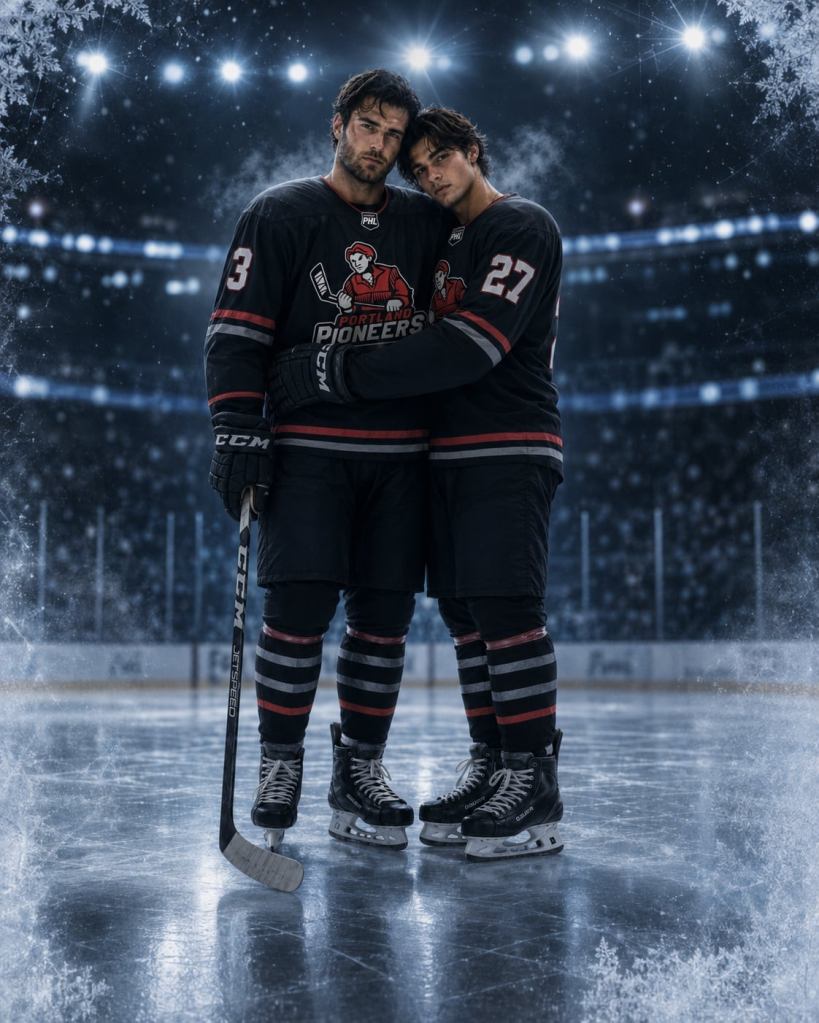
I have been sitting with this image for approximately twenty minutes and I cannot stop looking at it.

This is Deacon Worth and Konstantin Andropov. Number 43 and number 27. Portland Pioneers. My boys.

If you have been following along with the PHLu universe, you know Deke and Kon. You know the goal crease and the press conference and the year that changed everything and the specific, particular way these two found their way to each other on the ice and off it. You have lived inside their story with me. And now Paul — our incredible artist who has given visual life to all three of my universes — has given them a face.

I cannot tell you how close this is to what I saw when I wrote them. That is not a thing I expected to be able to say. You write a character and you have them in your head in the specific way that fictional people live in an author’s head — vivid and particular and entirely yours — and then someone else tries to render them and the gap between the interior version and the external version is usually where you learn to manage your expectations.

There is no gap here. None. This is Deke. This is Kon. The way they are standing, the way Kon is leaning in, the specific quality of how they are with each other — this is the book, made visible.

Isolated releases June 15.

Cover reveal June 5.

If you’d like to be notified the moment that cover drops — and I think you would like that, I think you would very much like that — watch this space. I am barely containing myself and I have known what the cover looks like.

You are going to love them. I already do, obviously. I have for quite some time.

🏒 — Bella

Meet The Worths

If you’ve spent any time in the PHLu universe, you’ve probably bumped into a Worth by now. They’re not exactly easy to miss.

Dalton Worth is the reason the Portland Pioneers exist. An ex-hockey enforcer who surprised everyone — possibly including himself — by transitioning into pairs figure skating, he met Aspen on the ice and never really recovered from it. She was the figure skater. He was the large man learning very quickly that grace was harder than aggression and that impressing this particular woman was going to require genuine effort. Reader, she married him anyway. Together they built a family, a legacy, and a part-ownership of one of the PHLu’s expansion teams, and if their children are anything to go by, they did not do any of that by half measures.

Because the Worth children are a lot. I say this with enormous affection. I also say it as someone who spent a great deal of time living in their heads, and I can confirm it is never quiet in there.

Peregrine and Bergen arrived first, because of course the Worth family started with twins. They’re 28 when our story opens, identical in face and absolutely not in personality, and they are the Portland Pioneers’ first line. If you want to understand why the expansion team punches as far above its weight as it does, start with these two. They’ve been skating together since before they could walk, finishing each other’s sentences and each other’s plays, and the chemistry between them on the ice is something opponents find genuinely unsettling.

Deacon and Sorrenson came next, a pair in the looser sense — same age cohort, very different orbits. Deacon is Portland’s starting goalie, the backbone of the team, the kind of presence between the pipes that makes coaches sleep better at night. Sorrenson looked at the family business, decided a little thing like gender wasn’t going to keep her out of it, and is currently head choreographer and lead performer of the Portland Wheelers — the Pioneers’ cheer team. She didn’t inherit the enforcer’s build but she absolutely inherited the enforcer’s stubbornness, and the Wheelers under her direction are something else entirely.

Anton and Hudson are the family’s gentle plot twist. Neither of them can skate. Not for lack of opportunity — the ice was always there — but some things simply don’t take, and what took for these two was story. Anton is in front of the camera on one of Portland’s hit television productions; Hudson is behind the scenes, writing for that show and several others, and between them they are quietly building toward something bigger — their own production company, because when you’re a Worth you don’t just participate in industries, you eventually try to own a piece of them. Both of them are somewhere on the spectrum and both of them are exactly who they’re supposed to be, and I love them unreservedly for it.

And then there is Grayson.

Seventeen when our story opens. The only singleton in a family that otherwise arrived in matching sets. He’s young and he knows it and he is trying very hard not to let anyone see how much he already understands about the game — because what Grayson Worth has, underneath the youth and the quiet watching, is the capacity to be a better goalie than Deacon.

Deacon knows it too.

That particular dynamic is going to be very interesting.

The Worths are the kind of family that fills a room before they’ve finished arriving — loud and warm and complicated and fiercely, sometimes overwhelmingly, devoted to each other. Writing them has been one of the great joys of the PHLu universe. Getting to know each of them has been a privilege.


One more thing about the Worths, because I feel it requires its own mention.

The shortest of the Worth children is Sorrenson. The girl. The one who choreographs and performs and has the kind of stage presence that makes audiences forget to breathe. Sorrie stands 5’11” and is, by some margin, the most compact member of her generation.

Her brothers range from 6’2″ to 6’7″. The tallest clears 6’8″.

Now. Here is where it gets interesting.

Dalton Worth — ex-enforcer, formidable human, the man who raised this small army of enormous children — is 5’11”. He and his tallest son see eye to eye only in the metaphorical sense. Aspen Worth, the woman whose genetics apparently decided to simply ignore the laws of probability, stands 5’4″.

Between them they have produced seven children, the shortest of whom matches Dad exactly and the tallest of whom could rest his chin on his mother’s head without technically trying.

I don’t have an explanation for this. Neither does anyone in the Worth family, though it has been the subject of considerable dinner table discussion over the years. Dalton maintains there must be someone tall in a previous generation somewhere. Aspen just looks at her children and laughs.

Grayson, who is seventeen and still growing, recently measured himself against Bergen and came away looking thoughtful.

Nobody mention it to Dalton. 🏒

— Bella

In Which I Have Thoughts About Hockey Shows

So this morning I finally sat down and watched Off Campus.

And I have to admit something that may get my hockey romance card revoked:

…I was kind of underwhelmed.

Not because it was terrible. It wasn’t. The production value was there. The budget was clearly there. Everybody was pretty. The hockey looked fine. On paper, this should have been exactly my thing.

But the entire time I was watching it, I kept finding myself comparing it to HR.

And unfortunately for Off Campus, HR exists.

Maybe if Off Campus had been the first modern hockey romance style show released, I would feel differently. Maybe I would have fallen completely in love with it. Maybe I would have been screaming into the void about locker room tension and emotionally unavailable men in compression shirts.

But instead, it arrived after something that already nailed the thing I personally think matters most in hockey romance:

chemistry.

Not just romantic chemistry either. Team chemistry. Friendship chemistry. Banter. Warmth. That feeling that these people genuinely exist together when the cameras stop rolling.

HR has charm in a way that feels almost accidental. Like lightning in a bottle. It feels lived in. Messy in the best way. The relationships feel textured and weird and human. Even the background interactions feel natural.

Off Campus, weirdly, felt more polished and somehow less alive.

And maybe that sounds unfair because objectively it probably is the “bigger” production. Better funded. Cleaner. More cinematic in places. But I kept waiting for it to click emotionally for me and it just… didn’t.

It almost felt like they had all the ingredients and somehow forgot seasoning.

I don’t even know if the issue is the writing. It might genuinely come down to casting chemistry. Hockey romance absolutely lives or dies on whether you believe these people would choose each other in every universe.

If I don’t buy the longing, the protectiveness, the “I would absolutely help you hide a body” energy, then the whole thing starts feeling like actors reading attractive dialogue at each other.

And the frustrating part is that there are glimpses in Off Campus where you can see the potential. Little flashes where I thought, oh there it is. Then it would disappear again under another overly polished scene that somehow forgot to feel.

The boys living in the dorm house almost had it.

That was the frustrating part.

There were moments — particularly during the training scenes — where you could feel the shape of the thing it could have been. The burpees, the exhausted chirping, the half-feral team energy, everybody existing in each other’s pockets twenty-four hours a day… for a second I thought, oh here we go. There it is.

And then somehow it just vanished somewhere between the motivational speeches and the bro hugs.

Which sounds ridiculous because I am absolutely the target audience for this kind of thing. Give me emotionally constipated hockey players living in a chaotic share house and I should be seated immediately with snacks and emotional investment.

But I kept wanting more texture.

More quiet affection.
More stupidity.
More loyalty.
More “this idiot is my family now.”
More moments where the audience gets to live with them instead of simply watching plot happen around them.

And honestly? I think that’s what I’m discovering I want from television in general these days.

I would not remotely complain if every scripted drama on the boob tube (good lord, am I showing my age with that phrase?) was one of the following:

  • hockey players navigating life and feelings badly
  • firefighters saving everybody while emotionally imploding
  • deeply repressed soldiers trying to figure out how to exist in normal society

Apparently that is my entire media diet now.

But I think the reason those stories work when they do work is because underneath all the action and conflict and dramatic music, they’re fundamentally stories about people choosing each other.

Found family.
Loyalty.
Protection.
Love in all its messy forms.

And maybe that’s why some modern shows leave me a little cold. Everything feels so determined to be high stakes all the time that nobody remembers to let the characters breathe together.

I don’t necessarily want less drama.

I just want more love.

More scenes where people cook dinner together.
More exhausted conversations at 2am.
More teammates showing up without being asked.
More “I’ve got you.”
More humanity.

The world is already exhausting enough. Let fictional people care about each other properly.

Also let them do it while wearing hockey gear.

Obviously.

Meet the McKenzies. Your Life is About to Get Complicated.

So. The PHL is going live June 15. You know that. You’ve marked your calendar. You’re ready.

But before the puck drops on the whole glorious league, I want to introduce you to the family at the heart of it all — because everything, and I mean everything in the McKenzie Legacy series starts with five Australian kids who looked at their futures and decided to chase them across the world, no matter what it cost.

Let me paint you a picture.

Five siblings. One family. Ambitions too big for one country to hold.

Three boys — identical triplets, because their parents clearly believed in doing things at scale — who grew up dreaming of ice. Of rinks. Of the NHL, or something like it. Of making it in the sport that had absolutely no business being the obsession of kids growing up in Australia, and yet. There they were. Obsessed. Determined. Entirely unstoppable.

And two girls — identical twins — who were born to skate, but not the way their brothers wanted to. Figure skating. Blades and music and the kind of precision that makes your throat tight when you watch it done perfectly. These two wanted it so badly, so completely, that they did something that still gets me right in the chest when I think about it: they gave up their Australian citizenship to compete for the country that could give them their dream.

Let that land for a moment.

Five kids. Five enormous futures. One family watching them all fly away, one by one, toward the lives they were built for.

The McKenzie Legacy is five books. Five love stories. Five characters who carry the weight of everything they left behind, and everything they’re still becoming.

And the first book?

The First Line.

🏒

Lachlan McKenzie. Captain. The kind of man who leads from the front and holds everything together and has absolutely no idea what to do when a woman walks into his orbit and refuses to be managed, organised, or tidily categorised.

Dr Sienna MacLeod. The woman in question. She has not read the memo about being tidily categorised, and she would like it known that she is very busy and does not have time for whatever this is.

I will be honest with you. When I imagine these two — when I see them in my head, which I have been doing for longer than I should probably admit — I see Thor and Merida.

You’re welcome.

He is, in every sense, built like a Viking who also somehow learned to skate. She is all fire and independence and she will absolutely shoot an apple off your head if you give her sufficient motivation. They are, on paper, a disaster. In practice — well. That’s what the book is for.

The First Line is the beginning. The McKenzie Legacy is the whole story — and once you’ve met this family, the triplets and the twins and all the love and loss and history they carry with them, I’ll be taking you somewhere very special.

To the team that sits at the shining heart of the entire PHLu.

The Portland Pioneers.

But first — Lachlan. And Sienna. And the moment everything starts.

June 15.

Cover reveal: May 31. Be there.

🏒 — Bella

It’s Happening. The Puck Drops June 15.

Okay. OKAY.

I have been waiting to write this post for longer than I care to admit, and now that the moment is here I have approximately forty-seven things to say and absolutely no idea which one to lead with, so let’s just go.

Hi. I’m Bella Bruce. I write hockey romance. Specifically, I write hockey romance set in the Premier Hockey League — the PHLu, if you want to sound like an insider, and you do, trust me — and on June 15, those books are going live.

I need you to understand what this means to me.

I need you to understand that I have been living inside this hockey universe for years. Years. I have populated it with teams and rosters and rivalries and love stories and families so large and interconnected that I have, on more than one occasion, needed a spreadsheet just to keep track of who is related to whom and whether they’ve already kissed. I have statistics for players who don’t exist. I have opinions about games that never happened. I once interrupted a family dinner to explain, in considerable detail, why the PHLu salary cap structure is actually more competitive than the NHL’s, and I can tell you with great confidence that this was not received with the enthusiasm it deserved.

My family is very patient. They are also very tired.

But here is the thing about building an entire hockey universe in your head over many years: eventually you have to let it out. Eventually someone reads it and tells you it’s good. Eventually you find yourself writing a blog post announcing that the whole glorious, chaotic, romance-soaked enterprise is about to land in front of actual readers, and you feel approximately like a player stepping onto the ice for game one and also like you might be sick.

Healthy. Very normal. Let’s continue.

Mark your calendars:

🏒 May 31 — Cover Reveal

Yes. We have covers. They are gorgeous and I have been sitting on them like a very smug hen and I cannot wait to show you. May 31. Be here.

🏒 June 15 — The PHLu Goes Live

The Premier Hockey League. The teams. The players. The families. The rivalries. The love stories that will, if I’ve done my job right, make you feel things in your chest that you were not expecting to feel about a fictional hockey league in which I have an embarrassing level of emotional investment.

If you love hockey, you’re going to love this.

If you love romance, you’re going to love this.

If you’ve ever watched a game and thought yes, but what if the star player was also falling catastrophically in love at the same time — welcome home. You have found your people. I am your people. Pull up a seat, grab a snack, and let me tell you about the PHLu.

My family, bless them, will probably not be joining us. They’ve heard enough.

But you?

You’re going to want to hear all of it.

See you May 31 for the reveal. 🏒

— Bella

Why Team Stories Feel Like Home

There’s a reason sports romance readers fall hard for team stories, even if they didn’t grow up watching a single game.

On the surface, these books are about hockey, football, baseball, or whatever sport the characters play. But the truth is, the sport is only the setting. The real story—the one that hits readers right in the chest—is about belonging.

Because team stories are about family.

Not the one you’re born into.

The one you choose.


The Locker Room Is Chosen Family

Every team has a locker room. A space that outsiders rarely see.

It’s loud. It’s chaotic. It smells faintly like tape and sweat and whatever someone microwaved five minutes before a meeting. But it’s also where something important happens: people who started as strangers slowly become a unit.

They learn each other’s habits.

Who tapes their stick three times before a game.
Who sits in the same stall every day.
Who always forgets their gear and borrows someone else’s.

They argue. They chirp. They shove each other in the hallway.

And somewhere along the way, those strangers become the people who know you best.

In sports romance, the locker room isn’t just background scenery.

It’s the heartbeat of the story.


Rituals Matter More Than You Think

Every team develops rituals.

The same playlist before every game.
The same diner after late practices.
The same terrible pre-game speech that somehow still works.

These rituals look small from the outside, but they do something powerful: they create stability.

Athletes live in high-pressure environments. Wins and losses can change everything. Careers can shift overnight. But the rituals—the music, the meals, the dumb superstitions—remain constant.

They say: You’re part of this.

And readers recognize that feeling.

Because most of us are looking for those small rituals too. The routines that make us feel like we belong somewhere.


Teasing Is the Language of Affection

One of the most recognizable elements of team dynamics is the teasing.

Someone gets roasted for a bad haircut.
Someone else gets chirped for a terrible playlist.
A rookie gets stuck carrying bags for a month.

On the surface, it looks like chaos.

But underneath it, there’s affection.

Teasing on a team is often a form of acceptance. It’s how players say you’re one of us now. The moment someone stops being polite and starts chirping you is often the moment you know you’ve been fully absorbed into the group.

Sports romance captures that dynamic beautifully.

The jokes.
The running gags.
The way teammates show up for each other when things get serious.

Readers fall in love with the romance—but they stay for the team.


The Desire to Belong

At its core, sports romance taps into a universal human desire: the need to belong somewhere.

Everyone wants a place where they’re expected.

Where someone notices if they don’t show up.

Where their presence matters.

Teams embody that idea in a very visible way. You can see it on the ice, on the field, on the bench. A team only works when every player is part of the system.

Remove one person and the structure changes.

That kind of belonging is powerful.

And it’s deeply comforting to read about.


Why Sports Romance Hits Harder Than Expected

Many readers come into sports romance expecting something light.

A fun story.
Some competitive banter.
Maybe a few locker room antics.

What they often find instead is something deeper.

Because sports romance isn’t just about two people falling in love.

It’s about finding a place where you’re accepted completely—strengths, flaws, and all.

It’s about teammates who become brothers.
Coaches who become mentors.
Fans who become community.

And sometimes, right in the middle of that found family, two people realize they’ve fallen in love.

Not despite the team.

But because of it.


Everyone Wants Somewhere They’re Expected

That’s the real magic of team stories.

They remind us that belonging doesn’t have to be complicated.

Sometimes it looks like a crowded locker room.

Sometimes it looks like a late-night team meal.

Sometimes it looks like a group chat that never stops buzzing.

And sometimes it looks like love growing quietly in a place where everyone already feels like family.

Because at the end of the day, most of us are searching for the same thing:

A place where we’re expected.

A place where someone saves us a seat.

A place that feels like home.

Creating a Home City: Using Setting as a Character in Your Hockey Universe

There’s a city I love that I have never been able to call home.

Portland, Oregon sits in that particular corner of my heart reserved for things that are yours in every way that matters and yet somehow just out of reach. I found it through a person — someone I love still, someone I will always love — and what we had was real and true and not quite possible to build into a life. The world we were navigating didn’t have the architecture for us. Same-sex marriage wasn’t yet a legal reality, and the immigration policies of both our countries had no interest in making exceptions for two women who had found something rare and were trying to hold onto it across an ocean. We loved each other. We still do. It just couldn’t be what we both wanted it to be.

So I did what writers do with the things they can’t keep. I made it into a world.

Portland became the home of my hockey universe for reasons that are practical and personal in equal measure. I have someone there I trust completely, someone who has been my eyes and ears and orientation on the ground for years — a person who will answer a text at an inconvenient hour to confirm whether a particular neighbourhood smells like coffee and rain or whether I’ve romanticised that detail from a visit I made years ago. The city just felt right in the way that only the truest creative decisions feel right — not chosen so much as recognised.

But here’s what I’ve learned from building an entire fictional NHL franchise in a city I love from a distance: setting is not backdrop. Setting is character. And if you treat it that way from the very beginning, it will do an enormous amount of your narrative work for you.


Your City Has a Personality, and You Need to Know It

The first question to ask yourself when choosing a home city for your hockey universe is not logistical. It’s not about whether the city could realistically support an NHL franchise or whether the climate makes sense for ice sports. Those things matter, but they’re secondary to a more fundamental question: what kind of city is this, and how does that shape the people who live there?

Every city has a personality. Not a stereotype — a genuine, textured set of values and rhythms and contradictions that residents recognise immediately and outsiders sense within hours of arriving. Portland’s personality is specific and deeply useful for fiction. It’s a city that takes its coffee seriously and its politics loudly, that has fierce civic pride alongside genuine social consciousness, that sits in landscape so dramatically beautiful it makes people feel things they weren’t prepared to feel. It’s a city that attracts people who chose it deliberately — not people who ended up there by default, but people who arrived with intention and stayed because it matched something in them.

That personality shapes my characters before I write a single word of their stories. A player who comes to Portland from a corporate, high-pressure hockey market and discovers he actually likes the farmers market and the independent bookshops and the weird little neighbourhood bar where the bartender knows his order by week three — that’s a character arc the city is generating for me, without me having to manufacture it artificially. The setting is doing the work.

Know your city’s personality. Not the travel brochure version. The real version, with its complications and contradictions and the things the locals find quietly embarrassing about the tourists. That’s the version that will make your world feel inhabited.


Specificity Is Everything

Here is the single most important craft principle when it comes to writing place: vague setting feels like no setting at all.

Readers can tell the difference between a city that has been researched and a city that has been gestured at. They can tell when an author has walked those streets — or found someone who has — versus when the setting is a named location with generic urban furniture arranged inside it. A coffee shop in a city you know is a specific place with a particular kind of chair and a view of a particular intersection and a barista who has an opinion about the neighbourhood’s changing character. A coffee shop in a city you don’t know is just a coffee shop.

This is where having someone on the ground is invaluable, and I don’t say that lightly. My Portland person has saved me from countless details I would have gotten wrong — not dramatically wrong, just slightly off in the way that readers who know the city would feel as a faint wrongness, a sense that something doesn’t quite sit right. The angle of the light in a particular season. Whether a character would realistically take that route between those two neighbourhoods. What the stadium district feels like on a game night when the streets are full and the air has that electric quality of collective anticipation.

If you’re writing a city you don’t know personally, find your person. Find someone who lives there and loves it and is willing to be your consultant. Writers’ communities are generous in this way — someone almost always knows someone. That relationship will improve your writing in ways that no amount of Google Street View research can fully replicate, because what you need isn’t images. It’s the felt sense of a place.


Let the City Create Conflict

Setting isn’t just atmosphere. In a well-built fictional world, the city actively generates conflict for your characters — and not just the obvious logistical conflict of traffic and weather and the difficulty of finding parking near the arena.

Portland’s geography, for instance, gives me conflict I didn’t have to invent. The city is divided by the Willamette River into east and west, and those two sides carry distinct personalities and different costs of living. A veteran player who can afford the established west side neighbourhoods exists in a different Portland than the rookie on an entry-level contract scrambling to find something decent in a rapidly gentrifying east side neighbourhood. Their city is the same city but it isn’t, and that difference in experience creates immediate character texture and potential for connection across difference.

The weather is conflict. Portland’s famous grey, wet winters are not just atmospheric backdrop — they’re an active presence that shapes how people move through the city, how they feel in their bodies, how they relate to seasons and light and the particular joy of a rare clear day in February when the mountain appears on the horizon like a gift nobody ordered. A character who grew up in a sun-saturated climate and arrives in Portland for their first November is having an experience that tells you something about their adaptability and their relationship with discomfort.

Ask yourself: what does my city do to people who aren’t expecting it? What does it do to people who chose it? How does it reward loyalty and resist certain kinds of ambition? The answers are your conflict.


The Arena as the City’s Heart

In a hockey romance universe, the arena occupies a special place in your city’s geography. It’s not just a venue — it’s the place where your city’s collective emotional life gets expressed in its most concentrated form. On game nights, the arena is where the city becomes briefly unified, where strangers share a language and a purpose and the particular intimacy of wanting the same thing at the same time.

Think carefully about where your arena sits in the urban landscape. Is it downtown, embedded in the heartbeat of the city, surrounded by bars and restaurants that live and die on game nights? Is it on the edge of the city, requiring a deliberate journey that becomes part of the ritual? What does the neighbourhood around it look like, and what does the contrast between that neighbourhood on a game night versus a Tuesday morning in February tell your reader about the role hockey plays in your fictional community?

The arena and the city should feel inseparable. The arena is where your team lives. The city is what your team represents. When your players skate out for a home game, they’re carrying something of the place on their shoulders — the pride, the expectation, the history. That weight is only meaningful if you’ve made the city real enough to generate it.


Your City Will Tell You Things You Didn’t Know You Needed

This is the part I didn’t expect when I started building Portland as the home of my universe, the part that still surprises me even now with 58 books mapped out and a series bible that has taken on a life of its own.

The city tells you things.

When you know a place well enough — when you’ve loved it long enough, researched it deeply enough, talked to the right people about the right corners of it — it starts to generate story without you asking. A neighbourhood you chose for purely practical plot reasons turns out to have a history that becomes thematically perfect. A weather pattern you included for atmosphere becomes a metaphor you didn’t plan. A geographical feature that just seemed like good description ends up being exactly the right place for a scene you didn’t know you needed.

I think this happens because real places have an integrity that invented places have to work harder to achieve. When you’re drawing on something true, that truth has roots — and those roots go deeper than you can consciously map. Portland’s particular combination of natural beauty and urban grit and fierce independent spirit has shaped my characters in ways I’m still discovering, three series deep into a universe that started with a love story I couldn’t keep.

I couldn’t build a life there. But I could build a world.

And it turns out that worlds, unlike lives, have no immigration restrictions. Mine is open to everyone.


Your home city is not the place where your story happens. It’s the reason your story happens the way it does, with these particular people, in this specific emotional register. Choose it with your whole heart. Research it until it feels like memory. Love it like it’s yours.

Because the best fictional cities always are.

Why Romance? An Unapologetic Defence

People ask me sometimes, with a particular tilt of the head that I have learned to recognise, why I write romance. The tilt says: you seem like a reasonably intelligent person. You seem like someone with opinions and complexity and a working knowledge of the world. And yet. The tilt is not always unkind. It is just confused. And I understand the confusion, I do, because I have spent enough years in the world to know that romance as a genre has been condescended to for as long as it has existed, which is ironic given that it is one of the most widely read and most emotionally demanding forms of fiction there is. But I am getting ahead of myself.

The real answer to why I write romance is not a manifesto. It is a book. A specific book, in a specific series, found at a specific moment in 1981 when I was at exactly the right age to be permanently altered by it.

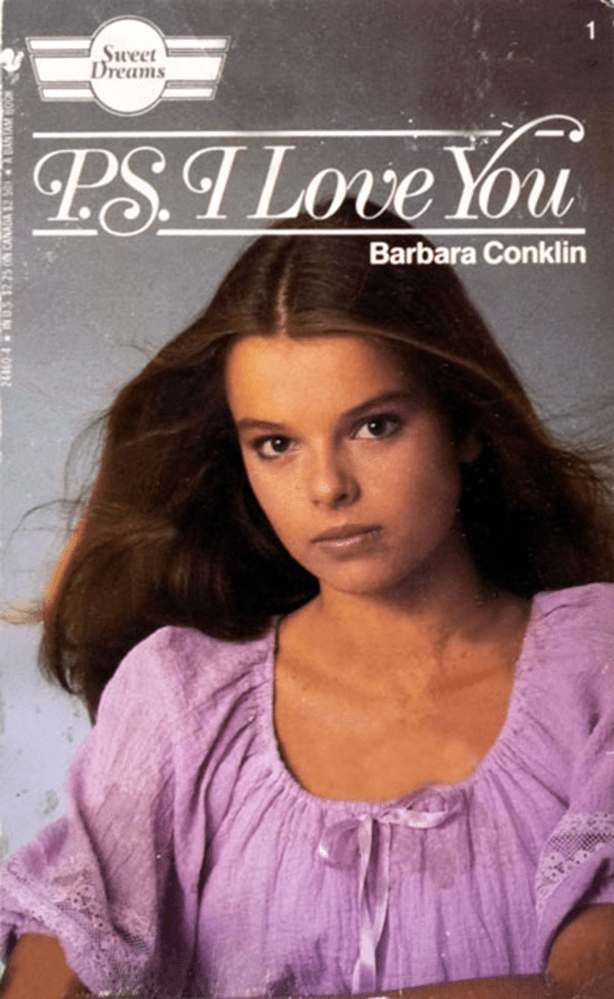
The Sweet Dreams series. If you were a certain kind of reader at a certain kind of age in the early eighties, you know exactly what I mean. Slim paperbacks with illustrated covers, girls with feathered hair and earnest expressions, the particular promise of a story that understood — completely, without condescension — that the feelings you were having were real and enormous and deserved to be taken seriously. The second book in the series was called P.S. I Love You, written by Barbara Conklin, and I picked it up and I did not put it down and when it was over something had shifted in me that has never shifted back. From the first page I was gone. Not just into that story, but into the understanding that this — this thing, this particular alchemy of character and feeling and the beating heart of a relationship finding its shape on the page — was what I wanted to do. What I had always wanted to do, if I am honest, because I had always known I wanted to write. Barbara Conklin just told me what.

So I wrote. For years I wrote. For decades, if we are being accurate, which we may as well be at this point in my life. I filled notebooks — not a notebook, not a shelf of notebooks, but a library’s worth, a accumulation of manuscripts that lived in those pages and nowhere else, stories that got the considerable benefit of my developing craft and the considerably less glamorous fate of never being read by anyone but me. This is not, I want to be clear, a sad story. Every single one of those notebooks was an apprenticeship. Every character I tried and failed and tried again to make real was teaching me something I would eventually need. The notebooks were not wasted. They were, with hindsight, entirely the point. You cannot rush the becoming of a writer. You can only do the work and wait for the work to become what it needs to be.

What it needed, as it turned out, was a box set.

I am not going to tell you exactly how old I was in 2014, because I have described myself as a crotchety old lady — well, not that old, I want to stress, merely older than the characters I write, which is the particular occupational circumstance of an author whose cast skews towards the improbably young and athletic — but what I will tell you is that by 2014 I had been loving ice hockey for the better part of three decades and writing romance in those notebooks for nearly as long, and somehow it had not yet occurred to me that these two central facts of my life could occupy the same sentence.

And then I found the Portland Storm series by Catherine Gayle.

A box set. Hockey romance. Hockey romance. A genre that existed, that had novels attached to it, that had been written with the specific understanding that the world of professional ice hockey was not just a backdrop but a character in itself — the culture of it, the physicality, the particular brotherhood of a locker room, the strange, suspended life of a season. I read it and something clicked into place with an almost audible sound. Not just I want to write this, but this is what I have always been writing, I just didn’t have the right ice yet.

My genre, it turned out, had been waiting for me to find it. It had not been waiting patiently — nothing about hockey is patient — but it had been waiting. And once I found it, everything that had come before made a different kind of sense. All those notebooks. All those years of learning to write character and emotion and dialogue and the particular tension of two people finding their way to each other through whatever obstacle the story puts between them. I had been training for this. Barbara Conklin started it in 1981 and the Portland Storm finished the thought in 2014, and everything in between was just the work, accumulating quietly, waiting for the moment it would know what it was for.

So why romance? Because it takes human emotion — the biggest, most ungovernable, most fundamentally important thing we experience — and treats it as worthy of serious artistic attention. Because a love story done well is not soft or simple or slight. It is an act of tremendous faith in the capacity of people to find each other, to choose each other, to be changed by each other in ways that matter. Because the Happy Ever After is not a capitulation to fantasy but a statement of intent: that joy is possible, that connection is real, that the effort of opening yourself to another person can be worth every terrifying moment of the attempt.

And because, if you are very lucky, your genre finds you the way mine found me. On the ice, where it always should have been.

But the evolution from finding my genre to truly inhabiting it took longer than a single moment of recognition, and longer than I can fully explain in one post. It required something I hadn’t entirely anticipated: navigating my own psychology around what it meant to build a fictional world inside a sport that already has a real one.

The NHL exists. It is vast and complex and full of real people with real careers and real lives, and I had to sit with the question of what it meant to write fiction inside that reality, or adjacent to it, or — as I eventually understood was the only honest answer — beside it entirely. My league is not the NHL. It looks like the NHL, breathes like the NHL, operates on the same rhythms and pressures and geography of professional ice hockey in North America. But it is its own thing, fully and completely. The Premier Hockey League.

And when I say fully, I mean it in a way that might alarm you if you knew the extent of it.

Every team has an arena. Every team has a full roster, a coaching staff, a front office, a training staff, a building full of people who show up every day because this is their livelihood and their life. Every player has a family. Every player has a history that existed before the story you are reading began and will continue after it ends. The world did not come into being on page one. It was already there, already running, already full of people going about the business of their complicated lives when the story decided to pay attention to one particular corner of it.

Some of those people are lucky. Their story gets told. You, the reader, get to know them as well as I do — their fears and their loyalties and the specific way they love, the history they carry, the future they are stumbling towards. You get to live in their heads for a few hundred pages and come out the other side knowing them the way you know a friend.

But here is what I need you to understand about the ones you only glimpse: the player who appears in a single scene, the team-mate who says two lines and is gone, the figure in the background of someone else’s story. I know exactly who they are. I know where they came from and where they are going and how they fit into the larger architecture of this world. I know which story is theirs and when it will be told. Nothing is incidental. Nobody is furniture. Every fleeting presence you encounter in these books exists in full, in my head, waiting for the moment the narrative turns in their direction and says: now. It’s your turn now.

That is the league. That is the world. It has taken years to build and is not finished yet and, truthfully, I suspect it never will be, because that is the nature of a living world — it keeps growing, keeps surprising you, keeps producing people who tap you on the shoulder and make clear that they have something to say and you had better be ready to listen.

So. I have told you how it started — a Tasmanian girl, a Sweet Dreams novel, a miracle in Lake Placid, a box set that changed everything. I have told you what I write and why and the particular madness of building a universe from the ice up.

Now there is only one question left. Are you ready to explore the Premiere Hockey League with me?

Snow Business: A Completely Unreasonable Love for the Winter Olympics

I live in rural Tasmania. Tasmania, Australia. A place that, I will grant you, has more claim to cold weather than most of the country — we are closer to Antarctica than we are to the equator, and there are mornings here that have genuine bite to them, mornings where you can see your breath and the paddocks are stiff with frost. So in that sense, I am ahead of most Australians. But snow? Actual, lying-on-the-ground, Winter-Olympics-calibre snow? That is largely not our reality. The highlands can manage it, occasionally, briefly, with the air of something doing you a favour it wasn’t entirely sure about. Down where I am, we get the cold without the compensation. We are, at the end of it, still an island hanging off the bottom of a continent that considers a cold snap a personality disorder.

And yet, every four years, I become completely unhinged about the Winter Olympics. And I mean that literally. I go nocturnal. For fourteen days I rearrange my entire existence around a television schedule being dictated by a time zone with no interest in my wellbeing whatsoever. I watch things at two in the morning. I watch things at four. I surface briefly into daylight, blinking, to attend to the basic requirements of life, and then I go back to the ice. My family and friends have come to understand that this is simply who I am for a fortnight every four years. They are very patient people.

It started — as so many defining passions do — at a precise, identifiable moment. Lake Placid, 1980. I was watching the Winter Olympics with the particular attention of someone who had not yet been fully claimed by them, and then two things happened that settled the matter permanently.

The first was the Miracle on Ice. If you know, you know. If you don’t: a group of young American college players, assembled by the extraordinary Herb Brooks, went up against the Soviet Union — a machine of a team that had dominated international hockey for years, a team of seasoned professionals playing with the kind of cold collective excellence that seemed almost inhuman — and they won. 4-3. In a game that had no business going the way it did, in front of a crowd that lost its collective mind, in a moment that transcended sport so completely that people who have never watched a hockey game in their lives know exactly what you mean when you say the Miracle on Ice. I was watching. I have never forgotten it. I have, frankly, never fully recovered from it.

The second was Robin Cousins. The British figure skater who took gold in the men’s event with a quality of skating that I — a child from Queensland with no particular frame of reference for what excellence on ice looked like — nonetheless understood immediately and completely was something extraordinary. The elegance of him. The apparent ease that concealed everything it cost. I sat in front of that television and thought: I need to see more of this. And that was that. I was hooked, thoroughly and permanently, and every four years I honour that commitment with the full dedication it deserves, which is to say: all of it, all the sports, all the hours, regardless of what the clock says.

I won’t pretend I don’t know why ice hockey sits at the absolute centre of it all. What Lake Placid started, the years that followed deepened into something that has become genuinely, thoroughly, central to my life in ways I could not have predicted sitting in front of that television as a child. I follow the NHL the way my countrymen follow the AFL or the NRL — with the bone-deep, slightly irrational, entirely non-negotiable devotion that Australians reserve for their codes. My team is the Washington Capitals, and I carry them the way a Geelong supporter carries the Cats or a Queenslander carries the Broncos: with pride, with occasional agony, with the unshakeable conviction that this is simply part of who I am now and there is no point questioning it.

It has gone further than that, even. Ice hockey has wound itself so thoroughly into my imagination that I write romance novels set in its world — stories about the lives that happen off the ice, the loves that form in locker rooms and hotel corridors and the long strange geography of a season, the particular emotional texture of a life built around a game. The sport gave me a passion and then, in a way I find both surprising and completely inevitable, it gave me my creative life as well. Not bad for something I discovered because a group of college kids beat the Soviets in upstate New York when I was young enough for it to feel like magic.

Because here is what ice hockey does that I have never been able to adequately explain to someone who hasn’t felt it: it is fast in a way that bypasses your brain entirely and goes straight to your nervous system. The puck moves as if it has its own agenda entirely independent of the players supposedly controlling it. The hits are seismic. The skill, when it surfaces, is breathtaking — a between-the-legs pass, a save that shouldn’t be physically possible, a goal scored in the quarter-second gap between a goaltender moving and the shooter reading that movement. And underneath all of it, always, is the ice. The particular quality of sound and light and speed that only exists in that environment. I grew up without it and I have loved it my entire adult life, which tells you something about the way sport can reach across any distance if it finds you at the right moment.

But the Winter Olympics are bigger than any one sport, and ice hockey — much as I love it — is not the whole story. Not even close.

The biathlon, for instance, is an event that should not work as spectacle but is utterly riveting. Cross-country skiing is, I think most people would admit, not obviously thrilling to watch. And yet the moment you combine it with rifle shooting — which is exactly as unhinged an idea as it sounds — something magical happens. The drama of athletes arriving at the range with heart rates in the stratosphere, forced to slow their breathing, to find stillness inside the physical chaos of their own bodies, and then to shoot with precision while everything in them is screaming otherwise. It is a metaphor for something, I am sure of it. I am not sure what. But I watch every race.

The sliding events — bobsled, luge, skeleton — terrify and entrance me in equal measure. These are sports in which human beings lie down on what is essentially a tea tray and hurl themselves down a tube of ice at speeds that no sensible person has any business travelling. The skeleton athletes go head first. I cannot overstate how much I think about this. They have seen the track. They know what is coming. And they point their face at it and push off anyway. If that is not a lesson in something, I don’t know what is.

I will not linger on the big air events except to say that I watch them through my fingers, that I am in a constant state of low-level horror for the duration, and that I have tremendous respect for every single athlete who stands at the top of a ramp the size of a small office building and simply decides to go. That is a category of human being I cannot fully comprehend and admire enormously from a very safe distance, preferably indoors, preferably with something warm to drink.

Figure skating, in all its forms — singles, pairs, ice dance — remains among the most beautiful things that sport produces, and Robin Cousins made sure I understood that before I was old enough to know how rare it was. There is a particular quality to the best figure skating performances, a moment when the technical and the artistic collapse into each other so completely that you forget you are watching something that requires extraordinary physical training and simply feel as though you are watching someone feel something, publicly, on ice, in sequins. Ice dance in particular operates on a frequency that is entirely its own. The intimacy of it. The way two people can communicate an entire relationship through how they hold each other in motion. I find it genuinely moving and I have done since 1980, and I refuse to be embarrassed about that.

But curling. Curling.

Here is where I must be honest with you. My love of curling is not rational. It does not require me to hold my breath in fear or clutch a cushion to my chest or say things like “oh no oh no oh no” at the television. It is, on its surface, a sedate sport. Rocks are thrown. People sweep. Enormous amounts of strategy are involved. Ends are played. Points are counted. And I am riveted from the first end to the last, in a way that I find difficult to explain to people who have not yet been converted and fully intend to keep trying to explain anyway.

There is something about the psychology of curling — the way every shot opens up or closes down possibilities several ends in advance, the way a team has to hold its nerve and its patience simultaneously — that I find completely absorbing. The communication between skip and sweepers. The read of the ice. The fact that it looks almost gentle and contains within that gentleness an extraordinary amount of competitive intensity. I have been known to watch the mixed doubles at three in the morning, sitting in a dark and very quiet Tasmanian lounge room, absolutely locked in, because the time zone does not care about my schedule and neither, frankly, does curling.

If you have never given the Winter Olympics a proper chance — if you have scrolled past it, assumed it wasn’t for you, told yourself you don’t understand enough of the sports — I am here to tell you that understanding is not the entry requirement. Curiosity is. Start anywhere. Start with the biathlon, or the ice dance, or the terrifyingly beautiful chaos of the big air final. Or start with curling, and watch what happens.

And if you really want to understand how someone from an island at the bottom of the world ended up here — writing novels about hockey players, losing sleep over Washington Capitals games, watching curling in the small hours with her whole heart committed to all of it — find footage of Lake Placid 1980. Watch the Miracle on Ice. Watch Robin Cousins skate.

You’ll understand immediately. I promise you that.