
People ask me sometimes, with a particular tilt of the head that I have learned to recognise, why I write romance. The tilt says: you seem like a reasonably intelligent person. You seem like someone with opinions and complexity and a working knowledge of the world. And yet. The tilt is not always unkind. It is just confused. And I understand the confusion, I do, because I have spent enough years in the world to know that romance as a genre has been condescended to for as long as it has existed, which is ironic given that it is one of the most widely read and most emotionally demanding forms of fiction there is. But I am getting ahead of myself.
The real answer to why I write romance is not a manifesto. It is a book. A specific book, in a specific series, found at a specific moment in 1981 when I was at exactly the right age to be permanently altered by it.
The Sweet Dreams series. If you were a certain kind of reader at a certain kind of age in the early eighties, you know exactly what I mean. Slim paperbacks with illustrated covers, girls with feathered hair and earnest expressions, the particular promise of a story that understood — completely, without condescension — that the feelings you were having were real and enormous and deserved to be taken seriously. The second book in the series was called P.S. I Love You, written by Barbara Conklin, and I picked it up and I did not put it down and when it was over something had shifted in me that has never shifted back. From the first page I was gone. Not just into that story, but into the understanding that this — this thing, this particular alchemy of character and feeling and the beating heart of a relationship finding its shape on the page — was what I wanted to do. What I had always wanted to do, if I am honest, because I had always known I wanted to write. Barbara Conklin just told me what.
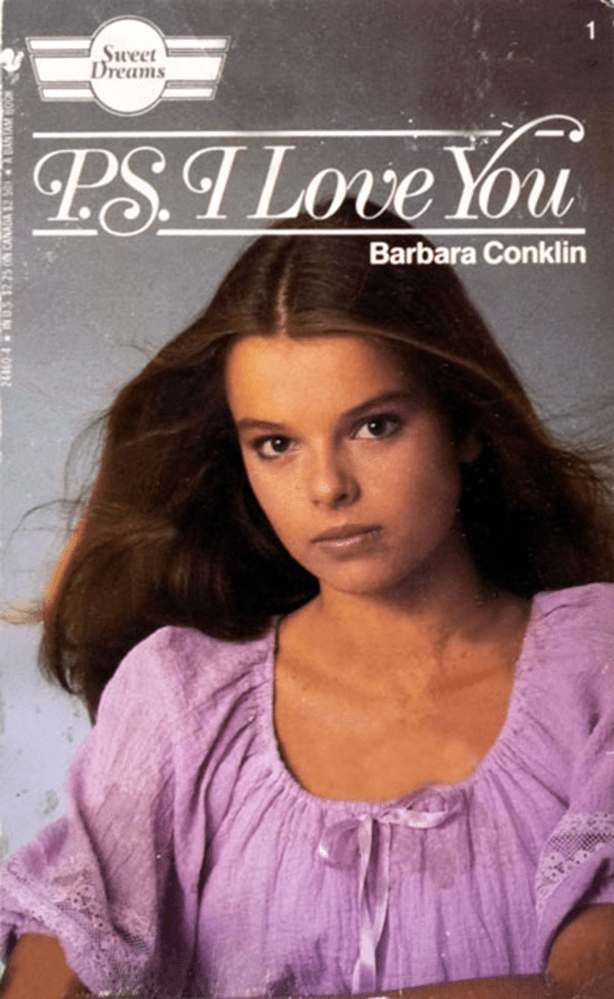
So I wrote. For years I wrote. For decades, if we are being accurate, which we may as well be at this point in my life. I filled notebooks — not a notebook, not a shelf of notebooks, but a library’s worth, a accumulation of manuscripts that lived in those pages and nowhere else, stories that got the considerable benefit of my developing craft and the considerably less glamorous fate of never being read by anyone but me. This is not, I want to be clear, a sad story. Every single one of those notebooks was an apprenticeship. Every character I tried and failed and tried again to make real was teaching me something I would eventually need. The notebooks were not wasted. They were, with hindsight, entirely the point. You cannot rush the becoming of a writer. You can only do the work and wait for the work to become what it needs to be.
What it needed, as it turned out, was a box set.
I am not going to tell you exactly how old I was in 2014, because I have described myself as a crotchety old lady — well, not that old, I want to stress, merely older than the characters I write, which is the particular occupational circumstance of an author whose cast skews towards the improbably young and athletic — but what I will tell you is that by 2014 I had been loving ice hockey for the better part of three decades and writing romance in those notebooks for nearly as long, and somehow it had not yet occurred to me that these two central facts of my life could occupy the same sentence.
And then I found the Portland Storm series by Catherine Gayle.
A box set. Hockey romance. Hockey romance. A genre that existed, that had novels attached to it, that had been written with the specific understanding that the world of professional ice hockey was not just a backdrop but a character in itself — the culture of it, the physicality, the particular brotherhood of a locker room, the strange, suspended life of a season. I read it and something clicked into place with an almost audible sound. Not just I want to write this, but this is what I have always been writing, I just didn’t have the right ice yet.
My genre, it turned out, had been waiting for me to find it. It had not been waiting patiently — nothing about hockey is patient — but it had been waiting. And once I found it, everything that had come before made a different kind of sense. All those notebooks. All those years of learning to write character and emotion and dialogue and the particular tension of two people finding their way to each other through whatever obstacle the story puts between them. I had been training for this. Barbara Conklin started it in 1981 and the Portland Storm finished the thought in 2014, and everything in between was just the work, accumulating quietly, waiting for the moment it would know what it was for.
So why romance? Because it takes human emotion — the biggest, most ungovernable, most fundamentally important thing we experience — and treats it as worthy of serious artistic attention. Because a love story done well is not soft or simple or slight. It is an act of tremendous faith in the capacity of people to find each other, to choose each other, to be changed by each other in ways that matter. Because the Happy Ever After is not a capitulation to fantasy but a statement of intent: that joy is possible, that connection is real, that the effort of opening yourself to another person can be worth every terrifying moment of the attempt.
And because, if you are very lucky, your genre finds you the way mine found me. On the ice, where it always should have been.
But the evolution from finding my genre to truly inhabiting it took longer than a single moment of recognition, and longer than I can fully explain in one post. It required something I hadn’t entirely anticipated: navigating my own psychology around what it meant to build a fictional world inside a sport that already has a real one.
The NHL exists. It is vast and complex and full of real people with real careers and real lives, and I had to sit with the question of what it meant to write fiction inside that reality, or adjacent to it, or — as I eventually understood was the only honest answer — beside it entirely. My league is not the NHL. It looks like the NHL, breathes like the NHL, operates on the same rhythms and pressures and geography of professional ice hockey in North America. But it is its own thing, fully and completely. The Premier Hockey League.
And when I say fully, I mean it in a way that might alarm you if you knew the extent of it.
Every team has an arena. Every team has a full roster, a coaching staff, a front office, a training staff, a building full of people who show up every day because this is their livelihood and their life. Every player has a family. Every player has a history that existed before the story you are reading began and will continue after it ends. The world did not come into being on page one. It was already there, already running, already full of people going about the business of their complicated lives when the story decided to pay attention to one particular corner of it.
Some of those people are lucky. Their story gets told. You, the reader, get to know them as well as I do — their fears and their loyalties and the specific way they love, the history they carry, the future they are stumbling towards. You get to live in their heads for a few hundred pages and come out the other side knowing them the way you know a friend.
But here is what I need you to understand about the ones you only glimpse: the player who appears in a single scene, the team-mate who says two lines and is gone, the figure in the background of someone else’s story. I know exactly who they are. I know where they came from and where they are going and how they fit into the larger architecture of this world. I know which story is theirs and when it will be told. Nothing is incidental. Nobody is furniture. Every fleeting presence you encounter in these books exists in full, in my head, waiting for the moment the narrative turns in their direction and says: now. It’s your turn now.
That is the league. That is the world. It has taken years to build and is not finished yet and, truthfully, I suspect it never will be, because that is the nature of a living world — it keeps growing, keeps surprising you, keeps producing people who tap you on the shoulder and make clear that they have something to say and you had better be ready to listen.
So. I have told you how it started — a Tasmanian girl, a Sweet Dreams novel, a miracle in Lake Placid, a box set that changed everything. I have told you what I write and why and the particular madness of building a universe from the ice up.
Now there is only one question left. Are you ready to explore the Premiere Hockey League with me?

