Two weeks. Send Help.

Two weeks.

Fourteen days. Three hundred and thirty-six hours, give or take, depending on what time you’re reading this and whether my grasp on the space-time continuum holds up, which frankly I wouldn’t bet on right now.

Isolated releases in two weeks and I have feelings about this. I have so many feelings about this that they have taken up all available storage space and are now apparently spilling out into a blog post at — I’m not going to tell you what time it is. It’s fine. Everything is fine.

Here is what I know: I am confident about this book.

I want to say that clearly and mean it, because it’s true and because I think it matters to say true things even when the rest of your brain is staging a complete carnival. Deacon Worth and Konstantin Andropov are two of my favourite people — not characters, people, because if you’ve been here for five minutes you know that’s how this works — and I have given them everything I have.

But I want to tell you something about how long this has actually been.

  1. That’s when Kon first came to me. Fifteen years ago. Fifteen years of knowing the Worth family, of knowing beautiful, complicated, resilient Kon — which means that what you’re getting in two weeks is not a book I wrote recently and released into the world while the ink was still metaphorically drying. It is fifteen years of a person becoming fully himself on the page.

When Kon first arrived he was already carrying so much. He was being beaten by his father back in Russia. He was trapped inside a system that outed him at a team function — not his choice, not his moment, just the world deciding it owned something that was his to give — and his father’s response was to send him away to the US with bruises and a message that he was a disappointment. Not that he was dead to him. Not quite that. But that he had failed some fundamental expectation, and that was that.
That is where Kon begins. That is what he is carrying when he meets Deke.

And then he keeps going. Because that is what Kon does — he keeps going, through everything, changing and growing and finding himself in ways that fifteen years of writing him have let me witness like watching someone you love become more fully who they were always supposed to be. He has been through so much since those early days. He has shed things and gained things and broken and healed and I have been there for every version of him, and every version has mattered.

I know him down to the marrow. I know what Deke’s hand on his face means to someone who learned early that hands could hurt. I know what as equals costs him to say and what it costs Deke to hear. I know the specific quality of Kon’s courage, which is not the loud kind but the kind that keeps going quietly in the dark without any guarantee of light at the end.

I believe in this book completely.

I am also nervous as absolute hell and I cannot find the off switch for that particular feeling no matter where I look.

And I’ve decided that’s okay. Confidence and nerves are not opposites. They live together, apparently — the confidence saying this is real and it’s good and people are going to feel it, and the nerves trailing off into a low ambient frequency of but what if that doesn’t really resolve into words. I’ve been trying to reign the nerves in for two weeks and I’m done. They have unpacked. They have booked the full fortnight. I’m going to let them stay and focus instead on the thing that matters more.

Somewhere out there are readers who don’t know yet that Kon exists. Who don’t know about the boy who was beaten and outed and sent away and chose, anyway, to hope. Who don’t know what it looks like when fifteen years of knowing someone finally gets to become a book.

I cannot wait for them to know.

Two weeks. I’ll be over here, alternating between serene certainty and low-grade chaos, if anyone needs me.

— Bella 🏒
On Writing Tenderness Between Men

I want to talk about something that comes up more than it should, which is the idea that tenderness between men requires explanation.

It doesn’t. But here we are, and since we’re here I’m going to make the case as plainly as I can.

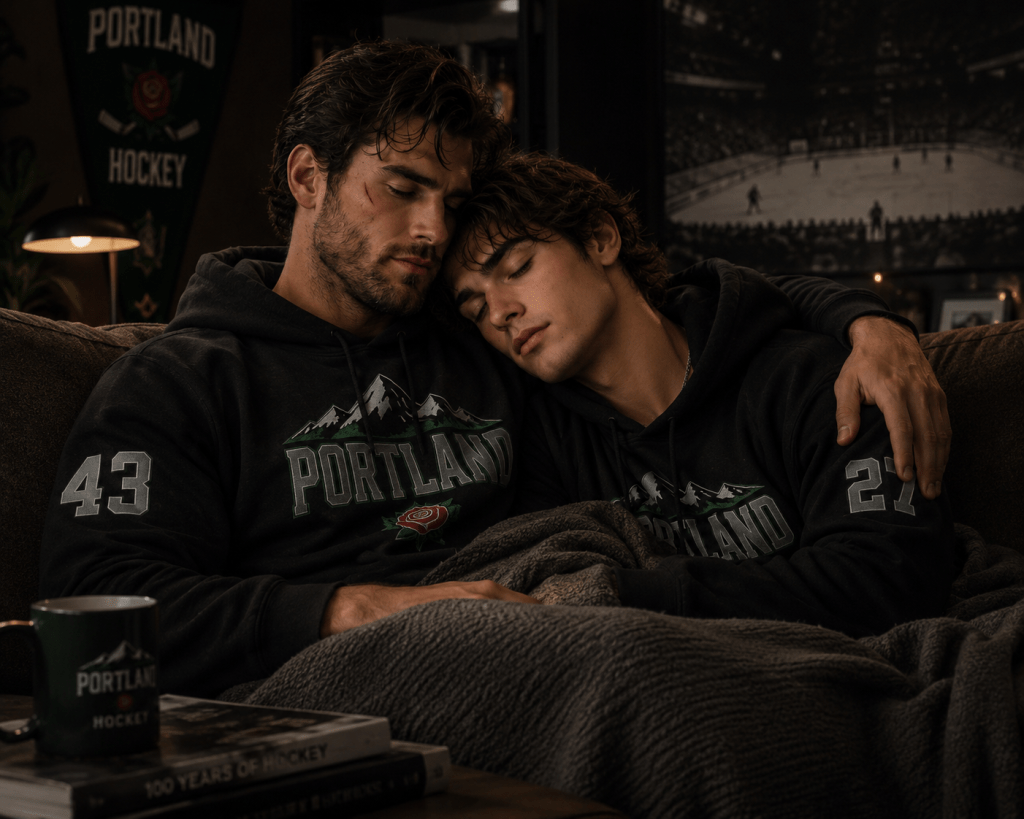
Men are tender. Real men, actual men, the men who exist in the world outside of fiction — they are tender with their children, with their elderly parents, with the people they love who are hurting. They bring cups of tea without being asked. They sit with someone in the dark. They know, without being told, when what’s needed is a hand on the back rather than a solution. Nobody bats an eye at any of this, and rightly so.

So why, the moment two men love each other, does tenderness become something that apparently needs to be justified?

I’ve thought about this a lot, because I write men loving men and I write them the way I believe them to be — which is fully human, with the full range of what that means. Deacon Worth does not become a different person because the love of his life is Konstantin Andropov rather than a woman. He is still a Worth, still led by his heart before his head has a chance to object, still capable of touching someone’s face with a tenderness that costs him nothing and means everything. That is who he is. The gender of the person receiving that tenderness doesn’t change it.

Because here is what I know about the men I write: they are not tender despite being the men they are. They are tender because of it. Because they have chosen, consciously or not, to reject the premise that strength and gentleness cannot occupy the same person at the same time. They are strong men who have simply never accepted the idea that tenderness is something to be rationed or hidden or ashamed of. The ones who have been hardened by the world — and some of mine have been hardened considerably — love with a quietness and a specificity that would undo you if you saw it up close.

What I’m really writing, when I write tenderness between men, is perspective. The perspective of a man who looks at the person he loves — this specific person, this face, these hands, this complicated and particular human being — and feels something that expresses itself gently. Not because he’s performing sensitivity. Not because the genre demands it. But because that is what love does when it’s paying attention. It notices. It takes care. It shows up in the small gestures that accumulate over time into something enormous.

That is not a female experience. That is not a male experience. That is a human experience, and my men get to have it, and I will not be writing them any other way.

They love who they love. They love them tenderly. That’s the whole story.

— Bella 🏒

On Found Family and the Teams We Build

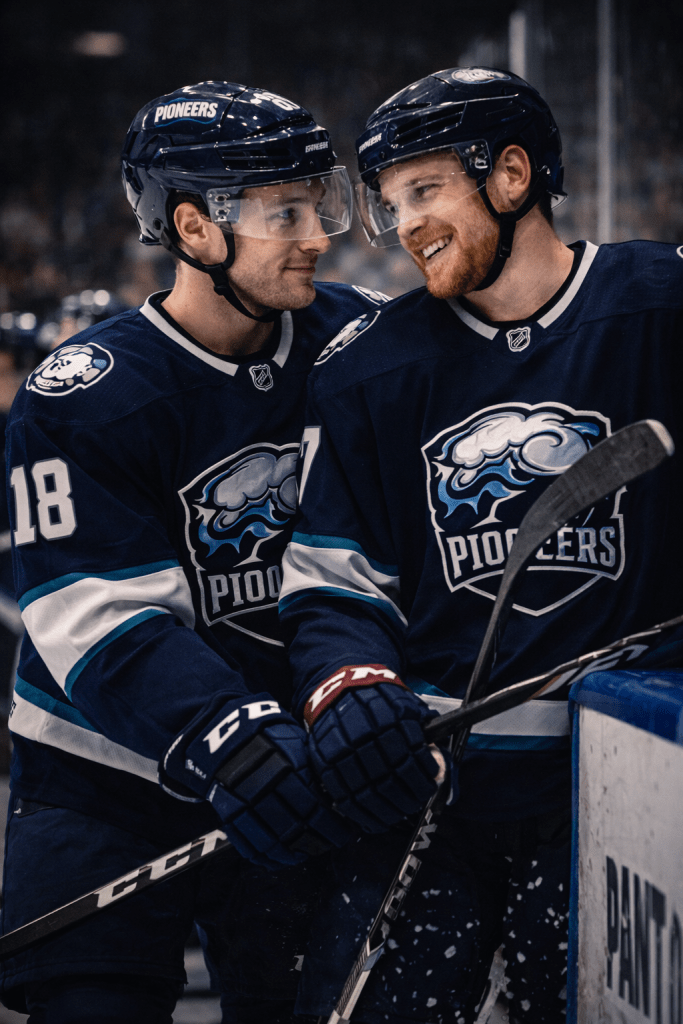
One of the things I love most about writing hockey romance is the thing that was true about hockey long before I started writing it: the team is always, already, a family.

Not always a comfortable one. Not always a quiet one. Families rarely are. But a family in the truest sense — people who did not choose each other initially and who, through the specific alchemy of proximity and pressure and shared purpose, become something to each other that has no cleaner name than that.

The PHL has its blood families, of course. Brothers who came up through the same system, who learned to skate in the same backyard, who ended up on the same roster because the talent ran in the same veins. Fathers whose sons are now playing the game they played a generation before, sometimes for the same organisation, sometimes facing each other across a faceoff dot with the specific complicated weight of all that history between them. Those stories are real and they are rich and they are part of the fabric of the league.

But they’re only part of it.

What gets me every time — what got me long before I started building the PHLu universe, when I was just a reader falling in love with this sport — is the found family. The one that forms inside a locker room and on a bench and on a bus between cities at two in the morning. The one that happens because these men spend more time together than they spend with the people who chose them by love or marriage or blood. You cannot be that present in each other’s lives without becoming something. The question is only what shape the something takes.

Sometimes it’s the veteran who takes the rookie under his wing and teaches him how to survive the league and doesn’t say a word about it to anyone. Sometimes it’s the line that develops the specific shorthand of people who have been reading each other’s bodies on the ice for long enough that the communication happens below language. Sometimes it’s the goalie and his defense, who have a relationship that the rest of the team watches and cannot fully explain and does not try to.

And sometimes — and this is the one that breaks my heart open in the best possible way — you find the small family within the family. The cluster of three or four or five players who have become something specific to each other inside the larger something of the team. The ones who have each other’s emergency contacts. The ones who show up. The ones for whom ‘teammate’ stopped being the right word somewhere around the second season and nobody has quite found the better one yet.

The PHLu is full of them. The Worth family gave Portland its backbone — real brothers, real history, the complicated grace of people who grew up together and are now performing the same work in front of crowds — but they are not the whole of what the Portland Pioneers are. The Pioneers are also every player who walked into that locker room without a single person who belonged to him and found, slowly and then all at once, that he had a room full of them.

That’s the story I keep coming back to. Not the blood families — though I love them — but the ones that built themselves from scratch, in the middle of a season, in the specific hothouse of a roster that has to function as one thing while being made of very many different and individual people.

It doesn’t take long, in hockey, to find the small families within teams. They’re always there if you look.

I have been looking for a long time. I am still finding them.

🏒 — Bella

They’re Real, They’re Actually Real

I have been sitting with this image for approximately twenty minutes and I cannot stop looking at it.

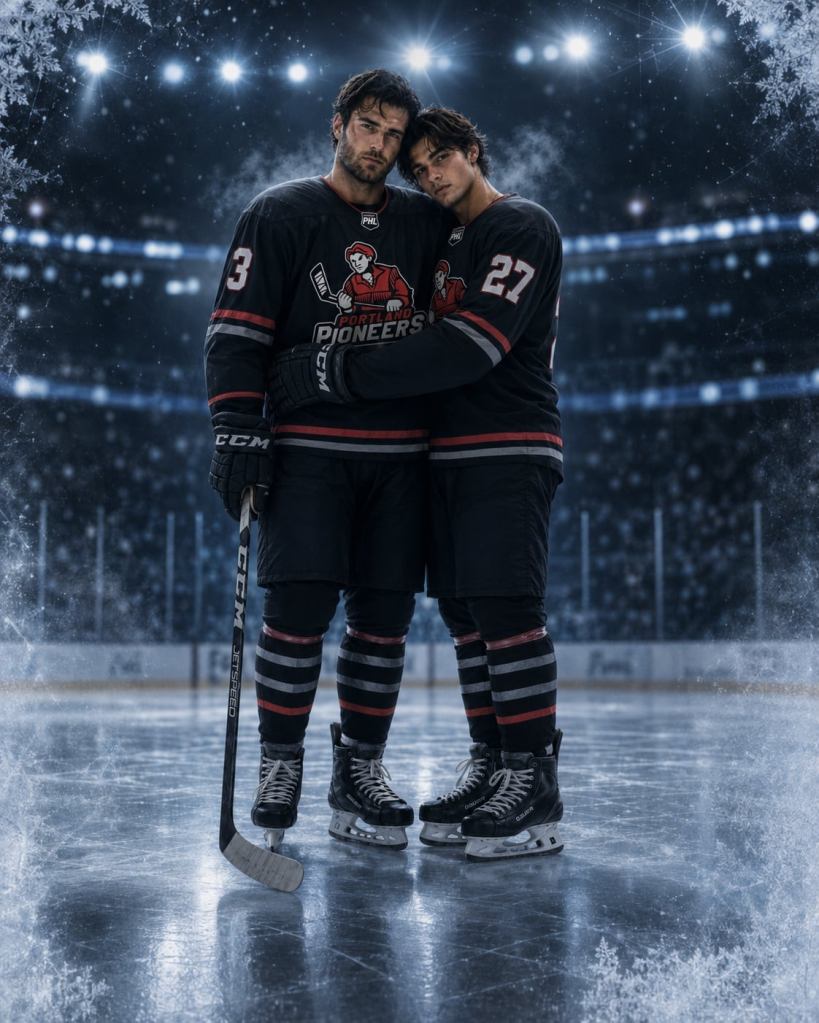
This is Deacon Worth and Konstantin Andropov. Number 43 and number 27. Portland Pioneers. My boys.

If you have been following along with the PHLu universe, you know Deke and Kon. You know the goal crease and the press conference and the year that changed everything and the specific, particular way these two found their way to each other on the ice and off it. You have lived inside their story with me. And now Paul — our incredible artist who has given visual life to all three of my universes — has given them a face.

I cannot tell you how close this is to what I saw when I wrote them. That is not a thing I expected to be able to say. You write a character and you have them in your head in the specific way that fictional people live in an author’s head — vivid and particular and entirely yours — and then someone else tries to render them and the gap between the interior version and the external version is usually where you learn to manage your expectations.

There is no gap here. None. This is Deke. This is Kon. The way they are standing, the way Kon is leaning in, the specific quality of how they are with each other — this is the book, made visible.

Isolated releases June 15.

Cover reveal June 5.

If you’d like to be notified the moment that cover drops — and I think you would like that, I think you would very much like that — watch this space. I am barely containing myself and I have known what the cover looks like.

You are going to love them. I already do, obviously. I have for quite some time.

🏒 — Bella