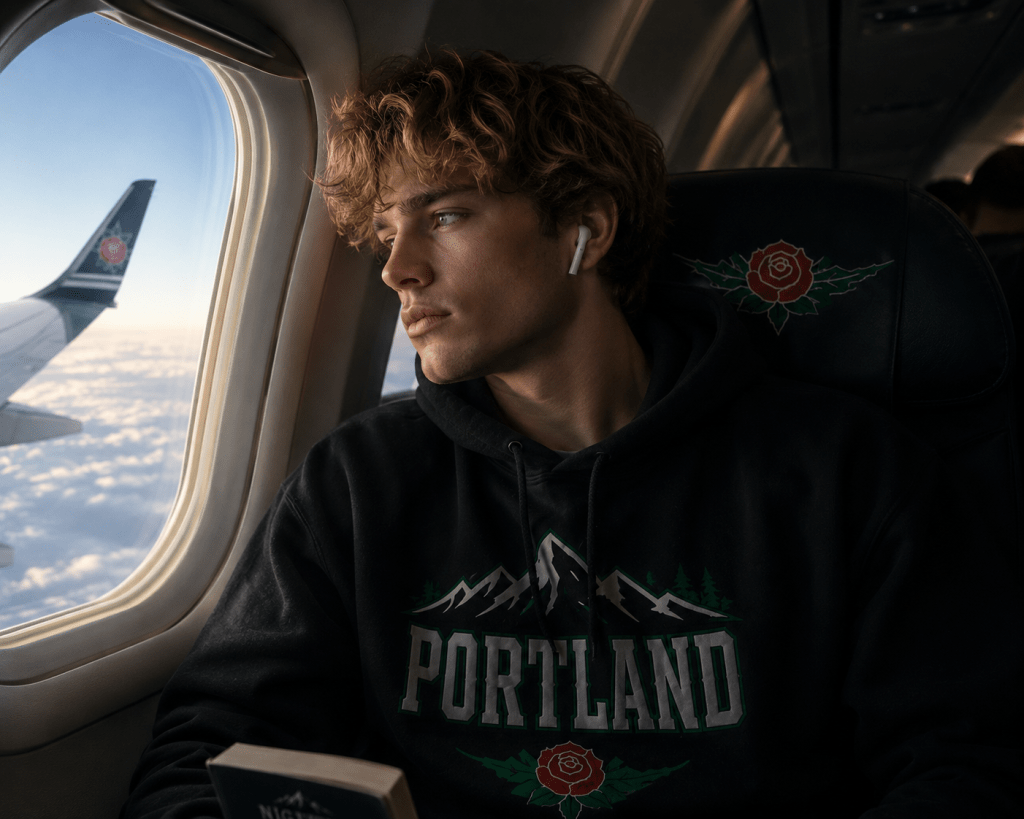
I want to show you something.
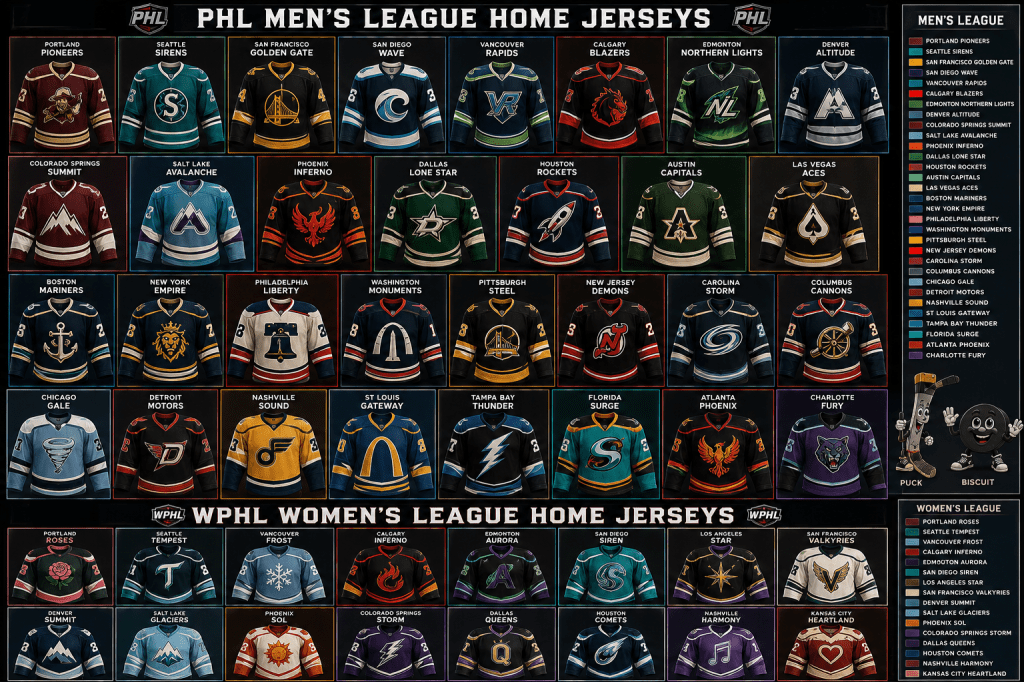
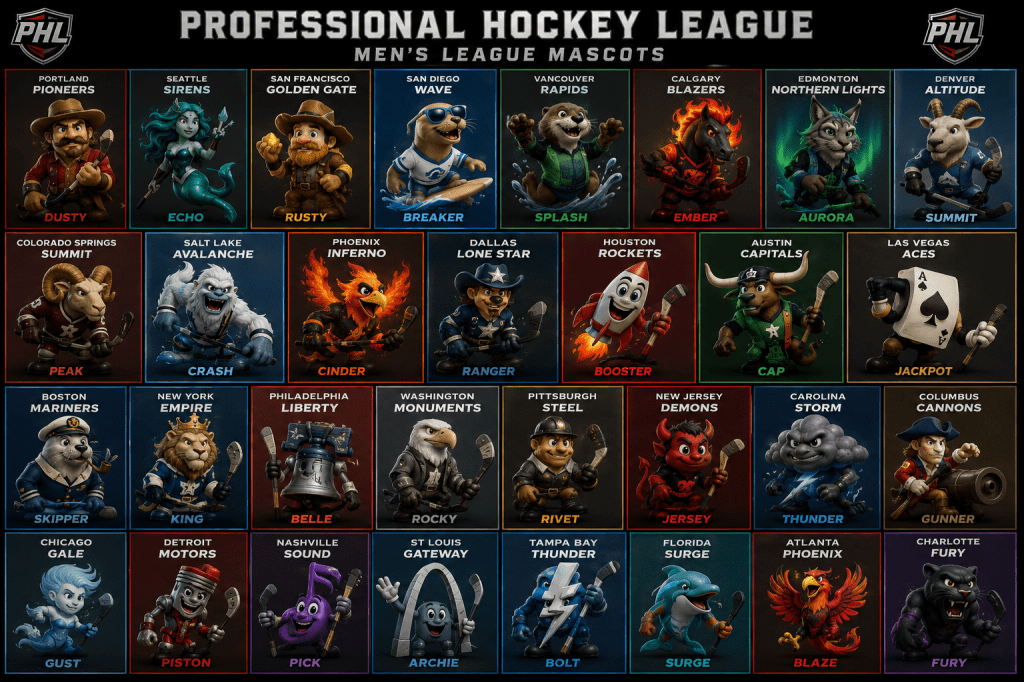
What you’re looking at — if you’ve scrolled down to the images I’ve attached to this post, and I hope you have — is the Professional Hockey League. The PHL. Men’s league, women’s league, full team rosters of logos, jerseys, and mascots for every franchise in both competitions.
Portland Pioneers. Seattle Sirens. San Francisco Golden Gate. San Diego Wave. All the way through to Charlotte Fury and Kansas City Heartland and everyone in between.
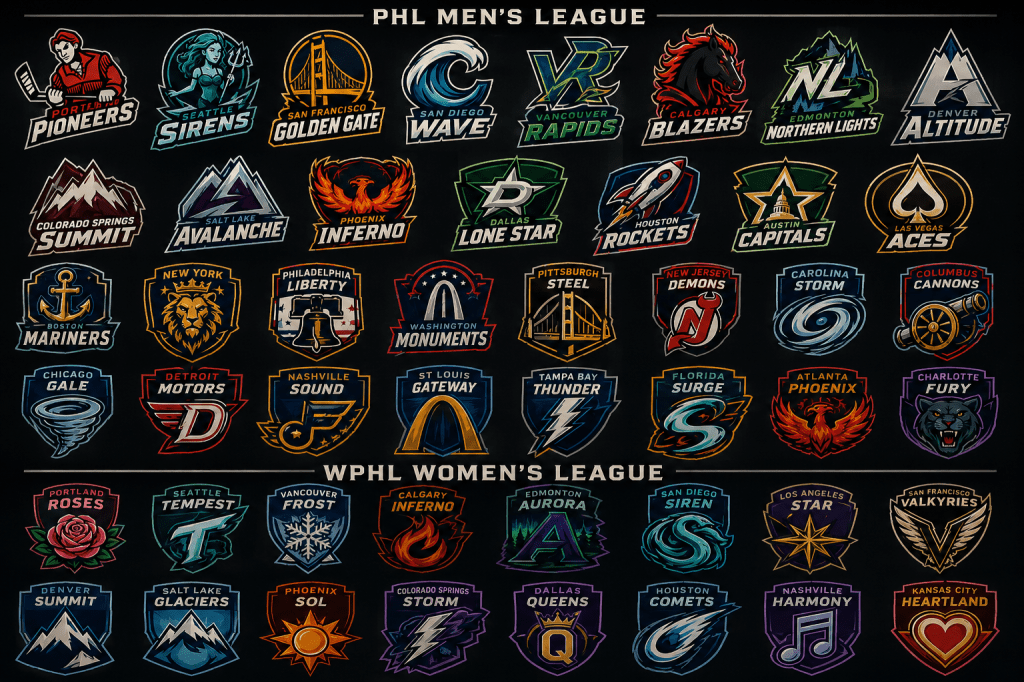
Every team has a logo. Every team has a home jersey. Every team has a mascot with a name — and I want to take a moment to appreciate that the Portland Pioneers’ mascot is called Dusty and he is wearing a cowboy hat, and the Nashville Sound’s mascot is a purple musical note called Pick, and the Dallas Queens have a horse in a crown called Queenie, and I love all of them unreasonably.
Now. Here is the thing I need to address directly.
I am, in my books, currently using three of these teams.
Three.
Out of thirty-two in the men’s league and sixteen in the women’s league. I have built forty-eight teams — complete with branding, mascots, staff rosters, full operational crews, support staff, back office personnel, and arena teams — and I am, at present, using three of them with any regularity.
Is this crazy?
I have been asked this question, mostly by myself at two in the morning, and I want to give you my honest answer.
No. It is not crazy. It is thorough research, and I will tell you why.
The PHLu exists as a universe, not a backdrop. When Deacon Worth skates out onto the ice in Portland, he is not skating into a vague gesture at a hockey league. He is skating into something real — real in the way that matters for fiction, which is to say internally consistent, fully populated, and detailed enough that I know exactly what the rivalry history is between the Pioneers and the Seattle Sirens, why the Las Vegas Aces have the reputation they do, and what it means for a player to be traded to the Austin Capitals versus the New York Empire. I know the arena staff by name. I know who runs the back office. I know the mascots and what they mean to their home crowds.
And that last part matters more than it might seem.
When a character gets traded — when someone leaves the team they’ve bled for and shows up in a different dressing room, a different jersey, a different city — that transition has weight. Real weight. I know exactly what colours they’re leaving behind and exactly what colours they’re pulling on for the first time. I know what their old mascot looked like and what the new one means to the fans in that arena. If a character hands a kid a puck with their old team’s mascot on it in a quiet moment of goodbye, I know what that mascot is. I don’t have to make it up on the spot or leave it vague or hope the reader doesn’t notice the gap. It’s there. It’s real. It’s Dusty or Cinder or Bolt or Surge, and it means something specific because the whole universe means something specific.
That is what the worldbuilding is for. Not the parts that end up on the page explicitly — but the parts that make everything on the page feel true.
None of it ends up in the text in any heavy-handed way. You will not read a chapter in which I pause to describe Jackpot the Las Vegas Aces mascot in loving detail. That is not what this is for.
What it is for is the texture. The specificity. The particular quality of a fictional world that has been thought through rather than sketched — the kind of world where a character can make a throwaway comment about another team and it lands as true because it is true, within the logic of the universe, because I actually know the answer.
I’ll also be honest about something else, because I think honesty is earned here: some of my logos will look familiar to hockey fans. There are only so many ways to put a letter in a shield or a flame around an animal before things start to rhyme with something already out there in that other league. I know this. These logos live in my blog and in my head and almost certainly nowhere else, and I’m at peace with that. They needed to exist. Not for the world — for me. For the integrity of this universe I have been building, which required real teams with real identities rather than placeholders with vague colour schemes.
This is my hockey world. I built it from the ice up. And my hope — my genuine, slightly sleep-deprived hope — is that the more I have already built it, the more you will love it too. That when you read about the Pioneers you will feel the weight of a real franchise behind them. That when a character bleeds in that jersey it will mean something, because you know what that jersey looks like and what it stands for and who else has worn it before them.
That’s the dream, anyway.
That and Dusty. Always Dusty.
— Bella 🏒