Why Hockey Romance Works – A completely Objective Analysis

I’ve been asked a few times why hockey romance works so well as a subgenre, and I have given this question the serious, considered, academic attention it deserves.

It’s because the men are hot.

I mean, I could dress this up. I could talk about the narrative tension inherent in professional sport, the built-in conflict between individual desire and team loyalty, the way the rink functions as a pressure cooker for emotion, the push and pull of ambition and vulnerability. All of that is true and all of that matters and I will absolutely discuss it with you if you want.

But let’s be honest with each other first.

Hockey players are built like someone sat down and said what if a person, but more. They are large and fast and absurdly athletic. They do something genuinely dangerous for a living and they do it with a level of skill and commitment that is, frankly, its own kind of attractive. They get knocked down and they get back up. They bleed for it. They fight for it. Every single game they go out there and they leave everything on the ice, and there is something in that — in the wholehearted, full-contact, nothing-held-back quality of it — that translates directly into the kind of men they are off the ice too.

Men want to be them. Women want to be with them. And honestly, depending on the day and the specific player in question, some people want both simultaneously and I completely understand that.

But here is where it gets interesting, because hot alone does not sustain a subgenre. Hot gets you through the first chapter. What keeps you reading at two in the morning is something more specific than that.

Hockey players, at least the ones I write, carry their hearts in the same way they play the game — all the way. Deacon Worth does not do anything halfway. Neither does Flynn McKenzie, or Lachlan, or any of the men in this universe who have taken up residence in my head and refused to leave. They are competitive and driven and occasionally absolutely impossible, and they love with that same all-or-nothing energy that makes them great at the game. When one of these men decides you are his person, you feel it in your bones. There is no hedging. No half measures. No carefully managed distance. Just the full weight of a person who has decided and is completely at peace with having decided.

That, combined with the fact that they look like that, is really quite a lot to deal with.

Hockey romance works because it gives us men who are physically extraordinary and emotionally all-in. Men who are tough enough to take a hit and soft enough to mean it when they say I love you. Men who are worth writing about and worth reading about and, on the best days, worth falling a little bit in love with yourself.

The men are hot. The rest is craft.

But mostly the men are hot.

— Bella 🏒

They’re Real, They’re Actually Real

I have been sitting with this image for approximately twenty minutes and I cannot stop looking at it.

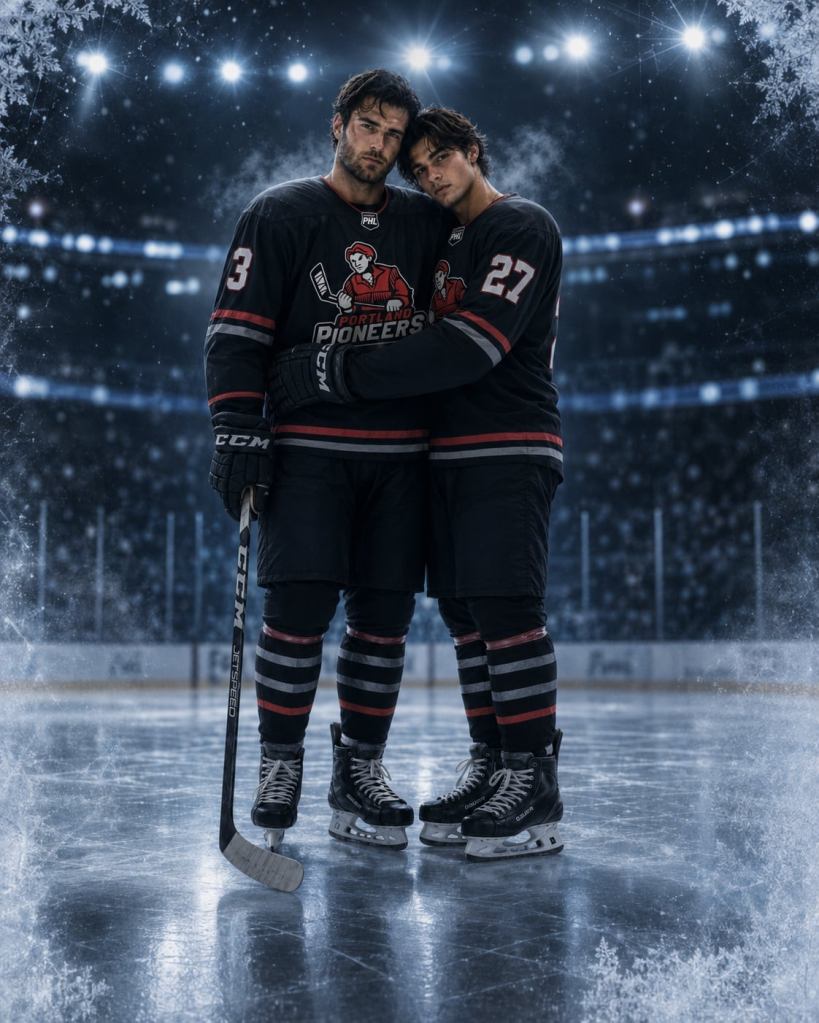
This is Deacon Worth and Konstantin Andropov. Number 43 and number 27. Portland Pioneers. My boys.

If you have been following along with the PHLu universe, you know Deke and Kon. You know the goal crease and the press conference and the year that changed everything and the specific, particular way these two found their way to each other on the ice and off it. You have lived inside their story with me. And now Paul — our incredible artist who has given visual life to all three of my universes — has given them a face.

I cannot tell you how close this is to what I saw when I wrote them. That is not a thing I expected to be able to say. You write a character and you have them in your head in the specific way that fictional people live in an author’s head — vivid and particular and entirely yours — and then someone else tries to render them and the gap between the interior version and the external version is usually where you learn to manage your expectations.

There is no gap here. None. This is Deke. This is Kon. The way they are standing, the way Kon is leaning in, the specific quality of how they are with each other — this is the book, made visible.

Isolated releases June 15.

Cover reveal June 5.

If you’d like to be notified the moment that cover drops — and I think you would like that, I think you would very much like that — watch this space. I am barely containing myself and I have known what the cover looks like.

You are going to love them. I already do, obviously. I have for quite some time.

🏒 — Bella

In Which I Have Thoughts About Hockey Shows

So this morning I finally sat down and watched Off Campus.

And I have to admit something that may get my hockey romance card revoked:

…I was kind of underwhelmed.

Not because it was terrible. It wasn’t. The production value was there. The budget was clearly there. Everybody was pretty. The hockey looked fine. On paper, this should have been exactly my thing.

But the entire time I was watching it, I kept finding myself comparing it to HR.

And unfortunately for Off Campus, HR exists.

Maybe if Off Campus had been the first modern hockey romance style show released, I would feel differently. Maybe I would have fallen completely in love with it. Maybe I would have been screaming into the void about locker room tension and emotionally unavailable men in compression shirts.

But instead, it arrived after something that already nailed the thing I personally think matters most in hockey romance:

chemistry.

Not just romantic chemistry either. Team chemistry. Friendship chemistry. Banter. Warmth. That feeling that these people genuinely exist together when the cameras stop rolling.

HR has charm in a way that feels almost accidental. Like lightning in a bottle. It feels lived in. Messy in the best way. The relationships feel textured and weird and human. Even the background interactions feel natural.

Off Campus, weirdly, felt more polished and somehow less alive.

And maybe that sounds unfair because objectively it probably is the “bigger” production. Better funded. Cleaner. More cinematic in places. But I kept waiting for it to click emotionally for me and it just… didn’t.

It almost felt like they had all the ingredients and somehow forgot seasoning.

I don’t even know if the issue is the writing. It might genuinely come down to casting chemistry. Hockey romance absolutely lives or dies on whether you believe these people would choose each other in every universe.

If I don’t buy the longing, the protectiveness, the “I would absolutely help you hide a body” energy, then the whole thing starts feeling like actors reading attractive dialogue at each other.

And the frustrating part is that there are glimpses in Off Campus where you can see the potential. Little flashes where I thought, oh there it is. Then it would disappear again under another overly polished scene that somehow forgot to feel.

The boys living in the dorm house almost had it.

That was the frustrating part.

There were moments — particularly during the training scenes — where you could feel the shape of the thing it could have been. The burpees, the exhausted chirping, the half-feral team energy, everybody existing in each other’s pockets twenty-four hours a day… for a second I thought, oh here we go. There it is.

And then somehow it just vanished somewhere between the motivational speeches and the bro hugs.

Which sounds ridiculous because I am absolutely the target audience for this kind of thing. Give me emotionally constipated hockey players living in a chaotic share house and I should be seated immediately with snacks and emotional investment.

But I kept wanting more texture.

More quiet affection.
More stupidity.
More loyalty.
More “this idiot is my family now.”
More moments where the audience gets to live with them instead of simply watching plot happen around them.

And honestly? I think that’s what I’m discovering I want from television in general these days.

I would not remotely complain if every scripted drama on the boob tube (good lord, am I showing my age with that phrase?) was one of the following:

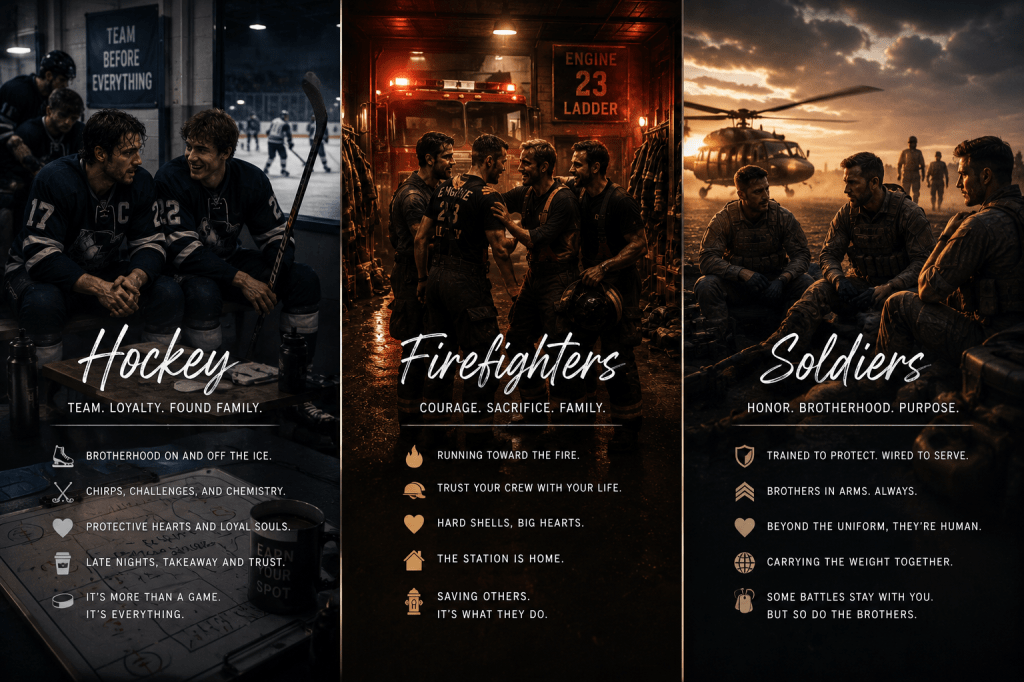
  • hockey players navigating life and feelings badly
  • firefighters saving everybody while emotionally imploding
  • deeply repressed soldiers trying to figure out how to exist in normal society

Apparently that is my entire media diet now.

But I think the reason those stories work when they do work is because underneath all the action and conflict and dramatic music, they’re fundamentally stories about people choosing each other.

Found family.
Loyalty.
Protection.
Love in all its messy forms.

And maybe that’s why some modern shows leave me a little cold. Everything feels so determined to be high stakes all the time that nobody remembers to let the characters breathe together.

I don’t necessarily want less drama.

I just want more love.

More scenes where people cook dinner together.
More exhausted conversations at 2am.
More teammates showing up without being asked.
More “I’ve got you.”
More humanity.

The world is already exhausting enough. Let fictional people care about each other properly.

Also let them do it while wearing hockey gear.

Obviously.

Meet the McKenzies. Your Life is About to Get Complicated.

So. The PHL is going live June 15. You know that. You’ve marked your calendar. You’re ready.

But before the puck drops on the whole glorious league, I want to introduce you to the family at the heart of it all — because everything, and I mean everything in the McKenzie Legacy series starts with five Australian kids who looked at their futures and decided to chase them across the world, no matter what it cost.

Let me paint you a picture.

Five siblings. One family. Ambitions too big for one country to hold.

Three boys — identical triplets, because their parents clearly believed in doing things at scale — who grew up dreaming of ice. Of rinks. Of the NHL, or something like it. Of making it in the sport that had absolutely no business being the obsession of kids growing up in Australia, and yet. There they were. Obsessed. Determined. Entirely unstoppable.

And two girls — identical twins — who were born to skate, but not the way their brothers wanted to. Figure skating. Blades and music and the kind of precision that makes your throat tight when you watch it done perfectly. These two wanted it so badly, so completely, that they did something that still gets me right in the chest when I think about it: they gave up their Australian citizenship to compete for the country that could give them their dream.

Let that land for a moment.

Five kids. Five enormous futures. One family watching them all fly away, one by one, toward the lives they were built for.

The McKenzie Legacy is five books. Five love stories. Five characters who carry the weight of everything they left behind, and everything they’re still becoming.

And the first book?

The First Line.

🏒

Lachlan McKenzie. Captain. The kind of man who leads from the front and holds everything together and has absolutely no idea what to do when a woman walks into his orbit and refuses to be managed, organised, or tidily categorised.

Dr Sienna MacLeod. The woman in question. She has not read the memo about being tidily categorised, and she would like it known that she is very busy and does not have time for whatever this is.

I will be honest with you. When I imagine these two — when I see them in my head, which I have been doing for longer than I should probably admit — I see Thor and Merida.

You’re welcome.

He is, in every sense, built like a Viking who also somehow learned to skate. She is all fire and independence and she will absolutely shoot an apple off your head if you give her sufficient motivation. They are, on paper, a disaster. In practice — well. That’s what the book is for.

The First Line is the beginning. The McKenzie Legacy is the whole story — and once you’ve met this family, the triplets and the twins and all the love and loss and history they carry with them, I’ll be taking you somewhere very special.

To the team that sits at the shining heart of the entire PHLu.

The Portland Pioneers.

But first — Lachlan. And Sienna. And the moment everything starts.

June 15.

Cover reveal: May 31. Be there.

🏒 — Bella

Starting with the Team: How to Build a Roster That Drives Multiple Books

I live in rural Tasmania. In Australia. Where it is currently summer and the nearest ice rink is a very long drive away. And yet somehow, I have spent the last several years building a fictional NHL franchise — complete with AHL and ECHL affiliates, a cheer squad, a rival team transplanted to Honolulu, a women’s league, a band, a television production company, and a cast of characters so large they now occupy 385 pages of series bible.

Fifty-eight books. That’s where this universe currently sits. Fifty-eight.

I tell you this not to brag — well, maybe a little — but because I want you to understand that what started as one hockey romance series has grown into something I genuinely did not plan and could not have predicted. And the reason it was able to grow like that, the reason those threads kept revealing themselves and asking to be followed, is because of what I did right at the very beginning. I built the roster first.

If you’ve ever fallen down the rabbit hole of a hockey romance series — and if you’re here, I’m guessing you have — you’ll know that specific feeling of finishing one book and immediately wanting to know whose story is coming next. You’ve spotted them in the background. You’ve caught a line of dialogue that made you sit up straighter. You’ve watched a character do something small and telling and thought oh, you have a whole book inside you, don’t you?

That’s not an accident. That’s an author who built their roster on purpose.

Creating a fictional hockey team that can sustain multiple books is one of the most satisfying and most underestimated parts of writing a hockey romance universe. Get it right and you have a living, breathing world that readers will return to again and again. Get it wrong and you end up frantically inventing new characters out of thin air every time you need a hero, with no connective tissue holding anything together.

So let’s talk about how to do it well.


Start With More Players Than You’ll Ever Need

Here’s the first and most important thing: build a bigger roster than you think you’ll use. A real NHL team carries around 23 players on their active roster, plus a minor league affiliate full of hopefuls and call-ups. You don’t need to develop all of them. You don’t even need to name all of them. But you need to know they exist, because that depth is what makes your team feel real rather than like a convenient vehicle for romance plots.

I know this because I accidentally proved it. When I started building my Portland franchise, I named not just the NHL roster but the entire AHL affiliate and the ECHL affiliate beneath that. At the time I thought I was being obsessive. What I was actually doing was creating a pipeline — a world of players at different stages of their careers, with different levels of certainty about their futures, and entirely different emotional landscapes to explore. Some of my richest story potential lives in those affiliate rosters. The guy grinding away in the ECHL trying to crack the big league carries a very different energy to the established NHL star, and both of them deserve a love story.

Give yourself permission to populate your world generously at the start, even if most of those names are just names for now. Some of them will surprise you. You’ll write a throwaway line about a guy who snores on the team bus and suddenly you’ll know exactly who he is and why he’s lonely and what kind of person would crack his heart open. That’s the magic of a fully realised roster — it creates its own stories without you forcing anything.


Think in Positions, Personalities, and Contrasts

One of the best ways to approach your initial character building is to think about the natural contrasts that hockey positions create. You’ve got your forwards who score the glory goals and eat up public attention. You’ve got your defensemen who do the unglamorous protective work and rarely get the credit. You’ve got your goalies, who are famously, delightfully unhinged, existing in their own psychological universe at the other end of the ice. And you’ve got your enforcers and grinders — the guys who bring the physical sacrifice, whose relationship with their own bodies is often complicated and rich with story potential.

These aren’t just tactical distinctions. They’re personality frameworks. The flashy sniper who can’t stop seeking the spotlight. The shutdown defenseman who has spent his entire career protecting other people and has no idea how to let anyone protect him. The goalie who has developed elaborate superstitions to manage the crushing psychological pressure of being the last line of defence. These archetypes are familiar enough to feel grounded and distinct enough to give each hero their own flavour.

You want contrast working for you throughout your roster — not just in terms of position, but in terms of personality, background, age, and where each character sits in their career arc. Mix your veterans with your rookies. Mix your confident public personas with your private introverts. Mix the guy who grew up wealthy in a major hockey market with the kid who played on an outdoor rink in a small town because that was all his family could afford.

In my own universe I went even further with contrast by building a rival franchise in Honolulu — which is about as far from Portland’s grey skies and rain-soaked streets as you can get while staying in the same league. The contrast between those two cities does atmospheric work for me across fifteen books before I’ve written a single word of rivalry. Contrast is doing the heavy lifting before your characters even open their mouths.


Know Your Captain

Every team has a captain, and in a hockey romance universe, your captain matters enormously. They set the tone for what your team values. They’re the character other players measure themselves against, or push back against, or desperately want approval from. They shape the culture of your locker room, which in turn shapes the world your heroes inhabit.

Your captain doesn’t have to be your first hero or even a hero at all — sometimes the most interesting captains are supporting characters who show up across multiple books, consistent and grounding, a fixed point in a shifting world. But you need to know who they are and what they stand for before you write anything else, because that knowledge will inform every scene set in the team environment.

Ask yourself: is your captain old school or progressive? Do they lead by example or by force of personality? Are they beloved or complicated? Do they know what’s happening in their locker room, or are they deliberately not looking? The answers ripple outward through your entire universe. In my Portland franchise, the culture of the team flows directly from the founding vision of the coach and his wife — who are also part owners — and that means the values embedded at the very top of the organisation shape everything below it. Your captain is the on-ice expression of those values. Choose them carefully.


Plant Future Heroes in Current Stories

This is the craft element that separates a good hockey romance series from a great one, and it’s simpler than it sounds. When you’re writing your first book, you should already know — at least in broad strokes — whose stories are coming next. Not necessarily the full plot, but enough to seed that character into your current narrative with intention.

Give your future hero a moment. One scene where they say something that sticks. A gesture that reveals character. A reaction that hints at a wound the current story doesn’t have time to explore. You’re not writing their book yet — you’re making a promise to your reader that there’s more here than they’re currently seeing. Readers are remarkably good at picking up on this. They will notice the guy standing slightly apart from the group. They will clock the joke that lands a little too sharp to be entirely a joke. They will remember.

I discovered this accidentally when I was building my universe and realised I’d already seeded characters from the cheer squad and the band into the team’s world without consciously planning to. They were just there, orbiting the roster, because that’s what real people do — they exist in community with each other. When the time came to give those characters their own books, the groundwork was already laid. The readers who’d been there from the beginning would know these people. That’s an extraordinary gift to give your readership.


Don’t Forget the World Around the Roster

Here is something I learned the slightly hard way: a hockey team doesn’t exist in isolation. The cheer squad are there at every home game. The front office shapes every decision. The coaching staff carry their own complicated histories and loyalties. The partners and families of your players have entire interior lives that intersect with the team world in ways that create conflict and warmth and story.

In my universe, none of the women who will eventually become partners to these players know that’s their future yet. They’re just living their lives — working, creating, competing — and the team exists alongside them in the same city. That’s how real relationships form. Not through convenient plot mechanics but through proximity and time and the way certain worlds keep overlapping until two people can’t keep pretending they haven’t noticed each other.

Build the whole ecosystem, not just the roster. The roster is the heart. Everything else is the circulatory system that keeps it alive.


Keep a Series Bible and Protect It Fiercely

By the time you’re three books into a hockey romance series, you will have made a staggering number of small decisions about your team, your city, your arena, your front office, and your characters’ histories. The rookie year of a character mentioned in book one. The name of the team’s coach. The record-breaking season your captain had seven years ago. The bar where the team goes after home games.

None of these things feel important when you first write them. All of them become potential continuity disasters if you don’t track them.

My series bible is currently 385 pages long. I know that sounds extreme. It is extreme. It also means I can tell you the jersey number of every player on three league rosters, the names of every member of the cheer squad, and the exact configuration of relationships that will eventually connect my California characters to my Portland family. That document is the reason 58 books can share a universe without collapsing under the weight of their own continuity.

You don’t need 385 pages to start. You need a running document, updated as you write, that captures every decision you make about your world. Start it on day one. Future you will be deeply, profoundly grateful.


Let the Roster Evolve Naturally

Real hockey teams change. Players retire. Trades happen. Rookies arrive. Careers end earlier than anyone expected because the body has limits — and I have one character in my universe whose entire second act, including the franchise he eventually builds, exists because his body gave out before he was finished. The grief of that cut short career became the foundation of something extraordinary. That only works if you’re willing to let your fictional world move through time honestly.

Let your roster breathe. When a veteran character reaches the natural end of their playing days, let them retire — and then use that transition as story material, because the identity crisis of a professional athlete facing the end of their career is absolute gold for character-driven romance. When a trade serves the story, make the trade. When an exciting rookie arrives and shakes up the existing team dynamics, let that arrival land with real weight.

The team should feel like it’s moving through time alongside your readers, not sitting still waiting for each new hero’s story to begin.


Building a roster that drives multiple books is ultimately about one thing: treating your characters as people before they’re plot devices. Give them depth even when they’re in the background. Give them history even when the page doesn’t have room for it. Give them a world that feels like it exists whether or not you’re currently writing about them.

I built my Portland franchise from a tiny island in the Southern Ocean, following a sport I love despite never having easy access to it, because the world of hockey romance grabbed me and wouldn’t let go. The roster I built became a universe I genuinely didn’t plan. And every single one of those 58 books exists because I took the time at the beginning to make the team real before I made the romance.

Do that, and your readers won’t just finish one book and move on. They’ll stay. They’ll wait. They’ll come back for every single story you’ve promised them — because you made them care about the whole team, not just the hero of the moment.

And honestly? That’s the dream.

Coming Back to the Page (and Reinventing the Journey)

So, it’s been about five years, a pandemic, and a cross-country relocation since I last put pen to paper in a blog.

The last time I was blogging, I was living in rural Queensland, running a cat rescue, studying full time, caring for my sister, and trying to get myself organised to release my first hockey romance novel. I had four books of a planned fifteen-book series written, cover art commissioned, and advanced readers lined up for part one.

Then COVID happened — and the wheels well and truly fell off.

We closed the rescue (gaining eleven permanent house cats in the process), I doubled down on study, and somehow made it through the pandemic completing a Bachelor of Creative Industries (Writing and Publishing), a Bachelor of Creative Writing, and then beginning a Master of History. Life was busy, intense, and not remotely predictable — but also deeply rewarding.

When the world finally started reopening, my best friend put her retirement plans into action and purchased a beautiful historic home in Tasmania. The house is nearly 120 years old, sits on two acres, and at one point in its life served as a police station and residence for the officer in charge. We even still have the original holding cells intact.

So, naturally, we packed up our lives and moved from Queensland and the ACT to Tasmania.

The climate shock alone was unforgettable. We left Queensland on a Saturday in a balmy 34°C heatwave and arrived in Tasmania to wake up Monday morning to –7°C and heavy frost on the grass. I was almost sixty years old and had never seen frost in real life before that morning. It was a steep learning curve — gardening, weather, wind, animals, and seasons that actually behave like seasons — but now I can’t imagine living anywhere else. I’ve become an accidental urban farmer and am finally moving closer to the self-sustainability I’ve always wanted.

Somewhere in all that life upheaval, my original book series quietly got superseded — at least that’s what I’m calling it.

While the world was locked down reading their way through the pandemic, reader preferences in hockey romance shifted strongly toward first-person narration. My entire series was written in third person — which I’m very comfortable with — but it no longer aligned with what readers are actively looking for in the genre.

For a while, I seriously considered scrapping the whole thing. New era. New concept. Maybe even leaving hockey romance altogether.

Then I stopped myself.

I’ve poured far too much work, heart, and creative energy into this series for it to only ever exist on my hard drive. And, if I’m allowed a tiny bit of pride — I genuinely think it’s good.

So instead of abandoning it, I’m rebuilding it.

I’ve begun rewriting the books from third person into first, and it turns out the changes required go much deeper than simply swapping pronouns. Voice, pacing, emotional proximity, internal conflict — it all shifts. The process has forced me to rethink structure, character arcs, and how each story connects to the next.

That deeper rethink sparked something unexpected.

Out of the restructuring came a new focused arc: The MacKenzie Trilogy — centred on three Australian triplet brothers: Lachlan, Flynn, and Declan. The brothers leave home to move to Switzerland to hone their craft, develop their careers, and ultimately find themselves all playing in the same professional hockey division. Three brothers. Three very different personalities. Three intertwined love stories. One shared competitive world.

This trilogy lets me tighten the emotional through-lines, deepen character growth, and create a strong entry point for new readers before expanding back into the broader series universe.

The trade-off? My original hoped-for June release is no longer realistic. At this stage, mid 2026 is far more achievable — which, honestly, gives me time to properly learn how to navigate the strange circus that is blogging and social media for authors.

So here I am — back at the keyboard, rebuilding stories, rebuilding platforms, and sharing the process again.

Thanks for coming along for the ride.

Until next time, my friends. 🏒📚