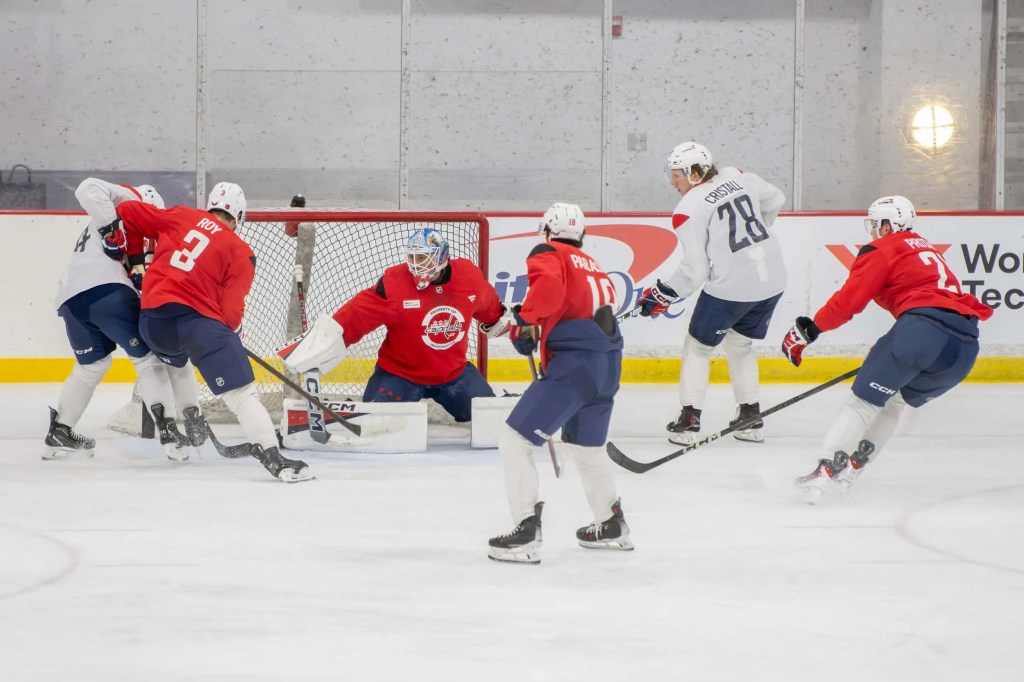
I know what the score was. I can tell you who scored, which period, how many shots on goal, and the exact moment the commentator’s voice went up an octave because something had happened on the left wing that I was, frankly, still trying to locate.
What I can’t tell you is what it smells like.

That’s the problem with watching hockey from the bottom of the world. I’ve watched an embarrassing number of games this year. Live, when the time difference allows (which means breakfast games, which means hockey with Vegemite toast, which is a sentence no Canadian should ever have to read). Replays when it doesn’t. Highlights on my phone in the queue at the post office. I’ve studied seating maps until I could find my way to Section 112 in my sleep. I’ve read about arena histories and watched fan videos and gone down a rabbit hole about Zamboni drivers that I’m not proud of and will not be discussing further.
Desk research is a wonderful thing. It gives me the bones. The rules, the rhythms, the vocabulary, the names on the backs of the jerseys. It means when I write a goalie tracking a puck through traffic, I know what traffic means. It means I don’t embarrass myself (as often).
But a broadcast is a story someone else has already chosen to tell. The camera follows the puck, because the puck is the point. And when the puck stops, the broadcast goes somewhere else entirely. To an ad. To a panel of men in very good suits. To a replay of the thing I was already watching.
And that’s exactly where my curiosity starts.
What happens in a TV timeout, when the players skate to the bench and the people at home get a car commercial? What’s going on in the building during those two minutes? Is there music? Is somebody on the big screen being dared to dance? Is there a kiss cam, and has anyone ever been caught on it with the wrong person? (Asking for a book.)
And intermission. Eighteen minutes, give or take, when the ice is being resurfaced and the TV audience is being told what they just saw. Where do twenty thousand people go? What’s the queue like for the bathroom, and is it as tragic as I suspect? What does the concourse sound like when it’s full? What are people eating? Who’s selling what? Is there a man with a cowbell, and if so, does he have a name?
These are the things I want to notice. Not the stats. The rest of it.
Because here’s the thing I’ve learned, writing a whole series about hockey players while being, technically, a woman who has never seen a hockey game: atmosphere does half the work in a scene. A first kiss in an empty arena after practice is a completely different scene from a first kiss in a packed concourse with someone’s nachos about to hit the floor. The noise changes it. The cold changes it. The smell of popcorn and ice and wet wool changes it. Readers might not consciously notice any of that, but they feel it, and they believe the scene because of it.
So that’s the plan. Notebook in my pocket. (Millie has already told me I’ll lose it by the second game. Jo has already told me she’ll be the one who finds it, under a seat, covered in something sticky. My sister knows me.)
But I also want to be honest with myself before I go, because I know my own habits. There is a difference between collecting details and forcing every single one of them into a book.
Collecting is the fun part. Collecting is standing on a concourse with your mouth open, writing down “cold air comes off the ice in a wave when the doors open” and “man in a vintage jersey crying, unclear why.” Collecting is greedy and joyful and wonderful.
Forcing is what happens when I get home and decide that because I paid for the flight, every single one of those details is going into the next manuscript, whether the scene needs it or not. Nobody wants a love scene interrupted by an informative paragraph about the arena’s concession pricing. (Okay. Maybe one person. But I don’t write for him.)
The trick, I think, is to collect everything and use only what earns its place. One right detail, the one that makes a reader go “oh, I’m there.” Not twelve. So I’ll gather a mountain, and then I’ll choose a handful.
Which brings me to you. I’d love your help before I go.
What’s one setting detail from a book you’ve read, any book, any genre, that made the whole story suddenly feel real to you? A smell, a sound, a bit of weather, the way a particular room was lit. The detail that made you stop and think, the author has actually been there.
Tell me in the comments. I’ll take your answers to Canada with me, tucked in the notebook I am definitely not going to lose.
Bella x